Home / Osaka / Ehōmakimakizushi
Ehōmakimakizushi 恵方巻き
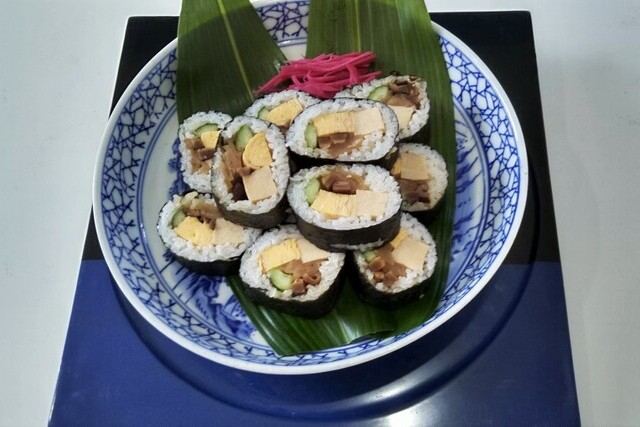
| Prefecture | Osaka (大阪府) |
|---|---|
| Region | Kinki |
| Japanese name | 恵方巻き/巻きずし(えほうまき/まきずし) |
| Reading | Ehōmakimakizushi |
| Home area | Shipyard, Osaka Prefecture all over. |
| Main ingredients | I'm going to have to go to the hospital. I'm going to go to the hospital. |
History and Origins
I have the custom of turning around on the eve of the year and of spinning a thick sushi on the day of the paragraph. This sushi is called "Ginyri." Megumi is determined by a dark path and varies from year to year, whereas she is in 2022 in northwest and southeast 2023. This custom may lead to a Osaka, but its origins and origins are not determined. There are many sources of it, whether born of a flower town or in the late Edo period, hoping to be a merchant at Osaka. Although it seems not popular until after the war, it has been advertised for promotion by the art industry since the 1970s, and it has spread throughout the country since the '90s, when convenience stores and supermarkets began to sell gift scrolls. Although originally there were no rules and regulations for the sushi that were eaten, in recent years there has been a major flow of seven-kind spools of equipment used by the god Fukuoka.
When It Is Eaten
Every year, at the time of the deadline, there are all kinds of gifts in supermarkets, convenience stores, and so on. Because of the problem with food loss, there are some stores that have pre-ordered rules.
How It Is Eaten
The character of the silver belt is, of course, in its way of eating. Remembering your wish to keep your age from getting away with it, you will eat a piece with silent gestures so that you won't run away.
Recipe
Ingredients
- 3 × 180 ml rice
- 10cm) 1 kelp (konbu)
- 1 tbsp sake
- Vinegar: 4–5 tbsp vinegar
- Vinegar: 3 tbsp sugar
- Vinegar: 1 tsp salt
- 8 dried shiitake mushrooms
- 100 ml shiitake soaking liquid
- Mix: 200㏄ dashi stock
- Mix: 2 tbsp sake
- 4 kanpyo (dried gourd strips)
- 2 freeze-dried tofu (koya-dofu)
- Mix: 200 ml dashi stock
- Mix: 1 tbsp sugar
- Mix: 1 tsp soy sauce
- Mix: a pinch salt
- 3 egg
- Mix: 1 tbsp sugar
- Mix: 1 tsp soy sauce
- Mix: a pinch salt
- 1 cucumber
- 4 roasted nori
Method
- Wash rice, put in wine and boil with the amount of water used for boiling.
- I'll make vinegar to match. When the rice is ready, add vinegar and cook rice.
- I'll make a good stew. The mushrooms are put back into water and chopped into fine pieces and boiled with a taste of citrus A. The cane is thoroughly washed in water, and after boiling with a lot of hot water for about five minutes, it is cooked with the conch.
- Takano Tofu lightly washs it and cooks it with a flavored sauce of citrus B.
- I'm making baked eggs. Cut the eggs apart, roast them with the flavor of citrus C's, and cut them into eight sticks.
- The cucumbers are salted and cut into eight pieces. The seeds have moisture, so I cut them off.
- Spread the roll, and place the burning stick on the front. Leave the rice on the other side two centimeters and spread it out to the four corners of the broom. We make a bank on the board.
- You can place a quarter of the tools in the center of the rice rice.
- I will roll it around in front of the sushi and on the other side. I'll cut it down to a size that's easy to eat when I'm finished. It's more delicious when you add tools, holes and onions.
More About Ehōmakimakizushi
A nice scroll, a good scroll, is a sushi that is supposed to attract luck. It is a sushi that eats it with a round and round bite on a given day.
Overview
Although the practice of eating sushi as a product of the birth of a commercial city of Osaka, the theory of its origin remains unexplainable and is often unknown.
It is said to have spread across the country since 1998, and spread rapidly since the 2000s, but there is no such thing as literature or newspaper articles that were previously called the Book of Grace. And the description of "George" is found in the 1993 book.
In the first place, the lunar month of the old lunar calendar (pre-date lunar calendar) prior to the conversion of the new calendar in Japan) was about the new month of February, and the good moon meant spring. In other words, New Year's Eve was marked as the "New Year's Eve" of the previous "New Year" and "year passed." In a dictionary of the Meiji period, the year passed is called New Year's Eve.
The phrase "too beans" was the event of the New Year's Eve in Miyagi. The New Year custom of the New Year's Eve, with its age god, with its altar facing the altar, and with its altar in honor of the god of the year, is still seen in the custom of the New Year's Eve, which is made in the Kasinai, south of Tokyo.
Now it's said that "on the night of the due time, you'll have a wish when you'll have a wish and eat it to the end without saying a word." Some people say "eat with their eyes closed" or "eat with a smile," which is different. Some people eat "Clips" and "C" instead of "Clips." From the word "circuit" as expressed by the Kinki region, there is also the idea that it wasn't originally a desire for business and domestic security. In folk science, it is sometimes treated as a subject of research on Falkolism. For others, it's also called "Good luck sushi" and "George Sushi" and so on.
According to The Daily Yomiuri, by the year 2025 the main flow of the blessed scroll was becoming more popular than of the bean-swinging section. According to the survey, in question after asking "How to spend a week," 75.7 percent" was the highest and second highest number of "Sweet Eaters" (38.8 percent) and the third place was "Sweet Bean" (36.4% percent). For reasons why you eat the Eucharist, the answer is often: "It's a product," and "it's a daily precedent," and "64.2%" are established as a favorable provision for a paragraph. There is a problem with the background: neighborhood trouble avoidance due to the noise and damage of bean-sniffers, accident and drowning. Thanks to the spread of the Book of Gifts from the housewife, there is a view that it is easy to think of the menu as a contribution on a few days of gift plus a little.
Materials
It is said that seven types of tools are used for spooling. The number of those who are responsible for the Seven-Feeto god, hoping for business prosperity or a disease-free disaster, is meant to involve the well-being. There is another interpretation, and there is also a theory that we can look at it as a demon killer when the demon who escaped from the carrolls has forgotten. The materials are not defined by the specific seven types of materials, but they may be used as a representative but not by the seven types.)
(Singing on cherry juice)
Also, from the time of the Great War onwards, there were many occasions when fortunes were mentioned during the early Showa period. (others of turpentine, citrus, citrus, citrus, citrus, citrus, citrus, citrus, citrus, citrus, citrus, citrus, citrus, citrus, citrus, citrus, citrus, citrus, citrus, citrus, citrus)
Sea Book.
(In the late 2000s, salmon, Ike, squid, shrimp, shrimp, and so on) There may be fewer than two, fewer than five, fewer than seven types of materials, or more than 11 different types of materials, 12 or 15.
History
A tour of the EdoXXZQ146X Museum has organized the theory of the origin of the Xinjid.
And there is no history of the city of Colors being in the seaside, which was the main area of the open sea, where the ancient merchants concentrated.
In his book The Book of the Dead, by Osaka City, in 1970, the testimony of the owner of the shop "In the beginning" of the Osaka City-Creator's shop in Tohoku, OsakaX, "was present at the beginning" of the "in the beginning" of the "precise" record" was "proposed to indicate the earliest period of the "conceivable" that was reached. "
The advertisement that Osakainjitani distributed in 1959 called "The Day of the Festival" remains in the Tokyo store at Osaka Heartsai Bridge.
And ad from the Osaka Museum of History, also distributed in 1940 by the OsakaX Festival, called "Good Luck Day" and "Sunday"
Postwar
In 1949, Osaka-rays revived an ad from the "Big Snack of Seduction" that they had gone before the war as a way to counter the custom of eating a laurel day.
Ooyama of Yoshino Su, the Osaka and the seaside shop, testified that he witnessed a rounding around about 55 years ago.
" The taste of the deer" by Okaji Ichiko, published in 1956, says the following in his book The Taste of the Wood:
On one day in the 1800 ' s, the zXQQ149X village was founded near this bar. It is suggested that the men and women living in this area gathered together and made a single gesture to avoid cutting the sushi.
In view of the reviews of the " Japanese Civil Map ' and the "All Foods of Japan, " which compiled a collection of early Japanese eaters from which the Japanese were serving, there were no items found to eat sushi in the spring's season, but there was no record of the eating of sushi in the season of spring.
In the late 1960s, the Osaka Sea Piracy Union and the Confederation of the XX149X jointed together and chartered an airplane as part of the campaign to spread the campaign and spread the advertising bias. But this was done only once by over-consumption.
At this time, according to the New Japan Publication Organization, 1980, and 1980, when you make a break at Osaka, you will "surprising" what is called "the horse's giant sea cucumber." It has been written that each of us has met a custom of saying, "If you finish your wish by remembering your wish and eating your food, then you must not talk to each other through success." It's also said that even a little bit of greeting will be "forgive you."
In 1974 the Osaka Seagull Storekeepers started a "susten fast eating competition" at a critical event after the oil shock, the Osaka Pitage Association was taken up by the mass media in 1997 at the Pitfall, the Kansai Mining Company started its advertising activity at the same time, and the same thing became increasingly well known.
Then again in Osaka, except for the last day of January in the Riverwood, there is a continuing "Creeping Early Eaters" contest in the Osaka Garden.
In 1992, many people learned about the gift scroll by means of the cartoons of Shinichiro, which were featured in "The Other Girl's comic book" by Shinichii.
National expansion.
The name of the kid's life - raising was more than in the mid- 1980s.
The Kansai Burn Company carried out extensive advertising operations.
As a sales event for late January to early February, when sales were down commercial, it was mainly centered on conveniences and was expanded in supermarkets and other stores.
It's a development and spread.
A convenience store.
Then, "Seven-Ibren's eyes have been turned on the round sushi and expanded as a "George's Book" will be fully popular." In 1989 the Operation Field Counselor, who was responsible for the 7 and 8 shop sales in Hiroshima City, discovered that in a conversation with the member store owner, the ZQ115X Sebn-Ebren started selling as a new event. It expanded sales areas since 1990, expanded sales areas in Western Japan from 1995 to 1998, and spread rapidly. In the 2000's, there was a campaign to promote sales around the center of every convenience store in the country.
The supermarket.
Since the 2000's, local supermarkets and private companies have also moved in.
The shrine.
In Kanto, the XKanagawa PrefectureYYYYYYYYOYYYAMI, the XXXOXIX, has begun a chain program from 1987 to 1987. In 2000, I first adopted the cult within the province of Tochigi Prefecture for the occasion of eating a spool. The shrine has a sieve, which is behaved by the participants at the festival, and a stela of "The Land of the Fukushi" built on the top of the fiesui's bearing. After the Miyagi intercedes, he distributes a round of about three feet, about five centimeters long, and all of them, with the signal of the drums, turn to this year's gift and wrap their sushi. It means "to avoid offense" and "to avoid offense" and "to keep on eating" and "to keep up" and "to keep up the good" and "to keep up the good work" and "to make a good relationship with the devil.
Sensitivity
The perception of the Book of Ginskan's study, the national average of 53 percent by 2002, 88 percent by 2005, and the national average of those who said they had eaten by the "Sense" and "I ate" in My Voicecom research, has increased by 54.9 percent by 2006. In a survey in 2018, the cognitive rate of the Sustenance Cyclopædia across the country was 84.2%, and the price of the food was 61.1 percent.
In 2011, when the Public Health Research Institute conducted a survey in the three - city area and heard what they had done with the interpolation, the answer was 48 percent, "I ate the Ginji," 44 percent, and the person who said, "I ate the Xill" set up as an up-and-a-wide business.
At the January 2024 press conference, the minister of self-supposes and consumers, along with his "Pi-sharp" allowance, called attention to the suffocated accident.
Sales Book
The number of sales books sold throughout Japan in 2007 is about 30 million. During February 2nd and February 3rd, 2008, it was said that in the two days of February 2 and 3nd, Seb-Ibren alone sold 3,880,000 copies and 7 million copies of the three-man convenience firm.
Sales outside spring segment
As a related new development, the largest supermarket ions, not only in February but also four times a year, began to issue the "The Fall Book" series from 2010 to August.
In 2011, the Book of Grace for Summer was carried on in the supermarkets and convenience stores. The family Mart has begun to expand in supermarket relations, the ions and the conveniences.
In 2012, in the summer's Book of Grace, new entry was made in a wide range. In the supermarket, the ions continue to expand, and besides the sale of products using doo-doo, new summits and Yaocoes have entered the summer's Book. Every year, the convenience relations are spreading around, as well as the family Mart, who continues to have summer's blessings, as well as the Seven-Ibren and Circle K Sands.
(May) For the same time, there was less necessity for a new trade due to the presence of the last phrase, but as the summer's Book of Mary settles on, there are shops that are gradually marketing.
Business Events
And I'm going to show you some examples of how it's spread across the country.
Text adapted and translated from the Japanese Wikipedia article 恵方巻 by its contributors, licensed CC BY-SA 4.0.
Dish data: Ministry of Agriculture, Forestry and Fisheries (MAFF), “Uchi no Kyodo Ryori” (Our Regional Cuisines) database, used under the Public Data License (PDL1.0); translated and adapted from the Japanese original.