Shiromisozōni 白味噌雑煮
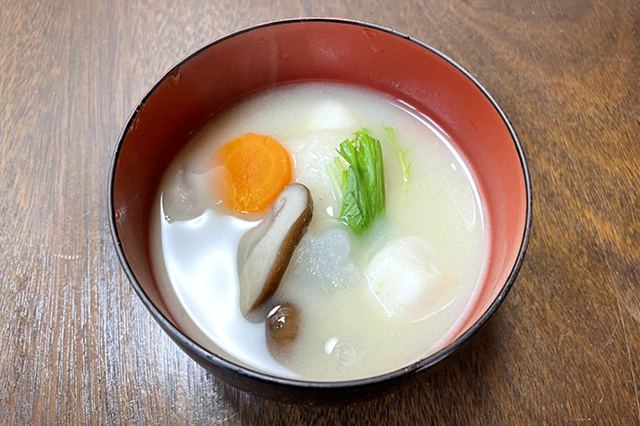
| Prefecture | Osaka (大阪府) |
|---|---|
| Region | Kinki |
| Japanese name | 白味噌雑煮(しろみそぞうに) |
| Reading | Shiromisozōni |
| Home area | All within Osaka Prefecture |
| Main ingredients | And I'm going to show you some of the things that I've learned. |
History and Origins
It's a dish with citrus sauce and citrus, beautifully shaped radias, carrots and resames and so on. It is said that the history of turquoise is very old and that it was already eaten by the time of the city. It was offered in high-class celebrations, but it was said that during the Edo era it spread among the common people. Even today, the custom of eating broth on New Year's Eve is nationwide, but there are various ingredients and flavors used by the community and by the family. Not only Osaka, but in Kansai, there has been a wide range of white turquoise, which has long been used with round and white peppers. The materials are cut out by the main roots and carrots. The use of round food is a virtue because it is a virtue of "to have no corners and fit fully." In the New Year's season, the supermarket of Osaka contains stylus and golden carrots as fresh-soon vegetables. A lye root is a small, small, large root, which will be just the right size to be put into the turquoise bowl if you cut it. The fine gold carrot is also a traditional vegetable grown from old age with Osaka.
When It Is Eaten
It's a New Year's meal. Once it's white, it's white, but on the second day, it will change the flavor and make it into a sauce of soy sauce. It's because of the Osaka, which is the city of commerce, that it's a custom to be "not tired."
How It Is Eaten
I'll make a slice of radish, carrots, and leathered lily potatoes, and boil them in soup and put the white sauce on. If you boil the bowl further, it will be finished.
Recipe — Serves 4
Ingredients
- 2(80 g) taro
- 1/3 blocks(100 g) tofu
- 80 g daikon radish
- 40 g carrot
- 60 g mizuna
- 4 round mochi
- Seasonings: 1 tbsp1/2 white miso
- Seasonings: 10 g kelp (konbu)
- Seasonings: 30 g shaved bonito flakes
- 4 cups water
Method
- I'll cut the radish and carrots into five-millimeter slices. It's thin because it's boiling. The vegetables are cut to three centimeters long. The baked tofu will be cut into a single - size dice.
- Put water into the pot and make the juice out of the cloth and the grinders.
- When you boil it, add a lily potato and cook it for five minutes. Add a bowl of water and cook two and three cups with a weak fire.
- (3) add a white paste to it, and add a baked tofu to heat it, then add some water.
More About Shiromisozōni
Japanese native dish. It's a white-snap stew, eaten with Kyoto Prefecture, Osaka Prefecture, zXQQ023X, Kagawa Prefecture, etc.
Kyoto Prefecture
The stew that will be eaten in New Year's season at Kyoto Prefecture is a white pepper with round rice, with potatoes and potatoes and carrots in gold. A cucumber can be baked, but it is more likely that it will interfere with the taste of white pepper.
The round is the meaning of a full and long life, the head potato is the meaning of offspring, the head is the meaning of success, and the cone is full if you cut it in half, and the turtle is the meaning of long life. The bright red of carrots at gold time is used for magical purposes.
White pepper was a taste of citrus and was eaten only in relatively affluent families, since it was a short term in maturity and low salt content, but it did not last in the day. Although the three New Year's Day is a white stew eaten by each family, there is no custom of eating white pepper daily, and there are not many families who use white pepper for boiling.
In the past night, some cooks used to cook vegetables by boiling them from the previous night.
Osaka Prefecture
The stew that will be eaten in New Year's with Osaka Prefecture is a white pepper that will use condensation, seams and carrots. I won't burn the bowl. Dicons and carrots will be cut, but it also means "to be without a corner and fit full."
In room town, they were eaten by upper class celebrations and by Edo they were eaten by civilians. Osaka is popular with sweet white peppers, but it is often made in order to order and make a "knit" that is better than the common white pepper used for boiling. Also, it's more effective to make chissy than the white sauce that you usually eat.
For Osaka, the first time you eat the stew in a white bowl, and the second day you change the flavor and make the broth of the oil. This is a custom for "delightful and untiring" from the city of Osaka.
Once on the boat, they will eat a white dish, a second bowl of water in the cooking pot, and three days later, they will be called commercial stews because they will eat the gravy in the sun. It's also a good reason to burn the rice on the second day before it's done faster than to eat it.
Kagawa Prefecture
In Kagawa Prefecture, the rice is added to the citrus sauerkraut.
Text adapted and translated from the Japanese Wikipedia article 白味噌雑煮 by its contributors, licensed CC BY-SA 4.0.
Dish data: Ministry of Agriculture, Forestry and Fisheries (MAFF), “Uchi no Kyodo Ryori” (Our Regional Cuisines) database, used under the Public Data License (PDL1.0); translated and adapted from the Japanese original.