28 2 きりせんしょ
| Prefecture | Iwate |
|---|---|
| Region | Tohoku |
| Japanese name | きりせんしょ |
| Home area | (Morioka City) |
| Main ingredients | And then you can see that there's a lot of oil in there. |
History and Origins
There is a theory that the name "single" is derived from a once-stabed soup that has been mixed in with a bowl and that turned into a "sniff." But already there has been no use in the beginning of Japan. It's been eaten from ancient times around the rice fields of Fukuoka prefecture and has been valued as a common food. It was offered at the Buddhist altar and on the altar with the celebration, and in the past, girls and mothers often made it together when they were in the peach phrase. Also, in this area, you could say "suntime between lunch and dinner" and often eat foods made from good rice flour, flour, millet, beans and other foods that were served in between the farm work. One of them is "I'm sorry." It is made from Morioka City, cigar, purple, and faraway cities, and is made in different areas, but it is common to use rice, powder, and Goma and taste the sugar and so on. Sugar often uses black sugar. It has a simple taste.
When It Is Eaten
(Machine, especially March 3rd) It's possible to be served at weddings, not only at Buddhist altars, but at Buddhist altars, on private altars, or in the middle of farm work.
How It Is Eaten
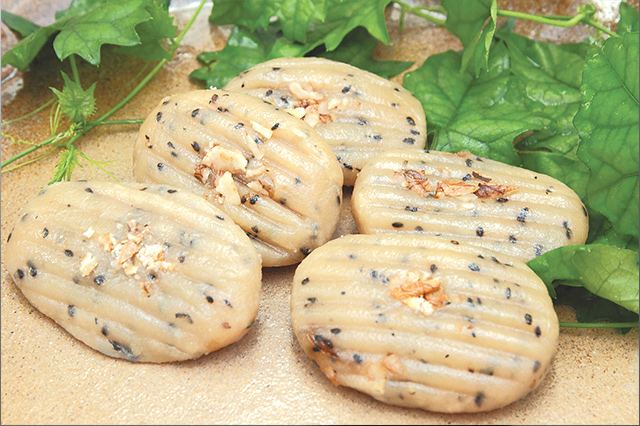
Although the local and family cultures differ in the way they cook and taste, shape differences, and shape, it is common to add flavors with rice flour, steaming rice, and adding Gomas, oil and sugar. There are a number of variations in shape, such as a small scale with chopsticks on it, or a leaf shape, or a wooden shape that has been used to shape flowers and boats. Among them, especially in the distant city, there are features of wrapping the dough around stains and black sugars into honey and making them taste with black sugar and soy sauce. When there is no peripheral pattern, it is good to crush the shape of the shape with the level of your hand and place a pattern on the shape of the spoon.
Recipe (see source)
Ingredients
- 500 g rice flour
- 600 ml water
- 30 ml soy sauce
- 200 g sugar
- 2 tsp salt
- 3 tbsp chopped walnuts
- 1–2 tbsp sesame seeds
- 50 g brown sugar
- as needed potato starch
Method
- In a large pot, water, soy sauce, sugar and salt are put into the fire to make it boil firmly.
- Put the powder on and immediately stop the fire and mix it until the powder is gone.
- (A hundred times, with the Goma in it, and the hand which is often rubed with it.) It's okay to do this in hot weather, but if you cool the cloth with wet cloth, it'll make it easy to make and make.
- The ones are shaped like sticks and 24s so that they are easily torn off.
- In the middle of the coral, I make a hole with my thumb, black sugar and glue, close the hole, and shape it into a box. I put it in a mold and shape it and put it on top. If you're easy to stick to your hand at this time, use a piece of flour.
- I'll put it on a steamer and steam it for about ten minutes. If it is steamed, you can turn off the fire and immediately put water on the stove and the fabric will come down.
Source: MAFF “Uchi no Kyodo Ryori” (Our Regional Dishes) database.