Home / Miyagi / Hesodaikonnonishime
Hesodaikonnonishime へそ大根のにしめ
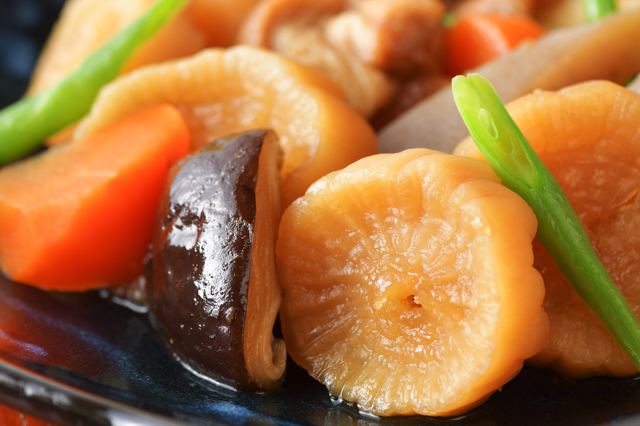
| Prefecture | Miyagi (宮城県) |
|---|---|
| Region | Tohoku |
| Japanese name | へそ大根のにしめ(へそだいこんのにしめ) |
| Reading | Hesodaikonnonishime |
| Home area | Miyagi Prefecture South. |
| Main ingredients | I'm going to have to do something about it. |
History and Origins
In the Tohoku region, which is extremely cold, it was the custom to expose vegetables and fish in the cold, old age. It's also one of those stored foods that is made up of Kanzochochocho, in south of the state. The delicious radish of the high altitudes over 300 meters high is cut into strips, boiled and mixed in the middle of the sea, and dried in the cold of winter for about a month. By repeatedly freezing at night and melting at noon, you will produce a candy - colored "nut root." The hole after the knife is "as if you can see it" from "as if it were a giant root" or "sniff." A well dried dish can be preserved until the summer of the year and boiled with seasonal vegetables is the prescribed recipe. When cooking, wash lightly and put it back in soft water, and boil it with a variety of tools when you like it. It has been found that sun - dried foods such as vitamin B, potassium, calcium and other minerals, and food fiber are more nutritious than the root of life.
When It Is Eaten
We harvest the root at the beginning of wintertime, peel it, and boil it in a large pot. The steamed radish passes through the middle of the bush and uses the cold to dry the house. For a month, the root, which has repeatedly been frozen at night and melted at noon, can be preserved until next summer. Therefore, from winter to summer, you go to the table with boiling sauce and other dishes.
How It Is Eaten
Before cooking, wash lightly, wash a soft bath, and cook with a variety of vegetables when you like it. In recent years, there have been instances in which the root has been used to make soup tools or to mix meat with what has been returned.
Recipe — Serves 4
Ingredients
- 8 daikon radish
- 100 g(1) carrot
- 4 taro
- 4 dried shiitake mushrooms
- 100 g(1/2 blocks) konnyaku
- 4 frozen tofu
- 15cm) 8 kelp (konbu)
- 2 tbsp mirin
- 3 tbsp soy sauce
- 1 tbsp sugar
- 4 bamboo-leaf kamaboko
- 3 cups dashi stock (かつおぶしまたは煮干しと干ししいたけのもどし汁も含む)
Method
- The root will be put back in the water overnight and will be light.
- The frozen tofu is put back in the soft water and then narrows down and cuts into two triangles.
- Carrots peel and cut in half. The lily potato peels off and the big one cuts in two. Even if you put salt on it, after you wash it, it'll be smoothed or cut on the triangle.
- The dried grain is soaked in water and returns to the axis. The soup is raw and used as juice.
- The knot cloth should be washed quickly and cut into two lengths and then lightly.
- The Japanese peppers cut one in two at an angle.
- Put all the ingredients in the pot, but add the juice and the flavor. Put it on fire. When you boil it, cook it until it's dry.
Dish data: Ministry of Agriculture, Forestry and Fisheries (MAFF), “Uchi no Kyodo Ryori” (Our Regional Cuisines) database, used under the Public Data License (PDL1.0); translated and adapted from the Japanese original.