Kokerasushi こけら寿司
| Prefecture | Wakayama (和歌山県) |
|---|---|
| Region | Kinki |
| Japanese name | こけら寿司(こけらすし) |
| Reading | Kokerasushi |
| Home area | Northern and Southern |
| Main ingredients | It's not just rice, fish, shrimps, vegetables. |
History and Origins
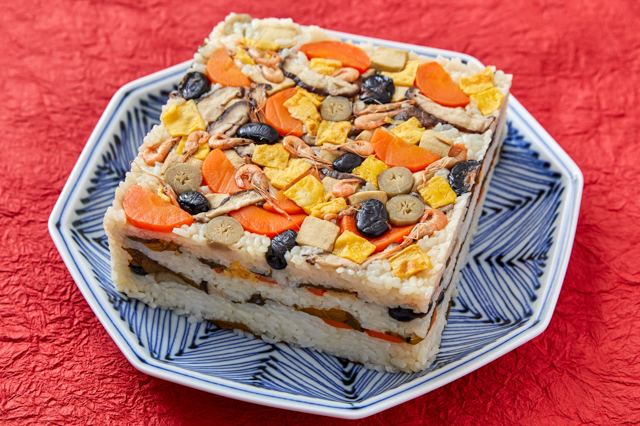
"Smushiki" is called a root type of "press" and "boxing" because of the fact that it is used to cook and loosen fish, carrots, eggs and other things, and pressed in wooden frames. There are various sources of the name, such as the idea that a wooden frame with a roof and a "smushi" could be called "somi" because of the fact that the wood sawing is similar in appearance to a piece of wood, and so on. The tools on top vary from region to region. In the vicinity of the port of Tanoura fishing at Wakayama City, the summer festival was once celebrated by praying for fish to be served and for fish for the year. At this time I'm going to wear a "Sumi-saki" with the Himeji and "Eso" taken from spring to summer. He had to put three pieces of salt on it and put it down for a while, so as summer festival approached, he prepared beforehand. The "Sumi-saki" made from Wakayama City Kogasaki uses the eso powder that is fried in deep-sea fishing. It's one of the nicest foods in the world. To make yourself soft, I hit a knife with a tonton, and it's also called "Tonton" The Sushi from the Wakayama City River makes several layers of shrimps and Thai slacks and rice. Also, they sometimes use red fish instead of shrimp. In the town of Yoichi, you can spread the tools of black beans, river shrimps, daisies, hanono Tofu, carrots, and so on. In the summertimes, they use pepper leaves, and in fall festival and New Year, they use vegetable leaves.
When It Is Eaten
It was such a big dinner during the celebration, such as summer and fall festival.
How It Is Eaten
When you cook and eat, you can taste different flavors.
Recipe — Serves 8
Ingredients
- Sushi rice: 5 × 180 ml rice
- Sushi rice: 90 ml vinegar
- Sushi rice: 90 g sugar
- Sushi rice: 25 g salt
- 2 egg
- 5 6 高菜の葉
- 100 g black soybeans
- 6 shiitake mushrooms
- 4 freeze-dried tofu (koya-dofu)
- 1 carrot
- 100 g river shrimp
- 1 tbsp pickled red ginger
Method
- The eggs are made into thin eggs and cut into one centimeter-inch cubes.
- Black beans, river shrimps, daisies, hinoto tofu, carrots, and carrots, they taste them separately with soup, sugar, oil and salt. The material is cut smaller than the black beans.
- We spread vegetables under the box and rice on a thick layer of rice from one to five inches thick.
- I'll scatter seven different kinds of tools into pieces on a flat surface.
- Put the vegetables back on, spread the rice, and then scatter the tools on top.
- Repeat this. I'll do it in three rows.
- Finally, put the vegetable on top, and set it on heavy stone for more than 12 hours.
More About Kokerasushi
A type of sushi. I've seen sushi, sushi, and so on.
Overview
In addition to sushi in an old shape, it has become a model of sushi, sushi, sushi, and boxing, it remains a local dish throughout Western Japan.
History
In the shrine of the Shinto shrine of Yoshida, the name of Koji is listed as a dedicated offering, along with such things as sushi. This is the oldest sushi appeared in the literature. It was caused by emulsion of lactate at the time, and it was put on top of the rice and pressed with heavy stones to produce the diuretics. The oldest form of the rice that was used to produce lysic acid is "not "not" and "not " grows" the rice together.
In the Edo period (in the year 1785) a "The Secret Cooking Box," written in the MT5 Year, was considered as a"no longer famous for its fresh sauce. " By this time it has changed from rinsing and rinsing with vinegar to rinsing with heavy stones, and the Japanese Japanese Japanese's 'Singuji' 2-year 1882' has introduced a recipe for placing tools on rice and rolling vinegar. This is how the sushi that uses vinegar for seasoning and preservation is called "half-gen, half-gen, unstinted." The present sushi is grown because vinegar rice has become a single rice meal and no longer has to be pressed. In the late Edo, the annual "Sacrificial Post" says that the Edo will be more than a box, more than a box, more than a handful. "The end of the box has been in the past five or sixty years." In Edo, the box was destroyed, and Knitsu was the main object.
In 1892, a sushi called box sushi comes in Osaka. This was a sushi that was provided as a box or one of two pieces of rice with "sniff," "sniff," and "sniff," and "sniff" together. This rice sauce is made of tassels and tassels covered with white fish. I called the box itself a little too much, but by the 1990s it was an old term.
There are still shops that provide rice from Osaka to draw the flow of silk, as well as local food left in many other places, where suppliers and families are on the decline because of the difficulties they're going through. However, you can see the reevaluation of the brush like the spring of the Hyogo Prefecture, which was inspired by a new novel for foreigners, which is a poor sight for raw fish. I'd like to be seen.
It's all over the place.
In the past, it has become a local dish in many parts of Western Japan.
I wasn't able to get a book.
I'm going to list some of the sushis that are called condiments that are classified in the unbooked way.
Shiga Prefecture Long Beach City
Gifu Prefecture
In Gifu Prefecture military county and county county, they used herin and large roots, but called it "sing."
Pushing sushi.
In this section, I'll list some of the types of sushi I make in my molds, called a chicken.
Iwashima
Akishima, where there is a rich local strain, has what is called a push.
There is a wide range of pressings in Mie Prefecture. It is characteristic of mixing leaves, such as rice, rice, rice, rice, and lettuce.
We use devices such as cicadas, carrots, govors, and so on. The leaves are between the rice and the implements, just like those in the tail city mentioned earlier, but here they are used.
Using vinegary fish, shrimps, extractibles and silky silk eggs.
The silky egg is rich in color, and it has a spectacular impression of sushi, but the sushi from fishing villages such as the same Wakayama City is similar to the island of Kogasaki and uses Eso's skin. It is also characteristic of Kogazaki's use of a single size type. By the 1980s, fewer people had already made it because of the burning of tubs in Wakayama City.
Hyogo Prefecture Lawaji Island
The daisies of Awajishima are a form of sushi that doesn't use heavy stones but doesn't use heavy stones. It's a kind of sushi that doesn't take long to mold. In Awaji Island, the marketless fish caught in the wilderness, such as Bella, Trahaze, and Eso, were baked in charcoal, and stored in dried fish by the side of the house. The sushi made from this dried fish is the sushi from Akishima. It's served as a dish for festivals and New Year's and guests.
A characteristic of this sushi is that dried fish are covered in the skin. So there is the old saying that the name comes from the name "screw" and that it has been cut to pieces with the idea that it resembles a piece of wood. And there is the idea that it has become "knit" because it changed its accent.
Tokushima Prefecture Seaside County, Sion City
It's a type of sushi that goes to Tokushima Prefecture Seaco County, Japan, but it's characteristic of not using any fish and fish. I'll pack the rice and rice made from vinegar and squeeze it out of the wood frame and then put on gold-time beans, cucumbers, and carrots leaves. And there is also a "scarleted" in the ocean county, apart from the seams, using the whole mass and the cud.
Kochi Prefecture
The Kochi Prefecture's not in the city of Toyocho, but simply in the city's cooking order. We use five pounds of rice, and we mix rice and utensils into a large rice box. As you take a set of rice and a set of utensils, you loosen the vinegar and put on a taste of "Nagosh vinegar." Repeat it until it's full and press it with heavy stones. If it's big, I'll sleep overnight to push it hard.
It's like a sushi.
Iseu is also a type of sushi, but I want to write down what is called "snap" for Toshio and Ishio Iwa's sushi.
Okayama Prefecture
It's a sushi that was put in a bowl and put on a heavy stone and slept overnight. In Nakamura, fish used by the community differ from fish used by the community. In Japan and the first, they are made by using sea cucumbers, separate places, Yoshida and Koko.
In Tottori Prefecture, which runs across the prefectures, and in Seung Jo City, similar sushi using leaves of the leaves is called the sushi of the fly. Kunihito, the wise man's soo, wants to be referred to the Izu's sushi #Tottori Prefecture Wise Head Area.
Fukui Prefecture
In the Fukui PrefectureYZ, I call the same sushi as with salt bowls unspoiled. The food here is mixed with a piece of pepper, wrapped in a bowl or a turtle leaf, and put a heavy stone on it.
Wakayama PrefectureI, Mountain City, Immaculate
I called it "susame sushi" in the Wakayama PrefectureI.
Text adapted and translated from the Japanese Wikipedia article こけらずし by its contributors, licensed CC BY-SA 4.0.
Dish data: Ministry of Agriculture, Forestry and Fisheries (MAFF), “Uchi no Kyodo Ryori” (Our Regional Cuisines) database, used under the Public Data License (PDL1.0); translated and adapted from the Japanese original.