Home / Gunma / Okirikomi (Gunma Noodle Stew)
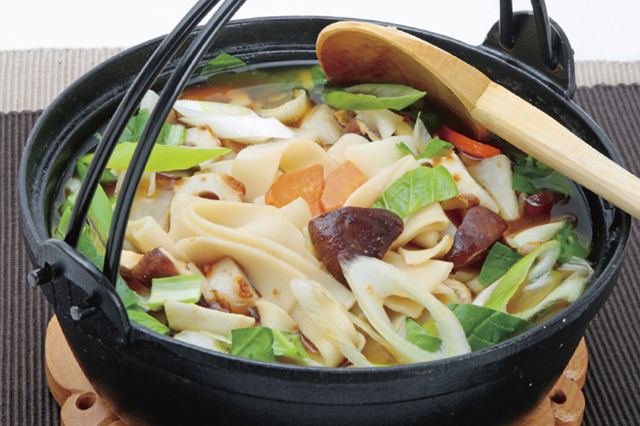
Okirikomi (Gunma Noodle Stew) おきりこみ
| Prefecture | Gunma |
|---|---|
| Region | Kanto |
| Japanese name | おきりこみ/おっきりこみ |
| Reading | Okirikomi |
| Home area | Throughout Gunma |
| Main ingredients | Wide wheat noodles, taro, root vegetables, miso |
| Recipe yields | Serves 4 |
Okirikomi is Gunma's noodle stew: very wide, raw flour noodles cut straight into a pot of root vegetables in a niboshi-and-bonito broth, seasoned with soy sauce and miso. The un-boiled noodles melt their flour into the soup, making it thick and filling.
History and Origins
Gunma's dry, windy plains grew wheat where rice struggled, and farm households cut wide noodles directly into the vegetable pot — 'kiri-komi', to cut into — saving both fuel and washing up. Okirikomi became the prefecture's defining farmhouse meal.
When It Is Eaten
An everyday, cold-season farmhouse dish eaten throughout Gunma.
How It Is Eaten
The dough is kneaded, trodden by heel in a bag, rested 20–30 minutes, rolled 3–5 mm thick and cut about 1 cm wide. A dashi of niboshi, kelp and bonito is strained, the vegetables go in hardest-first for 10–15 minutes, then the raw noodles, and the pot is seasoned at the end with soy sauce and miso.
Recipe (Serves 4)
Ingredients
- Noodles: 300 g medium-strength flour
- Noodles: about 150 ml water
- Noodles: about 30 g flour, for dusting
- 60 g burdock root
- Soup vegetables: 60 g carrot
- Soup vegetables: 100 g daikon radish
- Soup vegetables: 150 g taro (satoimo)
- Soup vegetables: 4 shiitake mushrooms
- Soup vegetables: 1 sheet abura-age
- Soup vegetables: 40 g spring onion (naganegi)
- Dashi A: 2 litres water
- Dashi A: 40 g niboshi (dried sardines)
- Dashi A: 1 piece kelp (10 cm square)
- Dashi A: 10 g bonito flakes
- Seasoning B: 2 tbsp soy sauce
- Seasoning B: 40 g miso
Method
- Make the noodles: put the flour in a bowl, hollow the centre, and add the water a little at a time. Knead by hand until no dry flour remains.
- Put the dough in a large plastic bag and tread it with your heel, folding and treading again, several times, until a little firmer than an earlobe. Rest it in the bag at room temperature for 20–30 minutes.
- Roll the dough out on a floured board to 3–5 mm thick, dust with flour, wrap it around the rolling pin, and cut it open along the pin; then cut it into strips a little wider than udon (about 1 cm).
- Make the dashi: put Dashi A — the water, kelp, and the niboshi (heads and innards removed) with the bonito flakes — in a pot, soak for about 5 minutes, then heat gently. Just before it boils, remove the kelp; simmer the rest gently for about 5 minutes and strain.
- Prepare the vegetables: carrot and daikon in quarter slices, taro in bite-size pieces, shiitake sliced, spring onion in rings, burdock in rounds or diagonal slices depending on thickness, abura-age in 7 mm strips — all roughly the same size.
- Put the dashi in a pot, add the vegetables except the spring onion, hardest first, and cook over medium heat for 10–15 minutes. Add the noodles and continue simmering, then add the spring onion and season with Seasoning B (soy sauce and miso). Serve.
Source: MAFF “Uchi no Kyodo Ryori” (Our Regional Dishes) database. Recipe quantities are as published in the MAFF source data; the text has been re-edited for this guide.