Home / Fukushima / Sagohachizuke
Sagohachizuke 三五八漬け
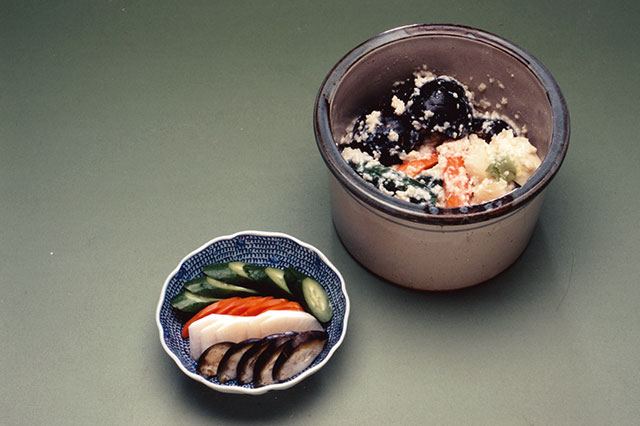
| Prefecture | Fukushima |
|---|---|
| Region | Tohoku |
| Japanese name | 三五八漬け(さごはちづけ) |
| Reading | Sagohachizuke |
| Recipe yields | Serves 4 |
History and Origins
In the area around Matsuya City where there are many fields and lots of fresh vegetables, vegetable native dishes are rooted. "Six-five-eight" is a dish where vegetables are soaked in the raw "three-five-eight" mixture of rice and salt. It's a kind of junk food from the Edo age, and it's been a long time since it's been loved for good health, as well as its abundant use of vegetables. It is claimed that this name was derived from three salts, five nuts, and eight rices, but the actual ratio was 1:1. For preservation, it was prized as the season of busy rice planting. In recent years more and more people have enjoyed eating meat and fish as well as vegetables.
When It Is Eaten
It's common to mix three, five, eight proteins you've made during the winter with such vegetables as summer peppers and so forth. I was eating this before spring or during the busy season of paddies. It's possible that it's sold now and that it can be eaten year after year.
How It Is Eaten
We mix cold rice with salt and mix it together. We put them together for about a month, then we make three and five 8. These three-five-eights are placed in vegetables, plastic bags, and so on. They'll be swallowed overnight. When making in a bowl, it is often done by putting light heavy stones on it. It's said that it's now being made with less salt and healthier recipes.
Recipe (Serves 4)
Ingredients
- Mix: 2 cups cooked rice
- Mix: 1 cups koji
- Mix: 1/2 cups salt
- Mix: cucumber, to taste
Method
- I use the sieve as a medium, and I use it as a base for my skin. I use it as a blender. It will be used after more than a month.
- I'll put three hundred eight in a bag, a plastic bag, and I'll eat the next day. Also, when using bowls or other items, they are often used with light, heavy stones.
Source: MAFF “Uchi no Kyodo Ryori” (Our Regional Dishes) database.