29 1 いぶりがっこ
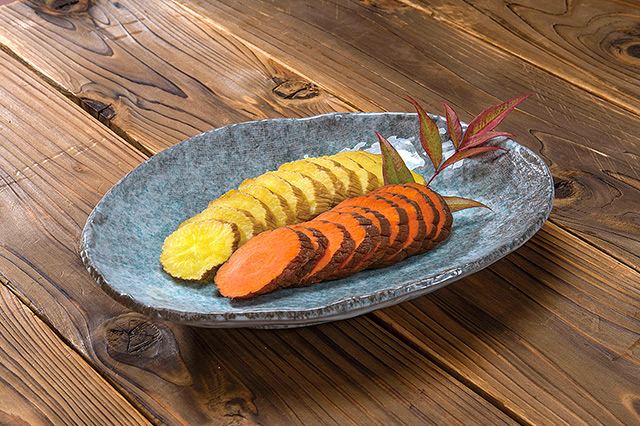
| Prefecture | Akita (秋田県) |
|---|---|
| Region | Tohoku |
| Japanese name | いぶりがっこ |
| Home area | South-South. |
| Main ingredients | (Laughter) |
History and Origins
Akita's typical dried-up rice bowl. Now it's made all over the province, but it's a local dish that was once made from a farm in the interior. In the early fall of winter, especially in the south and south of the state, the western winds of the Japanese Sea are stopped in the lower mountains during the late fall and winter, increasing rainfall and snow, and reducing daylight hours. Because the sun - dry roots were not dry enough to make the peppers, the snow - covered environment made them dry on the lining of the house. By drying with the heat and smoke of the fire, we were able to eat out of winter by increasing the preservation of large roots and by filling them with rice and salt. Also, in winter temperatures slow down the fermentation, and the scent of the radish and the ingredients of the paprika are dissolved with a good salt plum, and the flavor and flavor of the flavor are added. This seaming is the root of the "swinging" process, and it originated in the town age, and it was made in almost every corner of the area, and it supported the winter table of the Great Snowy in Akita. In the sense of "too" it means "to be self-decision," and "to be self-centered" means "to be self-centered.
When It Is Eaten
I'll start planting fresh roots and carrots before snowfalls. It's a product of the wisdom of the snowy Akita's climes, which must be used to support life and health in snow-closed areas.
How It Is Eaten
Wash the main roots in cold water, and keep them in order from the thick ones to make them tender. The smoke from the trees of the haiku tree, such as Nara and Sakura, will cover us for two days. You can dip it in with rice, salt, sugar, and so on. It will mature for more than two months. I'm going to take you out of the barrel and clean the rice bowl on the surface with cold water and then cut it down and cut it thinly and place it on the bowl. The food is also served as a wine bowl and tea. It also has a home - to - house flavor and enjoys guests as a feature of hospitality and admires their age with their neighbors.
Recipe
Ingredients
- 12 kg daikon radish
- carrot (あれば山内にんじんで), to taste
- Mix: 1.5 kg くず米のふかし
- Mix: 1.5 kg rice bran
- Mix: 1.5 kg salt
- Mix: 1 kg sugar (coarse sugar)
- Mix: a pinch uconium (紅花粉)
Method
- I'll weave about ten of them with strings. I've been hanging (Change Kotaru) in the hut, and I've spent five days watching the fire day and night.
- When I finished my balding, I washed away the sweats and dusts from my hands.
- Mix all the dandelions together, and place large roots in a large barrel, and stick them in a single layer, and stuff them.
- It's about 50 days since you soaked it in, and you can taste it, and you can eat it with a full amount of color.
More About 29 1
It's a raw material that has been wrapped up mainly in smoke - dry, smoke - dried, and dry, in the inland region of Akita Prefecture. It is considered rare in the world to find that a type of borax that has a fluoride in a vegetable dish is also found.
Often referred to as "Sweeting" but originally it is Akita Prefecture Yuzawa's home house, and it is a trading symbol that he wants to sell in 1948. In addition, on May 8, 2019, "Treasure" and "Ibnigakko" are a geographical display by the Ministry of Agriculture, Forestry and Fisheries as a specific crop (GI).
Overview
On the Japanese sea side of the Tohoku region, the climate is very humid, and during the harvest season of the Great Spring and winter months, the weather will be cloudy and snow will fall. Even if you make a large root to do this, you can't dry it outside of the house. This led to the building's being built by hanging a root on a beam in the room and using the smoke in the hearth to soak it up on dry ground. It's a souvenir handed down to farmers in Akita. It's been known for ages as a food for the great snowfield.
The spread of wood stoves in the 1930s has reduced home fireplace production, but in the '40s, the Akita Prefecture product began to be sold. There are names such as "Sympathy" and "Sympathy" and "Sympathy." In addition, "patch" is a word in the Akita Prefecture dialect.
In the area of Iseshima, there is a "Creep Pick" that competes with the taste of hibernating, and there is a Kashikal and a freestyle division.
What is registered as a particular crop of agriculture and water is supposed to use raw materials and other domestic roots in Japan. In addition, they use carrots in three or more of the Riku Mountain and then they make carrots in special products in the mountain.
Processing
The commercial product consists mainly of fluorine and a mixture of fluoride, but each manufacturer has his own recipe.
In this case, the main ingredients are used for cooking, using wood from the haiku and cherry trees, which are used for more than two days by day and night. After that, in the indentation process, the floor will be soaked for over 40 days to mature.
Many small-scale manufacturers, including the farm's side business, are concerned that the modified food health laws of June 2021 will require the obtaining of limited food facilities and sales licenses, and that there will be a continuing dissemination of the business.
Trade Marks
It is said that it was first sold for general use under the name of "Swoopy" in 1967.
(Crowd registration in 1983 by the P.E.
There has been a continuing conflict between this trading rights between the late startups in the province of 2014, who made the same name for their sales, and the founders of the company's trading company, the Jao-dono. (PEOPING 1588021) is a commercial sign that designed the six-letter plasma. He is a contractor in the House of Akita Prefecture, which he founded in 1963, and he said, "The commercials represent the quality and brand of the product." "Enochi claims that he's had a lot of self-interest and that his name is part of the trading rights." On the other hand, the Akita Union, which began in 2014 with multiple firms in its state's rear-ends, claims: "The name is not included in the trade rights."
We're going to have a limited supply of food in the interior of the country.
The above is a diagram of the symbol with the letter "Akita Okaju Food Cooking." In the state of Saigon food is a product of Akita Prefectureinya, Japan, and Japan, Japan, Japan, Japan, Japan, Japan, Japan, Japan, and Japan.
Akita Akita and the Cooperative were using the patent agency's decision system to determine the possibility of a violation of rights. In July 2016, the patent agency decided that the name "major" was not included in the name itself as "a common understanding of Akita Prefecture." Although the decision system is not legally binding, the product name has been more likely to be used as a "trick."
Text adapted and translated from the Japanese Wikipedia article いぶり漬け by its contributors, licensed CC BY-SA 4.0.
Dish data: Ministry of Agriculture, Forestry and Fisheries (MAFF), “Uchi no Kyodo Ryori” (Our Regional Cuisines) database, used under the Public Data License (PDL1.0); translated and adapted from the Japanese original.