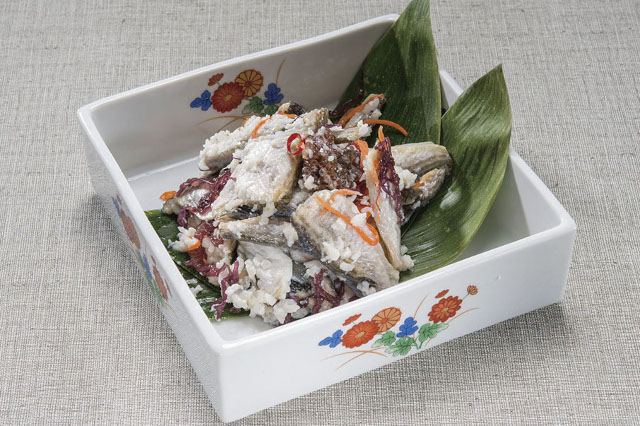
Hatahatazushi ハタハタ寿し
| Prefecture | Akita (秋田県) |
|---|---|
| Region | Tohoku |
| Japanese name | ハタハタ寿し(はたはたずし) |
| Reading | Hatahatazushi |
| Home area | All within the province, at the center of the coast. |
| Main ingredients | I don't know what to say. |
History and Origins
It was originally a fish in the deep sea, and when the sea was rough and thunderous, and it appeared in the vicinity only for a time during the hatching season, and it came to be called by the ancient name of the thunder bolt, "The Abominable God." It's called a red fish. Hatahata is so deeply rooted in local life that it's also sung in the folk song "Akita Head" and said, "You can't greet New Year without Hattera." Once proud of the catch of more than 10,000 tons a year, it is now treated as an expensive fish now that the fish have been reduced because of the overfishing and the changing water temperature in the Japanese Sea. Akita is made from rice, rice and rice in a steady amount, but it is essential to Akita's culture. There's a little difference in how to make them in different areas, and the method of quick salting them is old-fashioned. The way to process it after a while in the water, with the exception of a little bit of blood, is to take a fresh taste of sweet, sweet, odorless, fresh taste. That windy recipe has been passed on until today.
When It Is Eaten
The head of the Hatahata, the walnuts, and the seams that were wrapped up in them, are for the New Year's Eve or New Year's Eve, and the cut in a single-sized slice and the stuff that is essential for New Year's cooking.
How It Is Eaten
We wash and cut them to size, and then we soak them in the seasoning water for three days. I'll have them fertilize in the refrigerator, after all.
Recipe
Ingredients
- 10 kg hatahata (sandfish)
- Mix: 500 ml vinegar
- Mix: 100 ml salt
- Mix: yuzu
- 1.5 kg rice (炊いておく)
- Mix: 400 g koji
- Mix: 110 g salt
- Mix: 1 × 180 ml sake
- Mix: 1 × 180 ml mirin
- Mix: 70(10×7) bamboo leaves
- Mix: 4 carrot
- Mix: 10 南蛮
- Mix: 1 packets(15 g) nori seaweed
Method
- I'm going to remove the head, the internal and the tail.
- Clean with cold water, taking out the stain with salt.
- I'll soak in plenty of cold water and bleed three days and nights. Water exchanges twice in the morning and evening.
- Cut the blood-stained tapa into two sections, and then soak it in cold water all day and night.
- We pick up a monkey from the water and put in a bowl of rice and salt, which is a light weight, so we dip it in one day and a night. It's your favorite dish. It's your favorite dish. It's your favorite dish.
- I'll prepare the ingredients for the duplicating.
- It's a mild heat from the cooked rice, and it's mixed with citrus sieve, and it's kept warm for two or three hours at a warm place.
- Put the leaves of the honey in the pot without putting them in the pot. Put the salt, the wine, the lynx 7.
- Then we cover them with the leaves of the cartons and then we place them on the floor for two days or so.
- When the water comes up, I add a weight of up to 30 kilograms.
- I'll have them fertilize at a cool place for the week.
- When they are tried and matured, they throw away the water in the tub, use paper towels to clean up the water, and then split it into 200 grams and store it in the refrigerator.
Dish data: Ministry of Agriculture, Forestry and Fisheries (MAFF), “Uchi no Kyodo Ryori” (Our Regional Cuisines) database, used under the Public Data License (PDL1.0); translated and adapted from the Japanese original.