Home / Fukushima / Daikonmochi
Daikonmochi 大根もち
| Prefecture | Fukushima (福島県) |
|---|---|
| Region | Tohoku |
| Japanese name | 大根もち(だいこんもち) |
| Reading | Daikonmochi |
| Home area | County Mountain City |
| Main ingredients | Red muscle, rice powder. |
History and Origins
For many years, Fukushima Prefecture has grown various vegetables. Some of the vegetables are produced nationwide, and many of the state's own brands continue to be inherited as traditional vegetables. One of them, known as the Mansios muscle mass, is said to have been named because of the red muscles in the skin. It's characteristic of the soup when it is cooked tightly with meat, and it's also preferred as a cucumber, but it's the big root that's become available in recent years. I'll rub the red muscle root down, mix it with onions, amis, rice powder, and cook it up, like cooking like a favorite dish. It's one that can taste the flavor of a red muscle root properly.
When It Is Eaten
The stage of the red muscle root is in the middle of November and February, and during this time, local food with red roots containing large roots can often be eaten.
How It Is Eaten
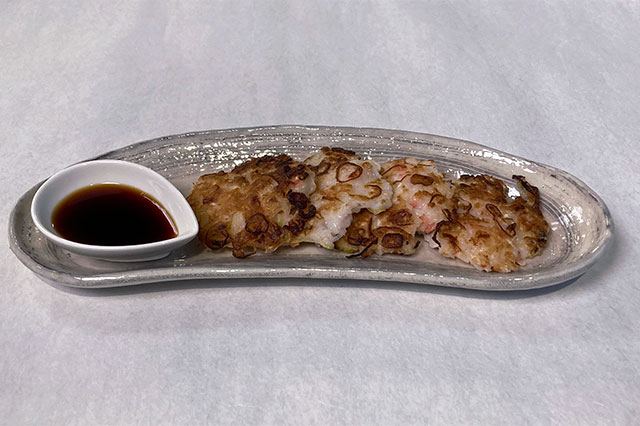
You can peel the root and make a large root base and mix it with chopped onions, amis, rice powder and salt. If you round the dough with a spoon and bake it with a fried pan, you'll finish it. Eat with vinegar oil. In addition to amis, I use a saxophone dryer. Also, if you put down a large root, the flavor will stay strong and delicious.
Recipe
Ingredients
- 1 daikon radish
- 1 green onion
- 2 tbsp ami shrimp (shrimp)
- 100 g rice flour
- a pinch salt
- sesame oil, to taste
- 1 tbsp rice vinegar
- 1 tbsp soy sauce
Method
- We're gonna peel off the big roots and make a big lump or a big lump.
- And then you have to mix the onions and the amy and the root.
- And mix with rice flour and a little salt.
- Put a little bit of sesame oil in the pan and put four spoons in the middle where you heat the fire.
- When you're finished with a small grouping, you'll have a hooker and a weak fire for five minutes. Turn around and burn in the middle of the fire for another four minutes. * I'll make the cooking time my favorite.
- It's made with a mixture of rice and soy sauce.
More About Daikonmochi
Osama Kotata, a kind of Japanese dish, is a condiment of rice, powdered roots, and water dough and a condensation. It's also one of the typical points of tea.
Overview
In addition to being used as a focus in the Canton tea shop, it's also used as an old New Year's dish in Canton and Hong Kong. In Chinese it is said to be "gao," that it pronounces "gao," but the kanji "high" also means "high" because of the same pronunciation, which means "high" and "good luck" is better.
Greata is very important among the food cultures of China's Canton and Fukuoka, and it is also common in Taiwan, Singapore, Malaysia, where there are many immigrants in the Canton and Fukuoka.
The general cooking method is to cut the roots fine and mix them with paste made from starch and cornstarch, and then add a chopped mushrooms, dried shrimp, Chinese sausage and bacon to steam.
Cantonian style
The traditional Canton tea shop's main root is generally two kinds of steaming and steaming and fried roots. Ch'en-sung is seasoned with soy sauce. The fried root can be served by boiling the cube and boiling it with a little oil until the surface becomes dull.
I'll also dip it in the dishwasher's bowl or the dish's bowl.
In addition to the tea shop and Hong Kong shop, they sell radish. But the ingredients are relatively simple and have no meat ingredients added. I usually taste it with soy sauce. I use it as a simple breakfast or snack, along with rice and soup.
In the Canton tea shop in Hong Kong and around Canton, they provide not only traditional large roots, but also XOota and the XOota root.
The Fukuoka.
Singapore, Malaysia, Fukuoka, and Tsukoku, they cut up their steamed roots finely into the eye of the bush, and put the oil, citrus, eggs and finely chopped boulders into the oil pan and heat them. The English notation is curry cake, but it's still there because it used to be mistranslated the main root as carrots. Carrots have not been in since old times.
In the Cantonese restaurants and stalls in Malaysia, they sell traditional root roots that are seasoned with sweet sauce and specially prepared materials.
A guest ceremony in Taiwan.
Taiwan's "Family Hara" has not a lot of additives and is based primarily on the taste of the radish.
The recipes are to soak white rice in water overnight, to be refined, and to add steamed finely chopped radish and add flavor to the seasoning, such as steam oil, orange marmalade, and so on.
Text adapted and translated from the Japanese Wikipedia article 大根餅 by its contributors, licensed CC BY-SA 4.0.
Dish data: Ministry of Agriculture, Forestry and Fisheries (MAFF), “Uchi no Kyodo Ryori” (Our Regional Cuisines) database, used under the Public Data License (PDL1.0); translated and adapted from the Japanese original.