Goheimochi 五平餅
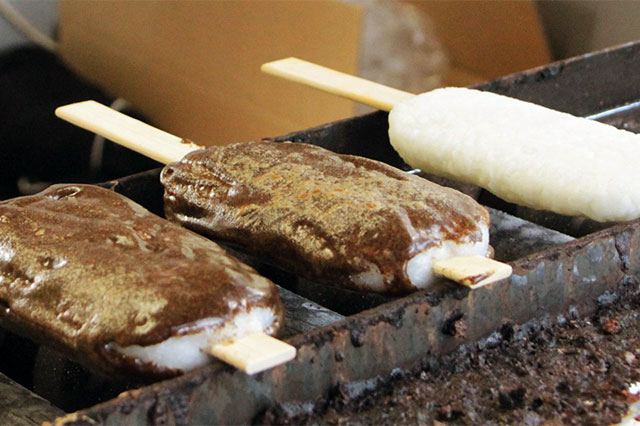
| Prefecture | Gifu (岐阜県) |
|---|---|
| Region | Chubu |
| Japanese name | 五平餅(ごへいもち) |
| Reading | Goheimochi |
| Home area | I'll be right back. |
| Main ingredients | It's not just white rice, it's orange, it's white. |
History and Origins
The native dish that was wrapped around the rice-cooking, with the roasting on it. Mainly eaten from the XNagano Prefecture Mr. Woodsa from the XGifu Prefecture, east of the Gifu Prefecture and Aichi Prefecture3 River. During the mid-Edo period, the central Alps in Nagano Prefecture, the woody regions and surrounding mountain ranges, and the woodcutters used to burn and taste and eat in a fire that had a piece of wood in it. In time, I was able to give up my job in the mountains and other things to pray for, and to be able to be eaten at the harvests and feasts of the new arrivals. It is generally said that the figure is similar to that of the idol, but there is also the theory that in the middle of the 16th century, in the 'Fight of the River, 'the Battle of Tsunami' and Tsubagakura, a man from Shikoku, started acting on his soldiers.
When It Is Eaten
After finishing the autumn harvest, I made the rice harvest in the newly acquired New Yorker, thanked God for the harvest and prayed for the next year's harvest, and filled people's stomachs. Not only is it a gift, but it's also a common meal for farmers. Today, visitors, including locals, are sold mainly on livable land, mostly on vacation grounds, and they are known to people outside the province.
How It Is Eaten
Forms vary in size, shape, shape, shape, shape, shape, shape, shape, and so on. There are three different kinds of citrus, taste, flavor, flavor, mix, but there are regions on the middle road, in the north, where it tastes a lot like oil, in the south, and in the south, where it eats a mixture of soy sauce and flavor. The secret taste is that the poplar and the phytoplankton are popular, but there are areas in the east where they use black wasp larvae, and it is also fascinating to see the unique flavor of the maker.
Recipe — Serves 4
Ingredients
- 320 g polished rice
- Sauce: 24 g peanuts
- Sauce: 12 g walnuts
- Sauce: 40 g ground white sesame
- Sauce: 2 g toasted white sesame
- Sauce: 64 g dark soy sauce
- Sauce: 80 g refined white sugar
- Sauce: 24 g sake
- Sauce: 32 g mirin
- skewers, to taste
Method
- I'm going to grind rice to the point where it's so sticky with saws and so forth. Hold the rice round. Put a bowl in the middle and wrap it up in the middle, and shape it into a strip.
- I'm going to burn it until the color is thin.
- Hanamoto, I'm going to crush the chrysanthemum. I'll cook the raw ingredients together.
- I'm going to burn it again, with three points on it.
More About Goheimochi
Goheimochi (Japanese: 五平餅) is a type of mochi made in the Chubu region of central Japan, specifically in Nagano, Gifu, and Aichi prefectures. Unlike regular mochi it is coated with a type of sweet and sour sauce, usually composed of sugar, soy sauce, and mirin. The mochi is then skewered and grilled. Goheimochi is typically made in one of two shapes: Waraji is shaped like a traditional sandal and rounded mochi is served on a skewer. The mochi is usually only half-cooked so that some grains of rice remain, the rice is usually short-grain rice giving goheimochi a firmer texture compared to standard mochi.
Varieties
Across the Chubu region there are many types of goheimochi. In the Kiso Valley and Hida region, goheimochi is often coated with soy sauce and sugar. In Aichi Prefecture, goheimochi is often covered in miso which is considered the region's specialty. Other examples of goheimochi sauce include honey, walnut, egg, and hachinoko (wasp larvae). Frozen goheimochi is now exported around Japan in vacuum sealed bags and can be found in supermarkets in Japan's larger cities.
History
Goheimochi was invented in the Edo Period, though its origins are unknown. Despite this there are a few theories regarding the origins of the dish. As the name of the dish is similar to that of Gohei (Shinto streamers) many theorize that the reason the dish was created as a form of money that was offered to Shinto gods. Another theory regarding the origins of the dish is that it came from the Japanese word for lumberjack, Gobei.
Cultural references
In the TV series Half Blue Sky, one of the main characters opens a goheimochi shop. This feature increased the dish's popularity outside of Chubu. The film Your Name is set in the Hida Region and characters are seen eating goheimochi in various scenes.
Text adapted from the English Wikipedia article Goheimochi by its contributors, licensed CC BY-SA 4.0.
Dish data: Ministry of Agriculture, Forestry and Fisheries (MAFF), “Uchi no Kyodo Ryori” (Our Regional Cuisines) database, used under the Public Data License (PDL1.0); translated and adapted from the Japanese original.