Takoyaki たこ焼き
| Prefecture | Osaka (大阪府) |
|---|---|
| Region | Kinki |
| Japanese name | たこ焼き(たこやき) |
| Reading | Takoyaki |
| Home area | Osaka City |
| Main ingredients | It's not just wheat, it's wheat. |
History and Origins
The taste of Osaka would be the first thing you can think of. It was a round bowl of iron plates, which was poured with flour melted with raw nuts and eggs, and then baked with chopped kites. I eat with sauce and mayonnaise. It's the soul food of the people of Osaka Prefecture. From the end of Meiji's life to the age of the Great Fukuoka, it was offered at candy stores and on the stand for the day's end, and it is also known as a sect from Chobo, which was popular with children. It's said that the fixed tools were connac, dry or dry, and that the flavoring was made with soy sauce in the dough and baked into flour. When radio broadcasts begin in Japan at the end of the great term, there is a "goo-roo-coo" restaurant named after the most advanced radio of civilization. Kuichi, in early Japan, in a barn in Osaka City, began to be sold "Kaki-Kaki" using a kite for radio cooking. At first, I ate nothing, but after the war, when the rich sauce was born, I heard that the present style of cooking was established, with sauce, blue, smoothing, and a hook on the fan. In time, it became known throughout the country as a Osaka masterpiece and became the nationally beloved food table.
When It Is Eaten
It's a local snack that you can easily eat. It's also widely absorbed in home cooking and many families own a kimchi shop. Today, more stores are providing burnout to major cities of the world, as well as to all parts of the country. Also, frozen cicadas, such as the United States and other restaurants and ramen stores have established themselves as side menus.
How It Is Eaten
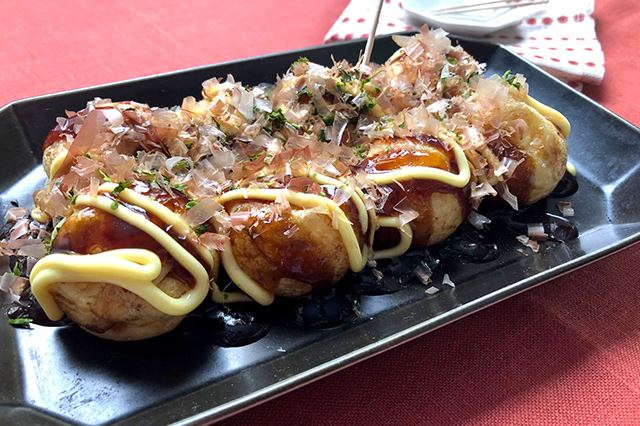
Heat the cooking pot in the kite cooker and lower the oil. Place the fabric in the mold of the kite-burner until the skin of the wax is hidden. Put a piece of the kite in one piece and then put it in the oven. When the edges are burned, I'll shape them into a round shape, putting in the thick fabric around them. Take it out into a vessel and apply a thick sauce with a brush and then place a blue powder on top of it and a sharpener on it.
Recipe — Serves 4
Ingredients
- Dough: 300 g cake flour
- Dough: 1,100 ml dashi stock
- Dough: 3 egg
- Dough: 2–3 g salt
- oil, to taste
- 200 g boiled octopus
- 60 g tempura scraps
- Mix: 濃厚ソース お好みの分量
- Mix: 青のり お好みの分量
- Mix: けずり粉 お好みの分量
- Mix: マヨネーズ お好みの分量
Method
- I'll cut the rice in about 15 mm.
- The eggs are melted well in the citrus, and then put in the order of thin powder and salt. The powder is sunk in the whole body and then mixed with it like a cut. I don't care. When you're done with the mix, I'll transfer it to a light cup.
- Heat the kite-burner to 220 degrees Celsius and squeeze the oil thinly.
- Drop a little fabric into the hole, and if it sounds "Ji-j-j-n-n-n-n-n-n-n-n-n-n-n-n-n-n-n-n-n-n-n." The whole plate is poured in so that it's buried in fabric. The fabric is often mixed before it sinks in because the flour is easily sunk.
- Soon put in the octopus and scatter the air over the whole thing.
- In about two minutes, the edges of the fabric begin to whiteen, so I put it back around the hole and cut the fabric all around the hole.
- I'll give it back quickly from the end of the hole. Don't give it back at once, but first you give it back 90 degrees and then you return it all. By returning 90 degrees before the whole fire goes through, the fabric in it can flow out and make a round roast. )
- After I've returned the whole thing, I'll keep returning it without rest. I'll put the jumper inside and make it a beautiful sphere.
- There's holes, and there's little fabric, and you'll have to take over the fabric.
- I will trade a well-burned hole with a non-burning one and then I will remove the roast.
- I'll add a little oil on the surface to make it teri and then cook it more gently.
More About Takoyaki
Takoyaki (Japanese: たこ焼き or 蛸焼) is a ball-shaped Japanese snack made of a wheat flour–based batter and cooked in a special molded pan. It is typically filled with minced or diced octopus (tako), tempura scraps (tenkasu), pickled ginger (beni shoga), and green onion (negi). The balls are brushed with takoyaki sauce and mayonnaise, and then sprinkled with green laver (aonori) and shavings of dried bonito (katsuobushi).
Yaki (焼き), meaning 'to grill', is one of the cooking methods in Japanese cuisine and can be found in the names of other dishes in Japanese cuisine such as okonomiyaki and ikayaki (other famous Osakan dishes). Typically, it is eaten as a snack or between meals, but in some areas it is served as a side dish with rice. It is an example of konamono (konamon in the Kansai dialect), or flour-based Japanese cuisine.
History
Takoyaki was first popularized in Osaka, where a street vendor named Tomekichi Endo (遠藤留吉) is credited with its invention in 1935. In the early 20th century, in Osaka, there were snacks called choboyaki (ちょぼ焼き) and radioyaki (ラジオ焼き or ラヂオ焼き, rajioyaki) that contained pieces of beef, konjac or other ingredients. Meanwhile, in Akashi in Hyōgo Prefecture, there was a snack made of an egg-rich batter and octopus, later named akashiyaki (明石焼き). Endo combined them and began selling it under the name takoyaki. It spread throughout Osaka, with various stalls making improvements, and after the Pacific War, the style of eating takoyaki with sauce and mayonnaise was established. Endo's takoyaki shop, named Aizuya after his hometown, still exists today and serves the original takoyaki without sauce or mayonnaise. Today, many shops offer different flavors of takoyaki, including ones filled with cheese or spicy seasonings.
Takoyaki was initially popular in the Kansai region, and later spread to the Kantō region and other areas of Japan. Takoyaki is associated with yatai street food stalls, and there are many well-established takoyaki specialty restaurants, particularly in the Kansai region. Takoyaki is now sold at commercial outlets, such as supermarkets and 24-hour convenience stores.
It is also very popular in Taiwanese cuisine due to the historical influence of Japanese culture. In recent years, takoyaki can be eaten with various toppings and fillings (such as cheese or bacon) as its cultural span has evolved in western parts of the world. The food, known as "octopus balls", quickly became popular throughout Japan.
Takoyaki pan
A takoyaki pan (たこ焼き器, takoyaki-ki) or—much more rarely—takoyaki nabe is typically a griddle made of cast iron with hemispherical molds, similar to a traditional Yorkshire pudding tray. The heavy iron evenly heats the takoyaki, which are turned with a pick during the heating process to pull the uncooked batter to the base of the rounded cavity. Commercial gas-fueled takoyaki cookers are used at Japanese festivals or by street vendors. For home use, electric versions resemble a hotplate; stovetop versions are also available, and many incorporate a non-stick coating to facilitate turning.
In popular culture
Takoyaki is the favorite food of Taruruto, the title character of the 1988 manga series Magical Taruruto. The food plays a major role in several episodes of the anime and a single tie-in film, and also serves as the many collectibles and potential platforms in several tie-in video games.
A children's book named Takoyaki Mantoman, published in the 1990s and later adapted into an anime television series produced by Studio Pierrot that aired from April 1998 to September 1999, focuses on a group of takoyaki fighting crime.
Image gallery
Text adapted from the English Wikipedia article Takoyaki by its contributors, licensed CC BY-SA 4.0.
Dish data: Ministry of Agriculture, Forestry and Fisheries (MAFF), “Uchi no Kyodo Ryori” (Our Regional Cuisines) database, used under the Public Data License (PDL1.0); translated and adapted from the Japanese original.