Home / Yamaguchi / Iwakunizushi
Iwakunizushi 岩国寿司
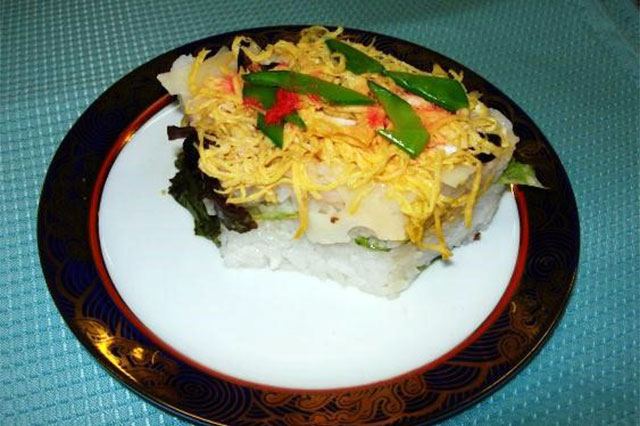
| Prefecture | Yamaguchi (山口県) |
|---|---|
| Region | Chugoku |
| Japanese name | 岩国寿司(いわくにずし) |
| Reading | Iwakunizushi |
| Home area | Iseland, Ikeland, |
| Main ingredients | I've got rice, fish, eggs, and a lot of eggs. |
History and Origins
Iwaji City, known as the eastern entrance to Yamaguchi Prefecture. It is a land of many historical and cultural heritages and even more beautiful nature. The famous symbol is the Archeological Bridge, built about 300 years ago. And it's called "Iwaji Iwaji." A report from the Edo to the Lord of Iwaji, who was delighted to present it to the Lord Iwaji, and a sushi called "The Master Sushi," says that it is a special rock country that has been prepared for its castles on the mountains and for its transporting by means of food that is convenient. It's been made as a celebration or a gift. It is said that to make a few adults at once, the wooden sushi frame is large and can be six feet tall. And when making big things, the craftsmen would push them on top of the lid. The sushi that has been made is served in a square, one by one.
When It Is Eaten
It is a dish that is used for celebration and is a traditional tradition from the Mexical era.
How It Is Eaten
We spread chisa leaves on the bottom of the sushi frame and then put rice rice in there with a mixture of aji and other ingredients. If you have a beautiful color, such as a rich silk egg or a thick egg, or a special rock country, or a bowl of vinegar, then you will put a chisha leaf on it again, and then you will put a wooden lid on it and then put a weight on it. The rice is basic, and the cook in white feet on top of the lids will stick his feet and pull the frame out of his head. When making them at home, they will be replaced by lunchboxes, squares, milkpacks, cake-likes.
Recipe — Serves 4
Ingredients
- 300 g rice
- Mix: 400 ml water
- Mix: 3 g kelp (konbu)
- Mix: 1 tbsp sake
- 50 g lotus root
- Mix: 1 tsp sake
- Mix: 2/3 tbsp sugar
- Mix: a pinch salt
- Mix: 2/3 tbsp vinegar
- 2 egg
- 1 tsp vegetable oil
- 8 g snow peas
- 4 dried shiitake mushrooms
- Mix: 100 ml shiitake soaking liquid
- Mix: 1 tsp sake
- Mix: 2/3 tbsp sugar
- Mix: 1 tsp2/3 soy sauce
- Mix: 1/2 tsp mirin
- Mix: 2 tbsp2/3 sugar
- Mix: 2/3 tsp salt
- Mix: 3 tbsp vinegar
- 20 g ちしゃ (lettuce)
- 5 g denbu (sweet fish flakes)
Method
- I'm going to wash rice and not have to wash it once before I drain it. I add a little bit of abscess.
- I'll water the dried surface back.
- I'll cut it in half-month. We boil the water in a small pot, add a teaspoon of vinegar (over half a teaspoon) and boil it in about two minutes. After the water is cut, it's soaked in a good mix of lye B's and flavored.
- I'll make a silk egg. I'm going to make the eggs tender with melted eggs and oiled egg pans.
- Put in boiling water one bit salt (in boiling water) and stir a little soy sauce and cool it with cool water. To make it easier to eat, cut one into two pieces at an angle.
- If you have put it back in water, cut the water in a fine three-millimeter width and boil it until it's dry.
- I'm making vinegar rice. Put the sieve in a pot and heat it up and melt it well. When the rice is ready, I'm going to sink into the rice bowl that I've made with water. I'll put in a citrus and mix it quickly so that I can cut it with a bow.
- I'm going to dip in a sushi container, put half of my rice in a bowl, fill in half my clothing, and scatter it in order of the rich silk eggs and the squabbles. After pressing it, you put in rice and the rest of your gears, you scatter it, and press it again. Sakura and Powder will be the last to roll as a color from above. If you don't have a type of sushi, you can also use a method of packing a wrap into a bottomless cake or on a piece of cake.
More About Iwakunizushi
Iwaji is a type of sushi made around the city of Yamaguchi Prefecture.
There are theories that the food preserved by the First Iwaji Manuji of Iwagawa Iwato's first Japanese family has spread to the people of the city.
Although many locals call it the "Change of the Horn," a slightly different method is used to make a small amount of sushi in the Hiroshima area.
Origins
In addition to the idea that the food preserved by the first Iwayani Shinmoto's host has been prepared for the war has spread to the people of the city, there is the theory that Iwaji, at the festival held once in 33 years in the Hajigigi, was born as a sushi that could be preserved because he said, "The festival is for fire precautions and must not smoke during the sun."
About 380 years ago, Ishiba was used to distribute vegetables to rice and roots in Iwaji, to feed fish in the vicinity, and to save food.
The reason why it was preserved was because of the Mountain Castle and because it prepared for a battle on a rock castle where water was not available.
Processing Characters
In large wooden frame, you can make a vegetable, such as spring, or Iwaji roots, mushrooms, and silky eggs, piled in layers, then pressed with sandwiches for a while, and then cut the wooden frame into a single size.
In order to cut the large mass sushi that has been produced into one by one, it has become an indispensable traditional dish in rock country for people to gather in the Hare.
Colored with rich silk eggs and cut them into pieces, shrimp and other things can be left behind, while the eye is a skimming wind and the eye is bright.
Text adapted and translated from the Japanese Wikipedia article 岩国寿司 by its contributors, licensed CC BY-SA 4.0.
Dish data: Ministry of Agriculture, Forestry and Fisheries (MAFF), “Uchi no Kyodo Ryori” (Our Regional Cuisines) database, used under the Public Data License (PDL1.0); translated and adapted from the Japanese original.