Barazushi ばらずし
| Prefecture | Kyoto (京都府) |
|---|---|
| Region | Kinki |
| Japanese name | ばらずし |
| Home area | Postponing Areas |
| Main ingredients | I'm going to try to make them look like this. I'm going to make them. |
History and Origins
In the latter part of the island, which faces the young Gulf, the Saba was well grown and were known as old and common fish. In the days when refrigerated technology was not developing, Saabbas may be fast-driven, and the carpenter thought of a long time to enjoy them. The dish that was born after the salting was added and added to it, was also the dish that was produced by the carpenter's master for longer taste of the saba, but cooking was also a way of saving. They say that they either baked and salted them and carried them inland. That is why there are a lot of native dishes used in cooking and cooking around the city streets. It is characteristic of making "nuts" with a native dish made from such a roasted saba and a tasseled cherry and colorful materials. Use unique tools, such as a wooden shallow wooden box called a citrus tree, cut out of the wood (for separating the rice) and a teechi). The local people often call it a "naked" but it is officially called "singing." There is a strong theory that "noodle" is derived from the idea that it will scatter the rags of the implements and sabbaticals on top of the rice, but it is also because of mixing the unspoiled rice called platé. In the past, I cooked the sabbatical for long periods of time, but recently I often use cans. So local supermarkets and other locals are selling huge, size - size cans that are not found elsewhere.
When It Is Eaten
Even now, they are eaten on celebration tables, such as festivals and weddings. In addition, it's a regular meal for large numbers of people, such as festival and athletic events, New Year's, trays and other seasonal events, birthdays, and so on.
How It Is Eaten
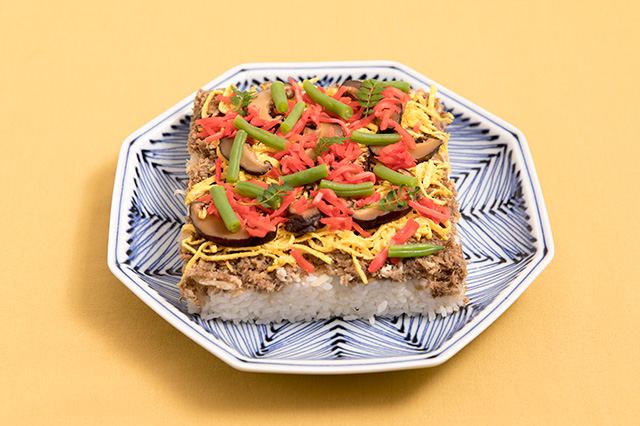
In the process, they spread the rice thinly, and then on top of it they scattered the powdered sabbatical that had been cooked sweetly, dried and dried, and the silky eggs, the peppers, and the reds, and then they scattered the season's ingredients in a fine color. Sometimes they're made in sections, but sometimes they're conscious of the crossing when they are cut, and they're held in two between rice and rice. If possible, cut and cut. It's necessary to use the macabre, but whether you use any other material or side or side, it's different for each family.
Recipe — Serves 20
Ingredients
- 1(1.5 kg) rice
- Mix: 280 ml vinegar
- Mix: 280 g sugar
- Mix: 1 tbsp salt
- 440 g 1 cans 味付けサバ缶
- 5 tbsp sugar
- 5 egg
- 45 g kanpyo (dried gourd strips)
- 100 g burdock root
- 20 g dried shiitake mushrooms
- 70 g pickled red ginger
- 青物 (sansho leaves), to taste
Method
- I cook rice while it's hot. I mix vinegar A.
- Aki will be turned back in water and cut small. I'll give you a little bit of a hug. I'll cook it in the soup together.
- The dried bowl is brought back in water and chopped and boiled in soup. With sugar and soy sauce (more than enough) you can add flavor.
- I will roast the saddle can in a small pot of soup. When the water is loosed, add sugar. Finally, by mixing one white egg with another, I make a powder.
- I put a little salt in the remaining egg and I make a baked egg.
- I'll cut the red pepper into pieces.
- If the vinegar meal is a little cold, I mix it with a cane.
- You can wash the crushed wooden box with vinegar, put seven on top of it, put it in a dry order, then put it in a silky order. If you don't have a bite, put the rice in a plate and put the paint on it.
More About Barazushi
Sung - Su - Su - Su - Su - Sa - Ra
Cooking
Soyoshi Ko, a type of sushi. It is often a sushi that mixs a wide variety of vegetables, fish and other ingredients into a rice dish. Okayama Prefecture - home dish of Okayama Prefecture. I don't have to be prepared. The Kasai-san, Okayama City's trigonobisac shop, has to be manufactured. - Kyoto Prefecture, native food. I don't have to do anything after work. Tokushima Prefecture - native dish of Tokushima Prefecture. The beans are made in golden when they are boiled with soy oil and sugar.
CENTRAL
Text adapted and translated from the Japanese Wikipedia article ばらずし by its contributors, licensed CC BY-SA 4.0.
Dish data: Ministry of Agriculture, Forestry and Fisheries (MAFF), “Uchi no Kyodo Ryori” (Our Regional Cuisines) database, used under the Public Data License (PDL1.0); translated and adapted from the Japanese original.