Home / Miyazaki / Chikinnanban
Chikinnanban チキン南蛮
| Prefecture | Miyazaki (宮崎県) |
|---|---|
| Region | Kyushu & Okinawa |
| Japanese name | チキン南蛮(ちきんなんばん) |
| Reading | Chikinnanban |
| Home area | All within the province. |
| Main ingredients | (Customer) |
History and Origins
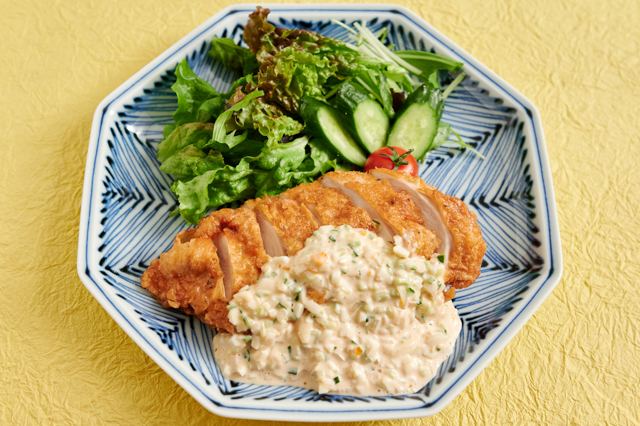
It's known from the birth of Saooka. It is believed that in the 30s of the Showa Showa period, in an ocean restaurant in extended Okaoka, it began to be made as a good dish. It seems that at that time it was called "susten from chicken" but then it became popular with today's style, with tartar sauce and salads and so on. In the '40s and '40s, I passed it as a family outing menu, and soon it became a common menu for restaurants throughout school meals, home cooking, and in the province. The "south of South Africa" in chicken South Africa is a word that describes Portuguese and their culture that originally came to us during the war years. Among the food cultures they brought with them is "snatched South" which is made of peppered sweets and is cooked with chicken, so they are said to be called "Chinese South Korean."
When It Is Eaten
They are eaten as a daily meal at home, at meals, at meals, at restaurants, at school, and at school.
How It Is Eaten
I'll fry the chicken and dip the eggs in sweet vinegar. After shake of flour, it's easier to swallow sweets and improve the taste of the vinegar by mixing the eggs with the juice. Originally, it was common to use beef, but now it is more fat and sometimes it is more meat, and it is more meat. There are two general "Chinese Southern Fabs" with tartar sauce and a simple "Chinese South Korean" system that can be tasted only with sweet vinegar. In each restaurant, there is a viscosity in providing original sauce and in making sure that the chicken South Korean curry and so forth.
Recipe — Serves 2
Ingredients
- 240 g chicken breast
- 20 g cake flour
- 34 g egg
- 0.4 g salt
- 0.4 g pepper
- oil for frying, to taste
- Mix: 36 g mayonnaise
- Mix: 2 g ketchup
- Mix: 3 g sugar
- Mix: 10 g() boiled egg
- Mix: 20 g() cucumber
- Mix: 20 g() onion
- Mix: 18 g soy sauce
- Mix: 18 g light soy sauce
- Mix: 9 g mirin
- Mix: 30 g vinegar
- Mix: 30 g sugar
- Mix: a pinch shichimi seven-spice chili
Method
- I make rice, rice, sugar, boiled eggs, mayonnaise, ketchup, and seasoning A.
- Put in ingredients for seasoning B and put them on a mixture and boil them once.
- Salt peppers on chicken meat, thin powder on thin flour, egg on eggs, and fried with 170 degrees oil. When it's up, we'll soak it up in the south vinegar.
- A dish is served with chicken meat cut from the vegetable juice, and salt sauce of seasoning A.
More About Chikinnanban
Chicken sesame is a chicken dish from the age of Miyazaki Prefecture, where the chicken chicken is boiled in oil and the chicken with its flour and melted eggs.
Tastes are usually served with sweets plus tartar sauce.
Overview
It was originally called "susten from chicken" but it doesn't use dough, nor does it use bread like chicken casserole. I'm sorry. After placing flour in chicken breast meat, they will take the melted eggs and boil them in sweet, sweet, sweet, sweet, sweet, sweet, sweet, sweet, and sweet, and taste them. It's common to use breast meat, but chickens can also use meat.
The Miyazaki Prefecture is the menu set in a restaurant or a restaurant, and in addition to making tartar sauce in each household, it is also spreading as a local dish and home dish. Home goods are sold in supermarkets and other grocery stores, such as tartar sauce for chicken mills and paddling hooks. In parts of Kochi Prefecture, including Shikoku, there is an ororora sauce instead of tartar sauce, and it is called chicken Nanban.
In addition to the Kyushu lunch chain, three different sources distinguish the chicken-sharp lunch and sell it as a limited product.
Besides the menu of the restaurant that provides Meinzaki's food in the capital and Kansai, it was adopted as a lunch box at a convenience store or a return lunch chain, which is now widely circulated throughout Japan. In 2007 it was selected as the "The Popular Cooking Chosen" of the Ministry of Agriculture, Forestry and Fisheries.
It's also used as a popular local dish for the people of Miyazaki Prefecture, and it's also used to feature local jokes such as, "It doesn't feel good to call a chicken South Korean dish a dish with tartar sauce on a chicken that's not hidden in sweet water." For example, if you're from the Miyazaki City Taliban, you don't like the "private" chicken nuggets. When I appeared as "The Man from Miyazaki," I began to get angry at the chicken-sharp food I encountered at Tokyo.
It's a birth shop.
There were theories about the origin of the chicken's "bings" that were served on tartar sauce and of the origin of "Nachan's" without tartar sauce. But "Dang" was discovered to be on the market about five years ago.
According to reference works, Chichi was born in '32, and was introduced in China, and Naji was born in '40, and then the wife of the founder, who was born in about 45.)
Ting.
The idea of chicken-sharp is called "The Chicken-Swang" by the brother of Kaji's founder, Akira. It was released about 40 years ago, and it was popular in 1942. It's possible that the originals were here because I'm old-fashioned with the owner of the restaurant "London," which was in a longer-lasting area. The tartar sauce is from the beginning, and the idea came from the place where the sulmica was put on a mayonnaise and eaten.
Nacchan.
One of the good dishes that appeared in the 'London 's '30s at a restaurant in Long Island was sweetened with chicken fried in clothing. After opening up his liquor shop in about the year 40 of the Showa, Toto, the founder of the "Law-chan" shop, was told that he had become an apprentice in London and had seen the root type of chicken-snap chicken, he sold it as a menu for around 45 years. They don't use tartar sauce when they're funded, but they pour in secret sweets. Now, the store's front sign also says, "The original chicken, Nanjo, Najiro."
Outside of Miyazaki Prefecture, there has been a spread of a salt sauce chicken, and the image of "a combination of tartar sauces and sweets" has become more popular.
An event in Sasoka City.
In any case, the birth of the island was in Prolongedoka City, and it was established as a local dish. In Saooka City, on July 8th, 2009, "Nao-chan" and "Dai-chan" were hosted by both parties, university personnel, cooking researchers, and "Depression Sympodium, the site of the birth of the chicken in the South Sea of China."
Text adapted and translated from the Japanese Wikipedia article チキン南蛮 by its contributors, licensed CC BY-SA 4.0.
Dish data: Ministry of Agriculture, Forestry and Fisheries (MAFF), “Uchi no Kyodo Ryori” (Our Regional Cuisines) database, used under the Public Data License (PDL1.0); translated and adapted from the Japanese original.