Nishime 煮しめ
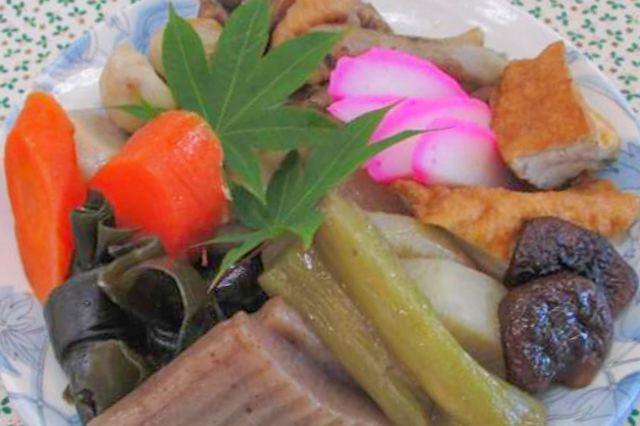
| Prefecture | Miyazaki (宮崎県) |
|---|---|
| Region | Kyushu & Okinawa |
| Japanese name | 煮しめ(にしめ) |
| Reading | Nishime |
| Home area | All within Miyazaki Prefecture |
| Main ingredients | It's a very simple process. |
History and Origins
To cook it slowly so that the soup doesn't leave, "I'll cook it" is called "sing" by the recipe. Now all of them are grown, but they were originally dishes that couldn't be celebrated or served as a wedding feast. It is laid on three sheets of New Year's cake and is provided for the whole night in Takaho. Also, it's a familiar and familiar taste, since it has been eaten as a lunch in between the fields of farm work and so forth. In addition, local materials are rich in character. For example, there are various sources of raw materials, such as lily chicken, chicken, dried chicken, salt eagle, sea eagle, and fish. As well as materials, there is a variety of dried-up in the northern part of the state, and chicken in the prefectures and in the western part of the village, Illusion in the country and in the region as well.
When It Is Eaten
It's often eaten on daily meals, but not on special occasions such as a celebration. The New Year's meal gives meaning to each dish and boils them together, so the wish is: "Let your family get along and prosper forever."
How It Is Eaten
I'll spend time boiling the soup so that it doesn't leave the soup with me. By making sure that the extra heat is there, the flavor gets even better. There are various localities, different family personalities, seasonal vegetables and so on. They are deliciously eaten and are known as the tastes of home.
Recipe — Serves 4
Ingredients
- 4 dried shiitake mushrooms
- 1 kelp (konbu)
- 50 g daikon radish
- 1 konnyaku
- 1/4 bamboo shoot
- 1 atsuage (thick fried tofu)
- 4 taro
- 3 cups dashi stock
- Mix: 2 tbsp sugar
- Mix: 2 tbsp light soy sauce
- Mix: 2 tbsp mirin
Method
- I'll keep the cloth dry and keep the water away.
- Keep the cut root flexible and back in water.
- I'll tie the cloth together and cut any other material into the right size.
- I'll put three cups in the pot, and then I'll put a bowl, and then I'll put a bowl, then I'll put a bowl, then I'll put a bowl, then I'll put a bowl, then I'll cook it for 20 minutes, then I'll cook it for 10 minutes.
- To taste A, taste it, and taste it in a smooth manner.
More About Nishime
Cooking is one of the dishes of stew. It's also one of Japan's typical household dishes. I often call them the sweetly boiled root vegetables, potatoes, sweets, cucumbers, oils and so on.
And while the basic recipes are the same, the last finish is the recipe that is used to make the paste with the paste called "same".
Overview
It's a cooked dish that keeps vegetables and dry foods from breaking down. It's called boiling the cooking process that takes time to cook slowly so the soup doesn't leave.
There are some dishes that are cooked together like roast chicken, when they are cooked separately. On this point, there is a case in which a pot distinguishs much of the food from "roast chicken" or "preboiled chicken," while there is also an example in which a soup is about the same as a chicken.
It's regional, such as in the bowl of Niigata Prefecture, where the casserole is used in the soup and in the casserole.
Fads
It is said that the origin of traditional cooking began with a few boils. In the construction of the heavy-box, it makes up either the heavy-sized part or the three-sized part.
A local meal.
- It comes from cutting the ingredients small, and it's called yuzu soup and yuzu soy sauce. For example, the Fukui Prefecture and so on, there are activities related to Buddhist affairs. It is sometimes introduced as a stew in the local food of the city of Hikoku-Yamaguchi Prefecture. In Iwaji City, we call them "oo-ha-ha." And yet in Tochigi Prefecture, it's called "wow" and it's called "wow."
Yum.
The basic cooking process is the same, but the last finish with the paste is called "heavy." Yuuki is called "saki" or "saki" and, in particular, in the Edo era, there was the letter "intensibly" with the letter "smell."
Text adapted and translated from the Japanese Wikipedia article 煮しめ by its contributors, licensed CC BY-SA 4.0.
Dish data: Ministry of Agriculture, Forestry and Fisheries (MAFF), “Uchi no Kyodo Ryori” (Our Regional Cuisines) database, used under the Public Data License (PDL1.0); translated and adapted from the Japanese original.