Igoneri いごねり
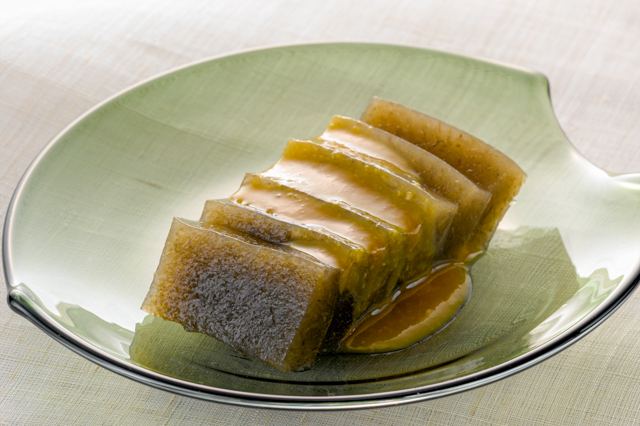
| Prefecture | Niigata (新潟県) |
|---|---|
| Region | Chubu |
| Japanese name | いごねり |
| Home area | XNiigata Prefecture all over. |
| Main ingredients | Weeds. |
History and Origins
The "Big" is a local dish representing the Sada, Japan, made out of rice plants from the Japanese Sea. It was built in each household from fall to winter. A chicken is a type of seaweed that grows in large algae like seaweed, such as sea cucumbers and Honda Walla, and is widely used around the Japanese Sea. In the Sasaki district, they call it "father" and in the Shinga area. I'll boil the weeds that I want to dry in the sun, boil them well, thin them, and cool them down, but I'll use the oil and the vinegar. It's characterized by a good sense of food, but it's not much, but it's a pleasant smell. It is said that the Kyushu's "trembling culture" came to the island through the Isle of the island of Haiku from the north by the traffic of the ships and fishing boats and passed it on to other parts of the island after the process.
When It Is Eaten
In mid- July and mid- August, we harvest grass, then dry it, and then make "cows" as needed. Originally built in families from fall to winter and centered around the crescendo, but recently, since manufacturers have been making it throughout the year, it has been eaten annually and has changed into everyday food.
How It Is Eaten
In Sado district, it is traditional style to roll a thin, tapered "brick" around and cut it thin like a seam. I'll give you some flavors, such as a steaming pepper, and then put some soy sauce on. On the other hand, in the mainland, after boiling the rice, it is the main flow, after boiling it in hot water, to cut it into pieces and eat it with poppy and vinegar. Recently, some of the black honey-sucking sweets have been sold, and new ways of eating the vanilla ice cream have been developed. There are dishes to eat with a thinly cut "Schoolchochochocho" called "Samaji"
Recipe — Serves 4
Ingredients
- 100 g いご草 (えご草)
- 2 L water
- as needed 長ねぎみじん切り
- as needed lemon
Method
- Put the bowl in the bowl and take the trash with the running water.
- Water is poured into the pot, boils it, boils one, and if it's in the pan, stop the fire and water it for about ten minutes.
- Once again, the garbage is taken from the fire and is baked with a weak flame. If you put the right water in the water and wet it so it doesn't get rough, you'll have to stop it.
- I'll cut three into a steel-stamp or a gold tray. If it hardens, it will be cut into 15 cm angles and roll like a roll. I'll cut it with a half-inch veil and put it on the board. I'm going to eat it with soy sauce.
More About Igoneri
Yuuki and Mauri, or Mako, is a local dish eaten mainly on the Japanese Seaside and in Sadoshima. It's an algae-processed food.
Overview
Ishikawa Prefecture climber ZX080X MAC, SAUC) eaten in large areas, such as Yamagata Prefecture066X064X XZZQQ58X and Nagano Prefecture NorthX. In Sado districts, such as the "father" and the other areas, it is called the "Sip" and so on. It is said that the Kyushu padlocks, by the traffic of ships and fishing ships, were passed from Hakata through the Isle of the Isle of Tsukishima to the Sadami, and from there to the other parts of the country. Even so, similar foods are found all over the country.
Because of low calories and abundant fiber, more people are eating for diet.
In Nagano Prefecture I've chosen the name "Syapama" for "Choose Un-Currential Cultures."
Processing
The traditional food that we eat is a traditional dish that is boiled into dried grass, and is made by cooling the well-finished food. Some sites introduce them as box-shaped, while the pupa is thin.
How to Eat
In Sashishima and the mainland, eating a thin form of food is common on a thin strip, and on a thin piece of sashimi, and on a thin piece of soft - mouthed or raw oil, but on the soil it is common to cut the box into sashimi and eat it with pontoons and citrus and citrus oil.
It can add flavors such as plywood to your taste and add to the harmony.
Text adapted and translated from the Japanese Wikipedia article いごねり by its contributors, licensed CC BY-SA 4.0.
Dish data: Ministry of Agriculture, Forestry and Fisheries (MAFF), “Uchi no Kyodo Ryori” (Our Regional Cuisines) database, used under the Public Data License (PDL1.0); translated and adapted from the Japanese original.