Kishimen きしめん
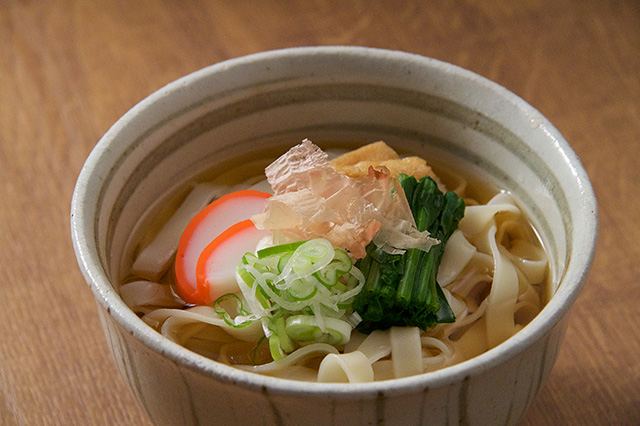
| Prefecture | Aichi (愛知県) |
|---|---|
| Region | Chubu |
| Japanese name | きしめん |
| Home area | All within the province. |
| Main ingredients | You're a pain in the ass. |
History and Origins
A flat rice that is about one millimeter thick and seven to eight millimeter wide is called a "knit." It is said that the Aichi Prefecture soul food eaten throughout the province is roots. There are various theories about the origin of the name "Kyoko" but it is said to be derived from the Chinese sweets. This is a dish with a bowl of flour and stretched out flat and cut through the shape of a rock with a bamboo tube and then boiled with a cucumber. It is said that the Aichi Prefecture caused the "pig" to pass through because the sauce is more flavored and tastes more firmly flavored to the local people. In the old-fashioned way, the sea cucumbers taste in a bowl of muroazi. This is because the taste is so thin when it is in the mouth for a flat noodles, it is said that the juice had to be made into a strong flavor. The muroji is characterized by a thick, more distinctive soup that is more distinctive than a casserole. While the soy sauce is made from soybeans and wheat, the mass is almost made of peas, and is a milder flavor and a unique flavor. This combination of the soup and the thick paste will complete the thick paste.
When It Is Eaten
We can eat regularly throughout the year.
How It Is Eaten
Generally speaking, I'll have frozen noodles or dried noodles. It makes me feel more native to me than to smell a particular red fox peculiar to Nagoya. Today, in addition to rice made from muroage and lumps, it is often made of soup and soy sauce. Also, there are a lot of variations in the range, such as "Current" and "Current" and "Calvonar" and "Current" and "Calvonar" and "Calvonar" In addition to the warm "knee," there are also the coldest "times," which are eaten in the summer when appetites are low.
Recipe — Serves 2
Ingredients
- 2 heads ゆできしめん
- 50 g spinach
- 40 g kamaboko (fish cake) (赤)
- 1 aburaage (fried tofu pouch)
- green onion, to taste
- Mix: 1 tsp soy sauce
- Mix: 1/2 tsp sugar
- Mix: 50 ml dashi stock
- Mix: 800 ml dashi stock
- Mix: 1 tbsp soy sauce
- Mix: 1/2 tbsp mirin
- Mix: 1/2 tsp salt
- 6 g bonito flakes
Method
- The spinach is soon boiled and cut to three centimeters long. I'm going to cut the pepper into semimoon slices.
- Oiling is quickly boiled, oiled, short bounded, and boiled with A.
- Put B in the pan, and let it boil, add some steam, and cook lightly.
- I can put three in a bowl, put one and two on top, and put a katsaw on top.
More About Kishimen
The daikon is a type of silkworm with a wide, thin, flat shape. And the dish that used the noodles points to. In Aichi Prefecture, the Aichi Prefecture is one of the best. It is also admitted that for products produced with Aichi Prefecture, they will show it as "The Great Master."
Nanono is also called a plywood, and is classified as a kind of rice in Japanese agricultural standards and justice trade committees. There are various names that exist throughout Japan, such as the Kanto region's "chafting" and Yamanashi Prefecture's "shoe" and Okayama Prefecture.
Standard
In Japan, dry cinders are classified as the dry season defined by the Japanese agricultural standard JAS. "Screws" are believed to be based on salts and powdered vegetables, and followed by additives.
According to the Cabinet Office's "Food Display Standards," the method used by hand is classed as "Slowing" in the process of making the flour into flour, mixed with salt and water, and applied well - prepared dough or oil or flour, stretched over it, dried and riped, and stretched it out by hand.
The Food Display Standard is supposed to be a "cute" and "sow" in principle, but what meets the following conditions can be displayed in such terms as "stuffing" and "extreme." If the width is more than 4.5 millimeters and the thickness is less than 2 mm, then the "stuff" can be shown. If you are in a drought, you can see the "extremely" feature.
For example, in the "Just Raced Law on Displaying Noodles" and in the "justice Races of Soybeans" and in the "Symbourn" section, it says, "You can replace names that are not misapproved by the common consumer. "
However, if you want to show it as a masterpiece in Nagoya, a special, adversarial, or a masterpiece, you need to meet the following requirements based on the rules of fair-competition regulations.
The material flour produced in Aichi Prefecture (sharp) - over 8.2 percent protein, less than 0.38 percent salt - a 40 - percent increase in the body weight of the material - a 30 percent or more for the material weight, a half an hour or more, a half or more, an hour or more, a half or more, a pair of teeth, a quarter to a quarter - a - half - hour - a - hour - a - half - hour - a - hour - hour - hour - hour - hour - hour - a - six - hour - hour - hour - hour - hour - hour - a - hour - hour - a - half - hour - long - hour - hour - hour - hour - hour - hour - hour - hour - a - hour - hour - hour - hour - hour - long time - hour - hour - hour - a - hour - hour - hour - hour - hour - hour - hour - hour - hour - hour - hour - hour - hour - hour - hour - hour - hour - hour - hour - a - hour - a - a - a - hour - hour - a - hour - hour - hour - hour - half - hour - hour - hour - hour
Cooking
Because of the thin shape, it's less time-long than the udon. Water, flour, and salt are made in the same way as silk, but in order to keep them flat, the water rate has been raised, and the rice has a smooth surface, and the rice has a smooth surface.
It's usually the way you eat a chicken, a chicken, or a chicken, or some other dish. In Nagoya, it is often followed by nationally, because of the use of the tinglings of the mid-colors of Western and eastern Japan. There is also the same dish cooked as rice, and you can also eat it as sweets such as chicken, chicken, chicken, and so on. The cinnaise absorbs water more easily than the rice, although it requires workers to cut down on the juice or to cut time with the rice, but there are many similar recipes and also sold in stores.
History
The Edo's "Enquist Islands" is attributed to the potato River and is also referred to by the "Create Man."
In the late Edo, we called it "chattering" in Edo, but in the "Stamping" book it is described as the accent of the river, and in Nagoya it is called "String."
Origins
The origin of each theory is not certain.
For example, Kato Toshito, from the University of São Paulo, speaks of the famous Edo, Aichi Prefecture Shenzhou, who was famous. The flat rice that was made there was called "Sumbo" and was known as the island since the early Edo, and the contemporary book "The Laughing Book" also says, "Is it the Edo?" The place of the "Susap River" is now a cold, but there are stories about the Edo literature in Akiyama and in this city and elsewhere.
On the other hand, the Nagoya City Education Commission claims that it has spread to Nagoya in the city of Nagoya, where it has been described as the "Cystic" section of Nagoya.
Source of the Language
The root words are, "Because the root was not noodle, but stone-like," and "from the words "from the beginning" and "from the beginning" and "from the beginning, "from the time of the Buddha's making" are the words "from the beginning of the beginning.
Text adapted and translated from the Japanese Wikipedia article きしめん by its contributors, licensed CC BY-SA 4.0.
Dish data: Ministry of Agriculture, Forestry and Fisheries (MAFF), “Uchi no Kyodo Ryori” (Our Regional Cuisines) database, used under the Public Data License (PDL1.0); translated and adapted from the Japanese original.