Komodōfu こも豆腐
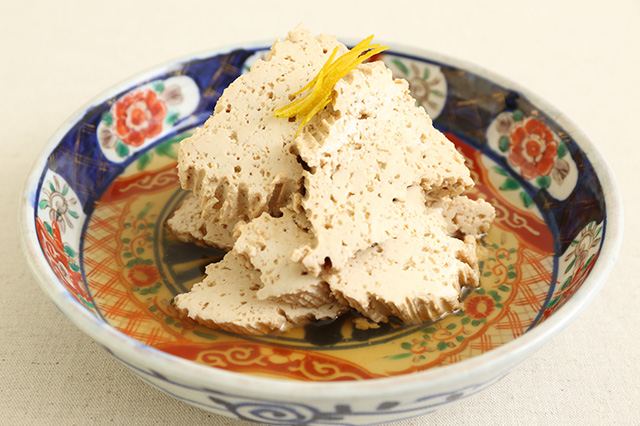
| Prefecture | Ibaraki (茨城県) |
|---|---|
| Region | Kanto |
| Japanese name | こも豆腐(こもどうふ) |
| Reading | Komodōfu |
| Home area | All within the province. |
| Main ingredients | Tofu. |
History and Origins
With a mild climate and rich water quality, the year-round, the Ibaraki Prefecture farm has been established. There are crops that are famous for their growth, such as cicadas and peppers, but there is also a local local crop of peas, which is the source of natto, representing Ibaraki Prefecture. The little bean is made into natto, and the large bean is processed into tofu. One of Ibaraki Prefecture native foods with such large beans is "rentain tofu." "The tofu tofu" was wrapped in salt and wrapped in natto. It was called "one and tofu." In addition to Ibaraki Prefecture, it's made up of parts, such as Fukushima Prefecture, Gunma Prefecture, Gifu Prefecture. Tofu is said to have been born 2,000 years ago in China during the Han period and then also brought to Japan through the Nara period through a passer. The temple's elaborate dish eventually spread among the poor, and it was said that by the time Edo, the tofu shop was already growing. When meat was not easily obtained, tofu was an important ingredient for getting protein protein. But because of not having much of a day, everyone in the village is said to be born from the support of the common people, to bring the meat together, to spread the tofu and to make it into a large pot of salt.
When It Is Eaten
In Fukuoka, province, it has been known as the dish for the Memorial. However, since it's difficult to get a job these days, I've had less opportunities at home.
How It Is Eaten
The chopped tofu is loosed, and then wrapped in a bowl and wrapped around it. In boiling water filled with salt, a bowl of tofu is poured into it and is boiled firmly. The tofu is made up by boiling salt, so when it is used, it is taken out and cooled off and removed from the bowl. Finally, the soup will be served slowly, including the soup, after a night's sleep and then eat. When you eat, it is common to eat with soy sauce and vinegar. If you remove the tofu from the citrus, the leaves of the leaves will produce a beautiful pattern, but if the scent of the skin and color of the leaves are transferred to the tofu, then it will be a simple taste. Also, when you fold the tofu into a pot, when you add twigs, beans, and carved carrots, the cut will be pale. Because of its other flavorability, various ovens are enjoyed, such as oiling them or putting them in meat tofu. In a non-surprising private home, sometimes people use wrappings and stuff. If you want to use a wrap, you first boil tofu and wrap it around what you've become, and make it tastey.
Recipe — Serves 4
Ingredients
- 4 blocks tofu
- Mix: 1 cups soy sauce
- Mix: 1/2 cups mirin
- Mix: 1 cups sugar
- Mix: 1/2 cups sake
- Mix: 2 cups water
- straw
Method
- Clean the straw and cover it.
- The tofu is so hot that it will have to be cold before it gets cold.
- The rotten tofu is placed in a bowl and tightly threaded with silk, and I'll keep it for half an hour.
- I put seasoning A in a pot, and if I get up, I put tofu from the rice bowl, and I cook it until it tastes good.
- Cut to size easily eaten.
More About Komodōfu
And tofu is a local dish of Fukushima Prefecture and Ibaraki Prefecture. The tofu was wrapped in natto and cooked with salt. It's eaten in a stew in High-Sided Town, Miyagi City, in Gunma PrefectureYZ.
I'm going to talk to you about sequito, a local dish of Gifu Prefecture and Tottori Prefecture. Or even Ibaraki Prefecture, they can call it tofu.
Overview
Tofu was an important food for eating proteins, but it was a challenge not to have it in the day. It is said that it was the birth of the plant that brought with it the tofu that came to be made from a large pot of salt.
It is heated to make the tofu hard, and it has an aceta. You can make the sauce taste better by putting the soup in the sauce. Also, the surface of the tofu has a straw pattern, but this pattern also has a flavoring effect, and it helps to improve the flavor.
Fukushima Prefecture
The rice and tofu are native food from the Fukushima Prefecture region. I used to wrap the tofu in a straw wrap. The trace of the straw becomes the appearance of a pipe roll.
In Isezu district, celebrations and Buddhist activities are made in each household and are also used in a number of soups called citrus.
There is also a tofu dish called a citrus, which is made into a bar of sweet wine, mixed with a tofu, boiled with rice or rice, boiled with rice, and cut out with a little tofu.
Ibaraki Prefecture
In the Ibaraki Prefecture Central region, food used to be popular for the Memorial feast has been reduced in recent years when homes have become difficult to obtain.
The Ibaraki Prefectures don't put much ss in them, but they are fed on the surface by flavorings such as sugar and so on.
Gunma Prefecture
Gunma Prefecture
It is estimated that what was dedicated from the Shogunji to the castle of Takasaki during the Edo period was passed across the city. It seems that by the end of the Edo, it was spread as food for the common folk. There are stories about a tofu shop that has been resuscitated from the boulders and opened and found that there is a fresh - month diet and tofu in Takasaki and that it was prepared and sold by candle.
If cut diagonally, it resembles the shape of a small test, so it's also known as trigonometric tofu.
In addition to boiling utensils, they're also eaten as wine bowls with soy sauce.
Tofu (Gunma Prefecture)
I used to wrap the tofu with a sieve tofu and season it with sieve oil and sugar. It's eaten in a single slice, like sashimi. The sense of food like a cold is characteristic.
Gifu Prefecture
Tofu is a native dish of Gifu Prefecture. I used to wrap tofu with straw.
The skin of the tofu is characterized by the skin of the straw and the scent of the foam that is in it.
It is believed that the first time you made tofu at home is when you gathered the leftovers and wrapped them in a fold. In Tsukiji, people like Bons and New Year often act when eating together.
On New Year's Eve, it is also used in cooking and cooking, as well as in cooking and cooking. It is also a local hospitality dish, including celebrations and Buddhist matters.
It's also sold at supermarkets, and in addition to regular tofu, it's also sold after flavoring.
Wakayama Prefecture
Wakayama Prefecture tofu is a colorful native dish by mixing carrots and gobou with tofu.
Tottori Prefecture
Tofu is a local dish around Tottori PrefectureBakuy.
The Tottori Prefecture had a lot of fish, and tofu was valuable as a protein source. Each village had a community tofu hut, and the tofu was made in large quantities.
In the past, when people gathered for festivals and weddings, and on Hale's day, it was always prepared, but since supermarkets appeared in the 30s, food supplies and consumption became easier, the tofu was gradually not made.
Sometimes we will eat with a slice, or with a sashimi oil or something, but we will boil it with a flavor made with sugar or sesame oil. The material is marked by carrots and gobouss, but sometimes you can add vegetables in the season and so on. There's a smell of straw in the tofu, and its flavor is distinctive.
Oita Prefecture
Oita Prefecture tofu is cooked in a low-frequency soup for a long time.
A rare tofu.
The Edo's "Streak of Tofu" is also listed as "tofu" as "tofu." This is a dehydrated cotton tofu that is broken, sweet wine and a little salt added to it, mixed together, and rolled around with a stick.
References
The Japanese family dish of 2019, published by the rural villages Society of Japanese Science. ISBN 978-4540191886.
Text adapted and translated from the Japanese Wikipedia article つと豆腐 by its contributors, licensed CC BY-SA 4.0.
Dish data: Ministry of Agriculture, Forestry and Fisheries (MAFF), “Uchi no Kyodo Ryori” (Our Regional Cuisines) database, used under the Public Data License (PDL1.0); translated and adapted from the Japanese original.