Korogaki 枯露柿
| Prefecture | Yamanashi |
|---|---|
| Region | Chubu |
| Japanese name | 枯露柿(ころがき) |
| Reading | Korogaki |
| Main ingredients | Miyagi. |
History and Origins
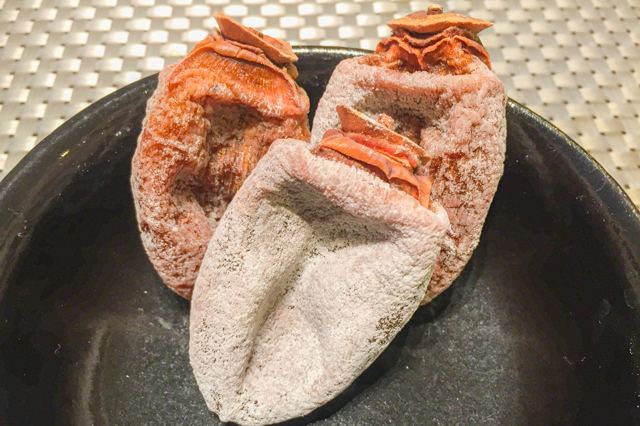
"Sunning" is common in the city of Chihua and South Alps. It is a candy - colored dry season with a large variety of seeds. The same dry season, with 50 percent softness, is called "silver," with a water content of 25 to 30 percent, with a sweet ingredient making crystallized white dust, and it is called "screw" and has been dry for a long time. It is said that the name "swallow" comes from the fact that when it is dried in the sun, the skin is arranged so that the sun's sun can be set on the whole surface. In the Matsuri region of Koyu, in the capital of Chihua, the big tundra will be taken, so it has long been known as the famous source of the "Daiji"; and from November to December, the sun - droughts on the fronts of the people's houses will be an orange curtain; and the autumn flavor will be popular.
When It Is Eaten
The end result of the "swallowing season" is sold from mid-December to late January and can be eaten. These days, storage techniques such as wrapping them can be developed and can be saved for about a month. If it freezes, it will last about a year. It's too sugary to freeze.
How It Is Eaten
About November, we harvest the ripe, redished plant in T characters, and then we dig through it, leaving only the tip of our ass skin and skin it. If possible, I'll let you take a bath in hot water to prevent caviar and to remove the under-the-side clavules. The plastic string is tied in a ring, and on both ends a T-stylus is tied together and tied together to a scythe, and the sun is set at the end of the house. You can take the rope off the rope and remove the string from the string and cut the stem with a slat and take off the mold in a small test. If it were, it would be wrapped between the rice bowls, and the powder would be so thick in cold and dark places. Sometimes you can put it in the "sour" of a traditional dish and make it "scroll" or put something hard on the ground.
Recipe (see source)
Ingredients
- as needed (60cm) plastic Strings
Method
- About the middle of the month, we harvest a full reded bush in T-letters.
- If possible, I'll make sure that I have a cavitto and a flat-stab on the surface to make it easier to handle. The skin is efficient when using a peanut. (If you make lots of them, you can get them to work with plastic gloves.)
- The plastic string is tied in a ring, and on both ends a T-stylus is tied together and tied together to a scythe, and the sun is set at the end of the house. (It's a good idea to keep the two of you dry.)
- With carefulness not to fall on the rain, I adjust the sun to the whole surface of the sea, and when it becomes soft about a week or so, I start to see my fingertips. It takes about a month to dry until your favorite softness. (Student December)
- You can take the rope off the rope and remove the string from the string and cut the stem with a slat and take off the mold in a small test.
- Then wrap it between the rice and let the powder fill in in cold and dark places. (End of the year)
Source: MAFF “Uchi no Kyodo Ryori” (Our Regional Dishes) database.