Okyu-to おきゅうと
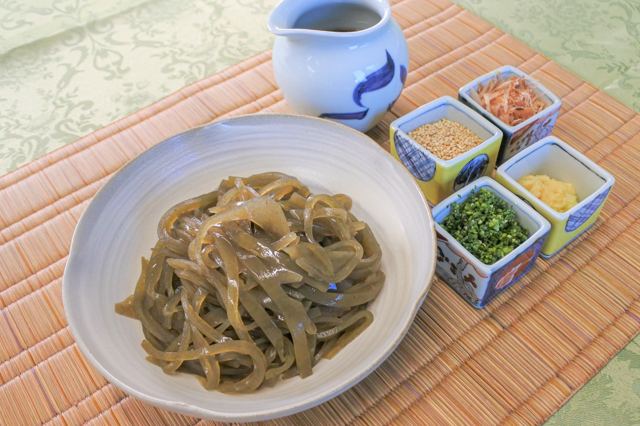
| Prefecture | Fukuoka (福岡県) |
|---|---|
| Region | Kyushu & Okinawa |
| Japanese name | おきゅうと |
| Home area | Fukuoka City |
| Main ingredients | I'm not sure if you're going to be able to do that. |
History and Origins
"Supreme" is a food that has dried and boiled and hardened the algae, and is a native dish of Fukuoka Prefecture on the sea. It's also called the "Sun-supreme" and until the time before the Asian and Pacific War, there were "Supres" and "Supres" sales every morning. It used to be an essential thing for breakfast. There are also theories of how fishermen were called "out of the sea" and "out of the sea" because they made food and saved many people from starvation in times of famine and food shortages.
When It Is Eaten
I've been eating breakfast all my life, but now I'm losing the habit of eating it. Since "suppose" is rich in fiber and low in protein, it is also best for diet foods, and also served in restaurants, such as restaurants, you can eat in the year of year.
How It Is Eaten
In Fukuoka City, an egonori is rolled and sold, and it is eaten with a slice when eating. If you cook a baked fish, it will be more delicious. The "single" characters use the flavors they like, such as citrus oil, pong wine, mayonnaise, or pepper oil.
Recipe — Serves 3
Ingredients
- 200 g おきゅうと
- 50 ml vinegar
- 50 ml soy sauce
- Condiments: 3 g sesame seeds
- Condiments: 3 g green onion
- Condiments: 3 g ginger
- Condiments: 3 g bonito flakes
Method
- I'll cut it into pieces.
- I'll put vinegar oil on and serve you the kind of roast I like.
- You can choose a card with either soy sauce or mayonnaise.
More About Okyu-to
Okyu-to (おきゅうと) is a traditional seaweed-based food that has been eaten since ancient times, primarily in Fukuoka Prefecture in the Kyushu region of Japan.
overview
Okyu-to is a traditional food made by drying the seaweed egonori, boiling it down into a gel, and shaping it into oval sheets. It is a local specialty unique to Fukuoka Prefecture, which faces the sea. Okyuto is also known as Okyu-do (おきうど), and before the Asia-Pacific War, it was so essential to breakfast that vendors called okyuto sellers would walk the streets every morning selling it.
There are various theories regarding the origin of the name. One suggests that during times of famine, when food was scarce, okyuto helped save many people from starvation and was thus called "御救人" (Okyuto, meaning "savior of people") or simply "救人" (savior). Another theory claims that it was accidentally created by fishermen from seaweed, and thus came to be called "沖人" (person of the open sea) or "沖独活" (sea udo).
History
The history of Okyu-to is believed to date back to ancient times.
In ancient Japan, Fukuoka was the homeland of maritime peoples, notably the Azumi people (安曇族), who were responsible for overseeing sea transportation.
It is said that Okyu-to originated as food eaten by these Ama People (海人族).
As evidence, in Azumino City (安曇野市) in Nagano Prefecture—where members of the Azumi people later migrated during the late ancient period—a similar food made from the same kind of seaweed is still eaten today, known as "Ego," despite the area being inland.
For the Kyushu people, who were historically a seafaring nation, Okyu-to holds special sacred significance.
Preparation and Eating Methods
The main ingredients, Egonori (also known as "ego grass," "Okyu-to grass," and called Makusa in Hakata) and Okiten (also called Kebo in Hakata, a type of Igisu or Gelidiaceae seaweed) are first washed with water. Depending on their condition, they are sun-dried between one and five times. The yield rate is about 70%, but skipping this drying process results in an inferior flavor and a darker color. Since the drying process diminishes the fragrance of Tengusa (Gelidium), for home use, people sometimes reduce the number of washings.
Next, the sun-dried Ego grass and Okiten are mixed at a ratio of approximately 7:3 or 6:4 and pounded thoroughly. Vinegar is added to the mixture, which is then simmered and strained. It is molded into an oval (koban) shape and allowed to solidify at room temperature. In Hakata, it is common to find Okyu-to sold rolled into a cylindrical shape.
To eat, it is cut into strips about 5 millimeters to 1 centimeter wide, placed over dried bonito flakes (katsuobushi), and garnished with grated ginger or chopped green onions. It is typically enjoyed with condiments such as plain soy sauce, mustard soy sauce, ponzu soy sauce, or sesame soy sauce.
Okyu-to is primarily consumed as a part of breakfast.
Text adapted from the English Wikipedia article Okyu-to by its contributors, licensed CC BY-SA 4.0.
Dish data: Ministry of Agriculture, Forestry and Fisheries (MAFF), “Uchi no Kyodo Ryori” (Our Regional Cuisines) database, used under the Public Data License (PDL1.0); translated and adapted from the Japanese original.