Tōfudengaku 豆腐でんがく
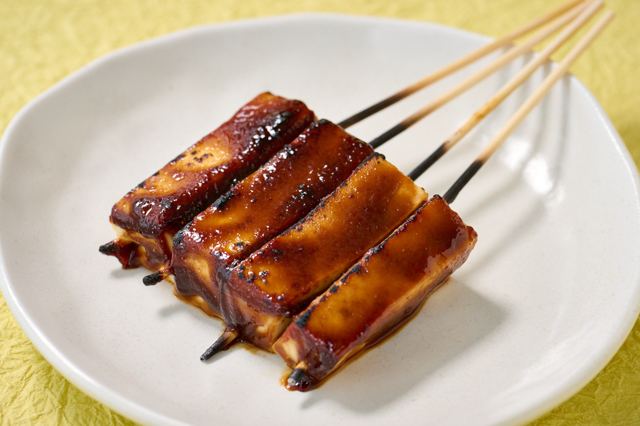
| Prefecture | Mie (三重県) |
|---|---|
| Region | Kinki |
| Japanese name | 豆腐でんがく(とうふでんがく) |
| Reading | Tōfudengaku |
| Home area | Iga culture. |
| Main ingredients | It's cotton tofu, and it's hot, and it's delicious. |
History and Origins
In Iga, a basin surrounded by mountains, there were difficult times for fish and beans, and the tofu made from beans was an important source of nutrients. Although the recipe for tofu is thought to have originated in China and is thought to have been brought back by a passer, it seems to be the first time in the book of the "shows" journal of the Spring of 1183. In those rural villages, there was a custom of dancing to the drums in the rice fields, such as in rice fields and festivals, and they were called lykoko. It is said that the Iga is derived from the place of the Iga, from which it comes from, and comes from the place of the Iga from which it comes from, and that the tofu from which it is called because it resembles the high - legged float of a white - robed stick. From what Tanigawa says in his book, "The Tofu Made and the Tofu Made and the Toku" is "to be named after the way you dance over the tap of the Toy Master," you can see that from the late Edo period until today it has not changed.
When It Is Eaten
It's part of the hospitality of inviting people, and for our annual dinner on New Year's Eve and the god of the mountain of New Year's Eve, and for our flowers. In the past, each home had a tapir stove and burned in charcoal, but it disappeared with the current of the times. Now it's eaten at the store and made from the Iga region.
How It Is Eaten
Add a bit of garlic to the sugary bowl and melt and put it on the fire. After a careful process, taste it, if it's too thick, then add the juice and adjust it. Cut cotton tofu that has been weighed down and drained of water into easy size, and bake both sides of the cake. I'll put on a flavor and roast a little. Spring is a tree's sprout from season to season, winter is a hatchet, and the other seasons may be blue, congealed, and sometimes spiny.
Recipe — Serves 4
Ingredients
- 2 blocks firm tofu
- dashi stock, to taste
- 80–100 bamboo skewers
- Mix: 4 tbsp miso
- Mix: 1–3 tbsp sugar
- Mix: 1–3 tbsp() mirin
- sansho leaves, to taste
- aonori seaweed, to taste
- miso, to taste
Method
- Put sugar in the taste bowl, add a little garlic in each taster, and melt it.
- I'm going to burn it and practice it well. I check my sweetness and adjust it in thick weather, but with the juice.
- Pack the tofu in a frickin, place equal heavy stones on it, and pull out the water. (When you take the water, it is water-heated once, cool, and then it lasts forever)
- Put the tofu on your side after you have drained it. Cut into a pistil shaped with a length of five and a half inches, and a length of two and a half inches, and a length of two and a half inches.
- Through the twenty-five-centimeter bamboo, I will burn both sides in five hands. I'll put on a flavored sauce and soon burn it and put it on the board. In the spring, the season turns the tree's sprout into the spring, in winter, in winter, and in other seasons, use green, condiment, and concierge.
Dish data: Ministry of Agriculture, Forestry and Fisheries (MAFF), “Uchi no Kyodo Ryori” (Our Regional Cuisines) database, used under the Public Data License (PDL1.0); translated and adapted from the Japanese original.