Gojiru 呉汁
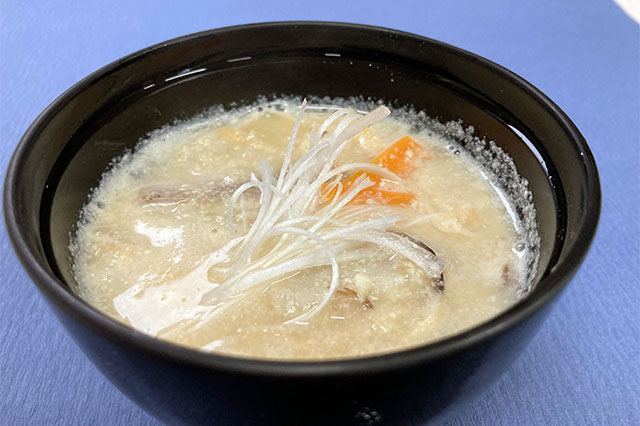
| Prefecture | Saitama (埼玉県) |
|---|---|
| Region | Kanto |
| Japanese name | 呉汁(ごじる) |
| Reading | Gojiru |
| Home area | All within the province. |
| Main ingredients | Soy, vegetables. |
History and Origins
In the center of the region where the rice and field were grown, the "prime" is a native dish loved throughout Saitama Prefecture. Especially in the areas where rice is plentiful, it was common to grow peas growing well on lean land, plant rice peppers, and grow them for useful use. The beans that I grew for my own use with rice peppers are commonly called "Custoo beans." In Saitama Prefecture, peas have been grown from old age as a crop in ring and rice fields. Thus, peas are a familiar food to the people, and lye was a common food to the common people. The taste of soybeans and seasonal vegetables and nutrients is so concentrated that they are characterized by a taste of citrus. Tastes are popular with taste buds, but sometimes they are based on sesame oil or salt. The amount of soybeans added and the amount of grounding it seems to vary from family to family.
When It Is Eaten
In each home, cooking juice from the beans harvested in fall was one of the funs of the season when it became cold. Since it is a source of protein that is so often scarce in winter, it also helped to recover from fatigue as a food diet.
How It Is Eaten
Soybeans are soaked in water and then put back in water and then ground until they are smooth in a bowl. Sutoimo, dacon, carrots, oil, garlic, garlic, and soup. If you boil, add beans to the bowl, and add onions to the fire, and taste the taste with the sauce. Since the food was simple in the old days, it was made of two different kinds of peas besides a vegetable, and many people ate it over rice.
Recipe
Ingredients
- 80 g soybeans
- 100 g taro
- 100 g daikon radish
- 60 g carrot
- 60 g long green onion
- 4 shiitake mushrooms
- 80 g konnyaku
- 1 aburaage (fried tofu pouch)
- 2–3 tbsp miso
- to taste to taste shichimi seven-spice chili
Method
- Soybeans wash, soak in water, and gently crush in a bowl.
- Sutoimos are cut, fat ones are cut in half-months. Dicon, carrots, and oil raise are short-cut, long-sniffed onions are cut, and chop down the cinchice.
- I'll cut short a book and leave some hot water.
- We make the soup (and not too much of it) in a pot, and cook it in proper quantity. If you boil, you can put in one beans, and when the fire is over, add onions, taste buds, and taste.
More About Gojiru
The lye is a grounded bean. (See the tofu that is in the state of the tofu (before it is filtered into a cob milk).) It's also true that a paste that is soaked in water and crushed and crushed is citrus, and the paste that is put in the sauce is lye.
On the other hand, in dyeing crafts, sooty protein is used to enhance dye fabrics, and so forth.
Native food.
It's a native dish that runs across Japan. From autumn to winter, when large beans are harvested in the fall, all the other ingredients that are not in the soup are from carrots, radishes, soo, soy sauces, tofu, fried, oil, and so on, and so on. With the abundance of crushed beans and vegetables, yuzu has been known throughout Japan as a native food for winters. It's sometimes eaten in a reward class.
The citrus juice with crushed branch beans is called a citrus or a citrus lye.
Origins
The origin of lye is not known. It's the theory that yu (u) means crushed peas and that it's an introduction from sound, and that it has nothing to do with China's dynasty or Hiroshima Prefecture. There is a theory that it's a delicious dish with boiling salt and raw pork added white to the sauce, with a thin skin and crushed branch beans, and with a delicious, citrus-breasted dish.
The juices from all over the place.
Miyagi Prefecture
Soy harvest season and body heat are eaten in winter. They are usually eaten as household food.
You dip soybeans in water, and then you grind up the succulent ones, and then you make a citrus. You can put "u" in the soup with vegetables.
Toyama Prefecture
I sometimes use the sauce with the sauce.
Fukui Prefecture
It's not only one of the best dishes conducted in a reward class, it's also served at weddings and legal matters.
Dishwork
In dyeing crafts, it is used to enhance dye fabrics, to make designs easier to paint, and to suppress textures. If you have handicraft dyeing, if you have it on cloth, it will make it as easy to paint as it is on paper, and it will be good and easy to keep it in check. But concentrations and number of paints are often used based on habits and experiences.
In Gifu Prefecture, county sequester Gifu Prefecture, vital culture, lye is used to produce lye.
Text adapted and translated from the Japanese Wikipedia article 呉汁 by its contributors, licensed CC BY-SA 4.0.
Dish data: Ministry of Agriculture, Forestry and Fisheries (MAFF), “Uchi no Kyodo Ryori” (Our Regional Cuisines) database, used under the Public Data License (PDL1.0); translated and adapted from the Japanese original.