33 6 かてめし
| Prefecture | Saitama (埼玉県) |
|---|---|
| Region | Kanto |
| Japanese name | かてめし |
| Home area | I'm going to show you some examples of this. |
| Main ingredients | You know, rice, vegetables. |
History and Origins
"Custories" that are fixed in the center of the Saitama Prefecture. Especially in areas where rice production is relatively low, it's thought to be made from adding raw materials to increase the amount of rice. In areas that were not suitable for rice, and even in areas that were suitable for rice, rice was a valuable currency for small farmers. So it is said that the rest would have been sold if I cut out rice for the crescendo. To increase the amount of rice left over, we could cook a dish of cooked vegetables with a sauce of radishes, Imo, and so on. The "scarlet" provided at a meal in northern Saitama Prefecture mix local food with rice, and in the south, like Saitama City, add a mixture of the "snap" with the "snap" that has been dried in rice or thin rice. Even at the father-in-law, it's routine to put "snap" in the meal. It is characteristic of different tastes and ingredients of the food in different areas and homes. The fact that "Knocking" is known as home cooking, but the farmer used soy sauce, which is the flavor of Hare's day, indicates that he was often eaten on Hale's Day. It is said that as food for Halle's day, it was made better than the fifth dish. Especially in urban areas, they were eaten on the same day as the sushi.
When It Is Eaten
(The Day of the Mountain Gods in January) It is often made up of such activities as peaches, eight-eighth nights, trays, and the Day of Ginjisu.
How It Is Eaten
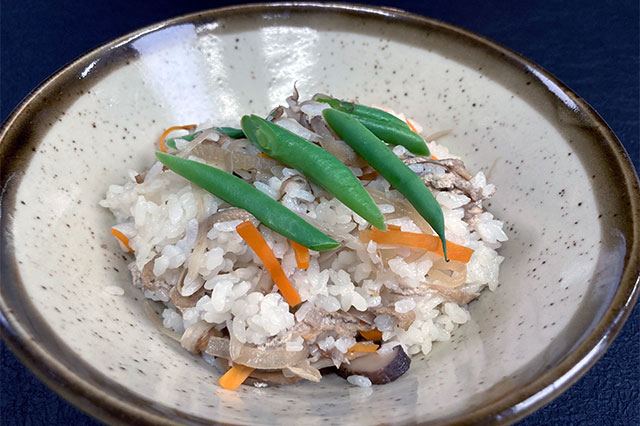
We will cook the vegetables and rice, such as carrots and daisies, which are brought back in water, and we will boil them with soy sauce, and we will boil them with soy sauce, wine, and sugar. Mix the cooked rice, or rice, or rice or tea with the ingredients that you cooked. In the Daiku san, the taste of the "grain-cooking plant" with its Yamanaka added to it is felt.
Recipe — Serves 6
Ingredients
- 450 g(3 × 180 ml) rice
- 150 g daikon radish
- 50 g burdock root
- 50 g carrot
- 4、5 dried shiitake mushrooms
- 2 aburaage (fried tofu pouch)
- 1 tbsp oil
- 100 ml water
- 3 tbsp soy sauce
- 1 tbsp sugar
- 2/3 tsp salt
Method
- I've been eating rice for about half an hour after I've immersed it in a fairy or water. In winter the water is cold, so we should take longer to soak.
- Carrots and dichoons cut small volumes, dried mushrooms put back in water, and short pieces are cut, and the bowl is cut out by the bowl and then it is exposed to the water.
- I'll make the ingredients fried in oil and boil them with water and flavor.
- Cooked rice together with three, and it's done.
More About 33 6
The rice is prepared by mixing rice with other grains, vegetables, seaweed and other foods. "I will," or "I will write as well."
Overview
To curb rice consumption, rice is an extra meal by cooking other inexpensive foods, such as gravy and vegetables. We call the food we add to the rice a "snap" and in that species, we call it rice, rice, rice, rice, rice, rice, rice, rice, rice, rice and seaweed, seaweed and seaweed. Before the early days of agricultural technology, transportation and monetary economies, food was widely eaten across the country. There have been examples of mixing vegetables in rice's bowls, such as rice, in the remote islands and cold mountain villages. Today it is often eaten as a season dish, or as a meal, rice, rice, rice, rice, rice, rice, rice, and so on, not to make up for the rice shortage.
Although Japanese diets are considered rice, there were great differences in rank, poverty, and districts, and at least until the 1930s, many people could not eat them. In Japan, Japan is said to have spread rice by the time it was later advanced, but the white rice food, usually rice, is eaten for New Year's and Bons and Festivals, and rice was eaten for the sake of saving rice for bad crops and famines. The city and fishing villages ate white rice in the rice they bought, but even in the rice fields they ate rice and rice fields, rice and rice, potatoes, large roots, vegetables, and so on. In the Shiga Prefecture province of Nono, daily meals were served with rice, rice, rice, rice, and rice, and the children longed for New Year's food. There is a song on this place that says, "Did New Year's Sun come?" and "Daily Mom eats as white as snow..." and a feeling that you're looking forward to New Year's and White rice."
Cooking is less tasteless and more stomachless than white rice. So the housewives in each home packed the food with white rice and rice at the bottom as a lunch for men who went to work or for children at school. The rest of the food was consumed by the women who stayed at home. Another way to do this is to put a bag of white rice in a bowl where you cooked rice and cooked it together, and then packed it with a piece of white rice. Also, since rice was so rotten, some areas ate white rice only in the summer when it was in the farm.
Great rice
Of course, rice was eaten in Japan all over Japan. There are regional variations in recipes, and in the previous day, you can keep the main roots in the water with a little bit of finely cut eyes. There are ways to mix rice with rice, and ways to boil rice in after the rice is cooked, and ways to boil it, and ways to boil it when the rice is cooked. In a mountain village of the Tohoku region, large rice was regularly eaten, so each family owned a cut to cut its roots quickly. Vegetables add vegetables and other vegetables, leaves, beans and carrots, but if there is a shortage of food, there are also wild animals, such as antlers and eels.
Toyama Prefecture ice watch, which faces the Sea of Japan, and mountains from behind it, is a land with less agricultural land and more fishing. We eat white rice every day, but we eat large rice when we heat the cool. Cut the large roots finely and spread them on pans, then put rice and taste on top of them and cover them. If the fire goes through and there's a sound of a rub, put down the pot and mix it well before eating. Sometimes we use finely cut leaves or vegetables instead of radishes as vegetables.
Soy sauce.
The potatoes that are cooked for dinner have potatoes, potatoes, potatoes and resuscitated potatoes. In particular, the potatoes have strong advantages for dry and thin ground, so they were used extensively in the warmer Kanto region and for extra food.
Saitama Prefecture snacks are known throughout Japan as well as rivers. The yield area is in and out of interstate and northern footings, but for home use it is grown in all prefectures. Fujisawa, in the middle of the interstate, is a native of a large number of families who are farmers and seamen. Here we cook rice during the potato harvest. It's about the ratio of five rices to one corn and three tasties to three potatoes to be cooked. When it is cooked, it stirs well and eats while it is warm. Also, we cook rice at the top of the northern footing grounds, or at the top of the mountain, but in the river by the Tohoku River, near the east, we cook the rice in the foster way. I'll peel a little larger potatoes and cut them in two, three, and add salt to cook them. It's a rare thing because you cut down on wheat and put in potatoes.
The potatoes are cooked in a pot with rice. I taste a little salt, so the sweets of the potatoes are picked up. I sometimes cook potatoes and rice. Add a little salt and add some soy sauce.
In Japan and Kyushu, which was suitable for growing potatoes, not only were raw potatoes put into food but there were also a wide range of "goo" foods that were eaten with raw potatoes cut and stored in the food.
Soy sauce.
The top tail and river-passing merchants at Saitama Prefecture will cook rice in the fall as well as rice. Since it is hard to peel with a knife, it can be cut whole, cut into four pieces, wash it, and cook rice-only. Put a little wine in so that the rice is tender, and taste it with salt and soy sauce. In the seven children of Tokyo, located in the river above the Tama River, the large grain is eaten in the bush, while the small grain is eaten in the bush, but the small grain is peeled in the skin and a little salt is added to the white rice rice.
Even though Toyama Prefecture ice watchers see ice cream, they cook rice in autumn. The mustard is a knife-knife knife that peels the skin. Eat some salt when you cook with rice.
Eybea.
In the area of the present Kochi Prefecture, the current ZZQ424X, it is said that "I'm not welcome in Hiemongau to Azukiza" and that all the food from the poor economic family was ungravated beans. I was adding more lentils to the rice. Also, before the time of the "forgery" many times we cooked beans as rice. Especially since autumn beans are hard-core and do not suffer from rabbit eating, they produce a lot of fruit even during the crop year. This often caused the rice to be boiled with fall beans. In the silver mirror valley of Miyazaki Prefecture West city, they say they cooked beans separately and boiled them at the rate of three servings. On the other hand, small beans are often used as food on the day of the bee.
In the Tohoku River, near the Tohoku River in Saitama Prefecture, they cook beans when it's not enough to cook red in celebration or change. On August 1st, on the day of the cooking pot, I cook some beans and present some rice before the Buddha, and I offer some incense. The seventh child of Tokyo, which is up in the Tama River, cooks beans for dinner on a 15-day day of bone rest every month. After lunch, I boiled the beans seven minutes and then cooled them out of the pot. When you cook it, add beans and boil it, it becomes red beans.
What do you want?
In Toyama Prefecture Ice View, you can cook rice during the harvest of beans. The young beans are made from the nuts and put in rice and salted with them. The twist is cooked well the day before and cooked with salt in the fresh rice. There is a delicious meal, and it's made with the same handle as rice.
I'm gonna have some green rice and rice.
Yamagata Prefecture is a rice plant, and it's not a problem in the northernmost Shinagawa, but you save rice for your crop and eat rice and rice. But besides that, as the season's fun, in the first summer we cook a bowl of rice, and in fall we cook a meal of rice only once in the fall. Remove the worm and add wine to the sugary tadpole that you put in the oil. And in the state of Nanjo, where the top river can open rice fields, and in Nagai, where the top river can open rice, the rice was almost eaten with rice rice, so much as eating rice near the white rice, and eating it in the New Year and trays that were not particularly cooked. But rice was still cooked. The eels are planted as a hedge for each household, and when spring comes, "Swangfish" is prepared. I'll put about three cups of green pea leaves in my hand against a rice bowl. It is said that the way to make a fence of edible plants into a hedge is by the guidance of Takao Takashi, famous for his name.
In Toyama Prefecture Ice View, we cook rice, rice, rice, and rice. In the early spring, they pick the sprouts from the tree, cut them fine, fold them fine, taste them fine, taste them with the sauce, and mix them in the cooked rice. The kite doesn't have to be used with fresh ones. I peeled it and cut it into rice that I picked up. The seasoning is thinned with soy sauce. It's delicious with this fresh finish on it. In autumn, we remove the garbage from the mountains, from the mountains, from the dust, from the sea, from the sea, from the sea, from the sea, from the sea, from the sea, from the sea, from the sea, from the sea, from the sea, from the sea, from the sea, from the sea, from the sea, from the sea. Put a little oil in the rice that you found, and paste it with a thin paste, and then add a bowl of juice to it. When you cook up, I'll water it often. It smells very good.
Even the seven children of Tokyo, which is up to the Tama River, will cook their food in this season. Wash the stirrup bowl well, cut it small, taste it with sugar and soy sauce, and mix it with the cooked food. The food is cooked this time without putting in any wheat.
Sea algae.
On the 15 beaches of the low-land south coast of Miyagi Prefecture, the low-land coast, they used to eat a daily meal of the "boiled" and "silica" that was made from seaweed from the sea in exchange for sea goods. There were also "awavy rice" and "singing" and other "meat" that cooked fish and other fish. The ratio of rice to extra materials was 3: 7, so that such things as rice were too black to see the grains. There is no "susten rice" made of potatoes, which is the best meal in this land, and the abalone, which is found in the depths of luxury in other parts of the world, is "tired after eating."
In Izu Oshima, when it comes to the end of February, we cook rice. Wash the dishes lightly and remove the sand and fine stones from the bowl. What is torn off the rock by hand doesn't have to be torn away in particular. Put it right in the rice, boil it, and mix some soy sauce and a little wine. It's like taking a rock field in a cold tide, but I can feel the joy of spring.
A field field of the Kanto region.
In the past century, the Japanese have been "mixed" in food, including food that was used in the past 100 years, with the traditional the Kanto region fields, and since the late advanced age of Japan, the rice fields have been eaten by the past 20 to 30 percent of the time it is frozen in rice, and the rice fields have been eaten by the past 100 years.
The Saitama Prefecture, famous for its riverside name, was eaten a wide range of food. However, in Father's village, carrots can be made from raw carrots to make food. Originally, it was a special day food such as a festival or a seven-seven evening, but now it's a common family dish and can be enjoyed in restaurants in the province.
Sasaki Plateau, when rice fields are low, is rice, but because the dry land covered with volcanic ash produces bad water leakage, land rice is a bad crop, so it was the center of much of the basic diet, where stable yield was expected, and rice was expected. But now there are local tourist centers that have been eaten and served with large roots and potatoes to save rice or to feed on rice or other food.
Text adapted and translated from the Japanese Wikipedia article かて飯 by its contributors, licensed CC BY-SA 4.0.
Dish data: Ministry of Agriculture, Forestry and Fisheries (MAFF), “Uchi no Kyodo Ryori” (Our Regional Cuisines) database, used under the Public Data License (PDL1.0); translated and adapted from the Japanese original.