Home / Kanagawa / Yokosukakaigunkarē
Yokosukakaigunkarē よこすか海軍カレー
| Prefecture | Kanagawa (神奈川県) |
|---|---|
| Region | Kanto |
| Japanese name | よこすか海軍カレー(よこすかかいぐんかれー) |
| Reading | Yokosukakaigunkarē |
| Home area | Rashiga City |
| Main ingredients | And I'm going to show you some of the things that I've been working on. |
History and Origins
The Japanese home food company, curry rice. One of the roots of this theory is that the Japanese Navy was used to feeding on the army. In the Japanese Navy during the Meiji era, where we were eating a meal centered on white rice, our leg was a serious problem due to lack of vitamins. The curry introduced there for better nutrition was a curry with a stew of curry flavor that was provided in the British Navy. It seems that the reason for the scheme was "to fit for dinner" and "to be hard to spill on a rocking ship." By feeding on curry, which was full of meat and vegetables, the patient's patient's footiness was greatly reduced. It was said that soon after the soldiers had returned home, the Navy-style curry rice was spread throughout Japan. This modern replica of the military food recipe, "The Navy curry" was born in the year 11 of Manchuria as part of the city's deep sea-sized city of Sadako. Now, about 20 years after my birth, it is now a fine dish representing the city.
When It Is Eaten
It's a popular menu for men and women throughout the year, regardless of the season. Besides curry rice, there's a lot of related goods, such asししてててなななななななななななななななななななななななななななななででななななななななななななななななななななななななななななななななななななななななななななでででするななななななななでででです. In particular,ししととととととととと
How It Is Eaten
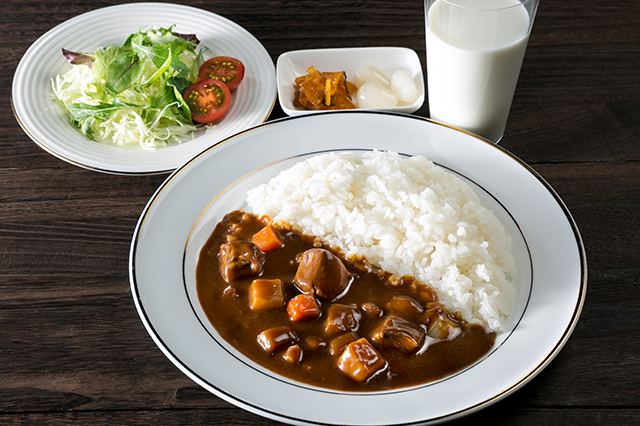
Cut meat, carrots, onions and potatoes into dice and roast them. Put beef fat in the frying pan, roast flour, curry, soup, meat, and vegetables, and boil it in a weak fire and taste it with salt. We eat rice and eat with chowneys and so on. Local approved stores have a rule that it is appropriate to provide salads and milk set for the Navy curry, which was considering nutrition balance.
Recipe — Serves 4
Ingredients
- 600 g cooked rice
- 200 g beef
- 1 tbsp wheat flour (A)
- 2 tbsp curry powder (A)
- 250 g potato
- 15 g carrot
- 300 g onion (B)
- 1 vegetable oil (B)
- 24 g butter
- 550 ml water (C)
- 2 solid Console (C)
- 150 g tomato (トマトジュース)
- 1/2 tsp salt
- a pinch pepper
- 1 tbsp ketchup
- 1 tsp Worcestershire sauce
- as needed galam masala
- as needed レッドペッパー
Method
- The beef is cut into small pieces and served with a light salt pepper. Put it in a plastic bag with A, and then wrap it in a well-sucked plastic bag.
- The potato peels, cuts five millimeters in half, and then drains the water. The carrots and the onions are cut into five-millimeter angles.
- Put (B) in a hot plate and heat it for five minutes at a range 600W.
- Put butter in the pot and burn 1 in the middle.
- If the meat is cooked, add two to it and add three to it.
- Add (C) and then boil the peppers and add a slice of tomatoes and boil them in a weak fire for 20 minutes.
- Add salt pepper and add tomato ketchup and winster sauce and boil it. You can add gnarrum massala and red pepper to your favorite dish.
- As a rule, the Navy curry has three points of curry salad milk.
More About Yokosukakaigunkarē
The Navy curry is the curry rice that comes from the ships of the Japanese Imperial Navy. In the city of Kanagawa Prefectureedaga, we are here as the "Damata Navy curry."
It's sometimes referred to as the root of curry rice in Japan, but in fact, the Marine Food curry is the ratio of the civilian curry to the common curry, not the birth of it.
In this article, we're going to talk about the sea self-carry (or cascaary) derived from the sea guard's diet.
History
(In 1884, I was told that the navy diet was eaten by seamen due to the prevention of foot-to-foot-to-foot control.)
On November 25th, the Navy Department's Fourth Fourth, the kitchen master's standard is set, and the menu is listed in the third-class cook's category.
On November 29, 1889, in the Fourth and Fourth Department of the Navy's Department of Cooking Education, fifth grade cooks were assigned to one of the subjects that cooks learn.
The oldest book that the Navy curry can check as recipe is the "Kerry's Book of Confederation" published by the Sculptors in 2008, and "Kerry Rice" with chicken rice.
In 1918, the Navy Education School textbook, issued by the Navy, has "Sing curry" in it, but the recipe is not much different from the "Kerai Rice" in the "Service of the Navy" book.
In 1932, the Navy Academy of Research and Cooking, published by the Navy Academy, contained various curryes, such as "Ichikakas" and "Iri curry" and "Iri curry."
A false legend about the Navy curry and the ocean self-carry.
Some legends point to errors. Show the type below.
The Japanese curry is the Ruts.
According to Takamori, the spread of curry in the navy is proportional to the spread of the civilian curry, and it says that the theory that the Japanese curry is the roots is not based on the Navy. Takamori also estimates that curry was introduced into naval warfare during the early days of the civil days when curry was spreading.
In Japan, curry appears the oldest in recipe books, in the book, in the book "The Western Foods" published in Iseshima 5 years ago.
I'm going to have a record of the rice curry at the Army Youth School.
(Laughter)
The Sea Guard has a custom of eating curry rice on Friday lunch. Takamori points out that curry comes from old naval traditions on Fridays. In the spring issue of The New Year's magazine, the former chairman of the League of Nations, Sakura's Self-Handler OB (OB) said: "Things can be told in error." This is a poor example, but it's different from the fact that it has been reported since the Navy that the presentation of Friday lunch for the Sea Self-Safe is curry rice. It says, "I'm not going to do this."
It's not a week.
It's sometimes explained to me that on Friday or Saturday the weekend, curry is eaten only because you don't forget it even when you're at sea for a long time. It's interesting as an explanation, so someone came up and got tail-tailed and spread. Takamori, who joined the Coast Guard as a second-rate Marine, remembers that he spent half a year in the Sakura Education Corps, but only a few times did curry appear on the camp. About that kind of thing, I remember thinking, "Friday curry" is a lie. It says, "I'm not going to do this."
Osama Nono, who joined the Sea Guard in 1977 and served as a director of the sea and an organizer, said, "The Sea Guard originally had Saturday lunch as a curry." I had to make lunch easy to take off on Saturday afternoon, because curry met that requirement. Then Saturday became a holiday, so the Saturday curry slided into a Friday lunch menu. I didn't send curry on Friday or Saturday so I wouldn't forget the day of the voyage. She testifies to the meaning of "."
It wasn't until about the year 1985 that curry rice could be served on Friday lunch in the Sea Guard. Because of the fact that the two-day week off at sea has become a reality, the idea of Friday instead of Saturday has been established, and the lunch on Friday has been added with training and daily lessons. The process only led to the misexisting explanation: "The only reason we eat curry on a particular day in the Sea Guard is to remember the day in our long-term sea behavior."
It's not like I'm going to do it.
The theory that Rashiga is the cradle of the Navy curry is wrong. Kokoko, who knows the history of curry rice, has never heard of the military curry dining room in Rikuga and Wu.
Now the ocean self-carrie.
What's eaten by the Sea Guard is called "The Self-Safe Self-Steaker" group. Because each ship and land unit has its own recipe, the curry made is different from each boat and land unit. There is no single taste recipe. Each ship and land unit has its own hidden taste. The Coast Guard Self-Safe is publishing curry recipes for each ship and land unit on the "Safe Self-Safeguard Recipe Page."
At the the Ministry of Defense, Sea Self-Steel Channel on YouTube, a recipe for the original Navy curry rice recipe, which is a modern-day replica of the old Navy's "Kerai Rice" in the "Service of the Navy" book, is released on YouTube.
A program to be eaten by the public at the events of the convoys and ground bases of the air service) could have been made public.
Moreover, curry rice, which is served by the Coast Guard as a staff, is strictly prescribed for the providers and is also forbidden to eat by the non-paying self-preservation guard, even if it is called taste. In fact, in the 23rd Air Force of Kyoto PrefectureS Kasur and the General Chief of the General Police of Aomori Prefecture Securge, the the Ministry of Defense announced in March of 2022 that there was a violation of the law of punishment.
The recipe that's left in the works.
It seems to me that the Japanese Navy's oldest curry recipe for printing is the recipe for the "Kerai Rice" published in the book "The Navy's "Service" published by the Sakura Marine Corps in 1941. As noted below. This isn't curry recipe made by the Navy by its own. It's just like a recipe like that one was made in private at the time.
(The ingredients are beef, chicken, carrots, onions, horse bells, salt, curry, flour, heat, soy sauce)
I'll start with the rice. Meat, onions, carrots, and betel nut are cut in the eye. I will roast flour with a fried bread with het, add curry powder, and extend it to the thin juice of soup. Cook the two meat vegetables, put them in three, and cook them in a weak fire. I'm going to put it in after it's almost cooked. The rice is cooked in soup. When I cook up, I'll put it on the plate. It is added to the menu, such as "chatchnut" when serving the cooked in four with salt and on a plate.
There's no description of "soup" used for cooking and making Lous, but it's estimated that he boiled bones, tail, chicken and so forth with scraps of vegetables, and then used a little curdyyon.
Oh, my God, Navy curry.
Kanagawa Prefecture-Santa, once the former Navy's Conservative Order of Conservatives, and now the Sea Guard Self-Sitting Camp, has launched a campaign to declare the City of curry on May 20, 1999. A store that can use the name "Key Navy curry" is identified as a shop that has a recipe for the Navy war machine that has been approved to meet the definition of the Navy curry. We've got a character "Scarlet" page and a web page called "Current in curry." Navy curry has built a city because the Consulate was employing a Navy curry, and it was captured by Sakura City that curry rice spread across the country. But this isn't a historical fact.
In addition to the city of Rashita, curry powder mixed with flour is sold on the market, and it can be made easily at home. The Navy curry provides three points of curry salad milk, in principle.
In August 2010, as a spin-out for "The Navy curry" a "A little" began to be sold in the city of Rashita.
- I don't know.
On February 6, 2017, a partnership agreement was made between the city of diapers and the Twing Trade Council and the General Chief of the Obligation. Ten stores are provided in the city, eight guards and two ground units are passed out to each restaurant. On March 2nd, the selection of supply stores was made at the city of diapers and the curry at each store was decided.
Sea Self-Control
In the city of Hiroshima PrefectureE, where the Imperial Navy's Conservative Council is put in place and where the Sea Guards are now located, the city hall and its district groups have been able to provide the "Sea Self-Carry" from 2015 to March 2018. On the curry of each ship and land force in the Wu Sea, the curry is passed recipes from boat and boat to restaurant, and in each store is a faithful re-enlightenment of taste. The curry presented: "A salvation ship A curry" is a unique system in each store.
For recipes for eating and drinking, boat and other cooks will go to each store and give practical instruction. Finally, we must eat the curry made by the ships and the captains and eat the curry made by each store, and we will reassess the confirmation when the command or captain changes. To keep curry taste and customer level, there is a "perimeter check" by the ship that provided the recipe.
Source
This is the first time that Japan has won.
Text adapted and translated from the Japanese Wikipedia article 海軍カレー by its contributors, licensed CC BY-SA 4.0.
Dish data: Ministry of Agriculture, Forestry and Fisheries (MAFF), “Uchi no Kyodo Ryori” (Our Regional Cuisines) database, used under the Public Data License (PDL1.0); translated and adapted from the Japanese original.