Hoshi-imo 切り干しいも
| Prefecture | Shizuoka (静岡県) |
|---|---|
| Region | Chubu |
| Japanese name | 切り干しいも(きりぼしいも) |
| Reading | Kiriboshīmo |
| Home area | Osama City, Oshima City, |
| Main ingredients | Sweet potatoes. |
History and Origins
Dried potatoes are said to have a Shizuoka Prefecture. In the Edo days, a man named the Right Gate helped a ship in the area that was lost off the coast of Osama. Then, as sweet potatoes grow in the province, the process of boiling and cutting sweet potatoes with a knife was invented by the sun - dried "Singing out" process, which is said to have begun as "Salting Out" was invented. By drying the sun, the sweetness and softness of the sweet potatoes will stand out. The winds of the west blowing in this particular winter were "Akron from far away" and the long daylight hours were suitable for the production of dried potatoes.
When It Is Eaten
Because it's a reserve food, we can eat it all year round. They're eaten when they're hungry or hungry. I'll eat it as it is. Or if you light up on a toaster or a charcoal fire, the surface will light up, but you can add soft sweetness to the food.
How It Is Eaten
I'll steam the sweet potatoes until they pass through. I'll peel the skin into a hot sauce and cut it down in a straight line. After that, we'll dry in the sun. If you make them at home, you can burn them in an oven and dry them instead of sunning them. Depending on the type of sweet potatoes you use, the sweetness and soft texture of the potato are different.
Recipe — Serves 4
Ingredients
- 4(1/250–350 g) サツマイモ
Method
- Wash sweet potatoes well.
- Put leather sweet potatoes in a pot so they don't fit together, and use plenty of water to cook to the boiling, and let them boil for about 90 minutes after boiling. If you stick the bamboo into a sweet potato and it passes through the center, it's about time. Depending on the size of the sweet potatoes, time boiling needs to be adjusted.
- I skin sweet potatoes for the heat.
- If the sweet potatoes are cold, I cut them with about an inch thick.
- We'll set up the sweet potatoes in a way that doesn't fit on the net or on a monkey or something, and we'll dry them for about five days. Two days, and then back.
More About Hoshi-imo
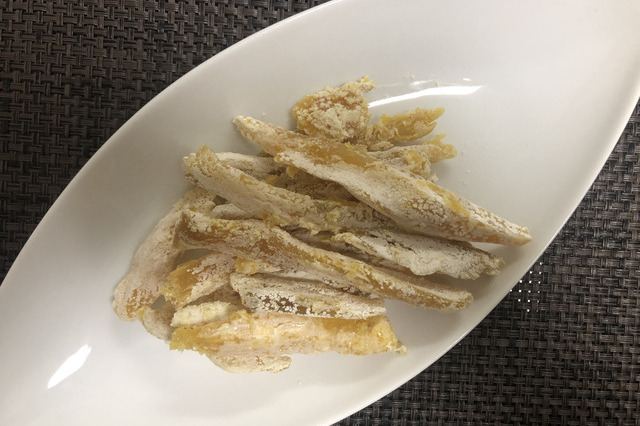
Hoshiimo (干し芋 "dried sweet potato") is a Japanese snack made of dried sweet potatoes and a specialty of Ibaraki Prefecture. The sweet potatoes are generally steamed first before peeling, slicing, and drying, with no artificial sweeteners added. In some cases, the sweet potatoes may be roasted rather than steamed. The surface may be covered with a white powder. Not to be mistaken for mold, this is a form of crystallized sugar that emerges as the sweet potatoes dry. With a chewy texture, it can be eaten raw or roasted.
Names
Hoshi-imo goes by other names in Japan such as, kanso-imo (乾燥芋), mushi-kirihoshi (蒸切干), and kiriboshi kansho (切干甘藷).
Varieties in Japan
In Japan, hoshi-imo is available in many shapes, ranging from French fry-like rods to broad, flat chunks roughly 10–15 cm in length and 5 cm in width. Sometimes oblong, unsliced varieties, known as maru-boshi (丸干し) are also marketed.
Many types of sweet potato (Ipomoea batatas) are used to make this product. Common varieties include Beniharu (紅はる), Tamayutaka (玉豊), Silk Sweet (シルクスイート), and Anno-Mitsuki (安納蜜嬉) sweet potatoes. Since China produces more sweet potatoes than Japan, and the price of sweet potatoes in China is generally lower than in Japan, much of the hoshi-imo sold in Japan today is, in fact, produced in China.
History
The snack supposedly originated in Omaezaki City in what today is Shizuoka Prefecture. Around 1824 a merchant named Shozo Kuribayashi began in manufacturing this dish on a small scale. In 1892, Rinzo Ohniwa and Jinhichi Inagaki of modified the manufacturing process to facilitate industrial production. Soon this product spread throughout Japan as a popular type of preserved food. It was also used during the Russo-Japanese War, briefly gaining the sobriquet as "soldier's potatoes." In 1908 large scale production began in Ibaraki prefecture. Two theories exist about how this product was introduced to Ibaraki prefecture. One theory holds that a rice cracker maker named Toshichi Yuasa hired a technician who modified his dried seafood processing facility to produce this agricultural product. Another theory holds that Seiji Koike and Jizan Ouchi got the backing of the governor of Ibaraki Prefecture, Masataka Mori, to start up local production with the aid of two technicians from Shizuoka.
Both public and private sectors in Ibaraki Prefecture have promoted steamed dried sweet potatoes extensively. In 2019 the Hitachinaka Chamber of Commerce and Industry was selected by the Japan Chamber of Commerce and Industry as the winner of a commerce prize for its "Dried Sweet Potato Attraction Project" that included the development of hoshiimo cakes and a book outlining the history of dried sweet potatoes. Today over 80% of the steamed dried sweet potatoes sold in Japan are from Ibaraki prefecture.
Nutrition
Hoshi-imo is particularly rich in vitamins A, B1, C, and E and contains much potassium and calcium as well as dietary fiber.
Similar dishes
It is similar to two Korean dishes: "goguma-malaengi" (고구마말랭이) and "mallingoguma" (말린고구마). The latter is cut into thinner slices and has a crisper texture than the former. In China, a snack very similar to hoshi-imo known as "dìguā gàn" (地瓜干) is popular and in Vietnam a product known as "khoai lang sấy dẻo" is common.
Text adapted from the English Wikipedia article Hoshi-imo by its contributors, licensed CC BY-SA 4.0.
Dish data: Ministry of Agriculture, Forestry and Fisheries (MAFF), “Uchi no Kyodo Ryori” (Our Regional Cuisines) database, used under the Public Data License (PDL1.0); translated and adapted from the Japanese original.