Konbumaki 昆布巻き
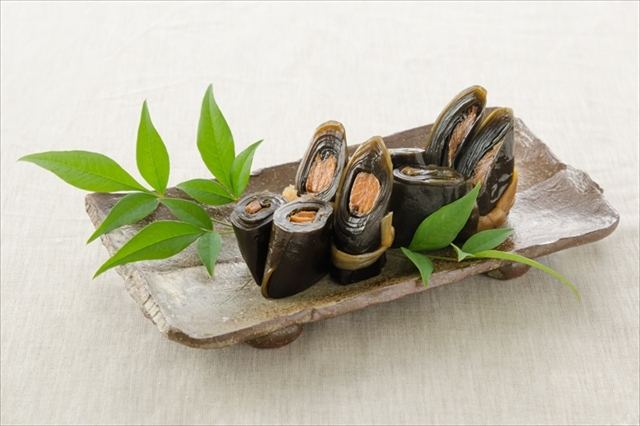
| Prefecture | Toyama (富山県) |
|---|---|
| Region | Chubu |
| Japanese name | 昆布巻き(こんぶまき) |
| Reading | Konbumaki |
| Home area | All within the province. |
| Main ingredients | It's a lot of cloth. It's a lot of nicin. |
History and Origins
In the time of Edo, the North Sea ships carried a lot of reeds from Hokkaido, so today's kingdom of China and Mount Fuji is built. There are a number of seams inherited, but the "scroll" that wraps up fish with cucumbers is an essential dish for the New Year's Day, beginning with New Year's. Typical is a roll of deadlyn. The herring is also a large mass of herring from Hokkaido with a cloth, then by the Northerlyn. The "scrolls" that boil slowly and sweetly over time, the thick yet soft cloths are very smooth and the taste is very strong in the herring inside. Besides herring, we also have to wrap up the ingredients of the season, such as the eagle from Tokuyama Bay, the hangfish, the bluish, the codico. Apart from Toshiyama, it's a favorite dish in neighboring Isegawa and Fukui.
When It Is Eaten
The word "smooth" often comes from the word "sweep" and is used as a good food. So "scrolling" is also a dish that will be eaten on New Year's Eve. And it's not just a celebration, it's a dish that goes to the usual table.
How It Is Eaten
I'm sorry. I'm sorry. I'm going to put the cloth back in the water for a while. This time I'll keep the water that I put in the cloth. Take a pot of water and wash half the dishes. If you tie your herring with a glue, use the water you put back in, and boil until it becomes soft. Add the taste-rates, such as sesame oil, two times, and then add them to the taste. The finish result of putting water in the water is lintel.
Recipe — Serves 4
Ingredients
- 2 dried herring
- rice-rinsing water, to taste
- 8×10cm4 kelp (konbu)
- 60cm 干ぴょう
- a pinch vinegar
- 1 tbsp sugar
- 1 tbsp soy sauce
- 1 tbsp sake
Method
- A hungry herring will be stuck overnight in rice yuzu and return to the pot.
- If you wipe sand, water, or dry it, then wrap half of herring around and tie it in a dry cloth.
- I'll boil the wine from the water, put some vinegar in it, and cook it in a weak fire until it's soft. If you become soft, you can divide the taste cost by half and divide it into twice, and it will contain the taste slowly. The cloth is rich in mineral and low in energy. It's delicious when you add tarac, lentils, oil, and carrots as well as herring. The futon is also available on the market, but since the flavor is often too strong, try making a thin roll at home.
More About Konbumaki
The squawk is Japanese food that has been wrapped around fish and cooked. The sieve's roll using a hungry herring is the main thing.
Cooking.
The sieve of the sieve.
The absent herring is soaked in rice juice and brought back. It'll take about four days to replace the rysso every day. The bones are removed from the bones and they are boiled in a fool's way. The cloth is brought back in water, soft, and binds with a knot wrapped around herring. Put it in a pot that has been laid with a tree, and boil it sweetly with soup, broth, and flavor. We can turn off the fire and make it cool. A pepper cut to a small size and then applied to a needle is served in the sun.
Culture
It is believed that during the late days of the room town, a drying process was established, that the flow was expanded, that the distribution was expanded, and that the oil was made because of the spread of soy sauce.
It's one of the dishes that comes from getting to "good."
A circadre.
It's a coil of glue that is produced and consumed mainly with Toyama Prefecture. This skeleton is the basic shape of Toyama Prefecture, and it is similar if you don't use spools. In contrast, the common wooded chick in the whole country is hardly made by local cicada manufacturers, and is not sold at the supermarket. There's also a red scroll, which is commonly used but which should be avoided as a color for food. In the region of Toyama Prefecture, once under the control of Kasaka, the cucumber was eaten extensively as a substitute for fish that could not be eaten by the locals. At the same time, Toshiyama is a land where there is a high consumption of cloth, and there was a drought in which it had been mixed.
Text adapted and translated from the Japanese Wikipedia article 昆布巻き by its contributors, licensed CC BY-SA 4.0.
Dish data: Ministry of Agriculture, Forestry and Fisheries (MAFF), “Uchi no Kyodo Ryori” (Our Regional Cuisines) database, used under the Public Data License (PDL1.0); translated and adapted from the Japanese original.