Sabazushi 鯖寿司
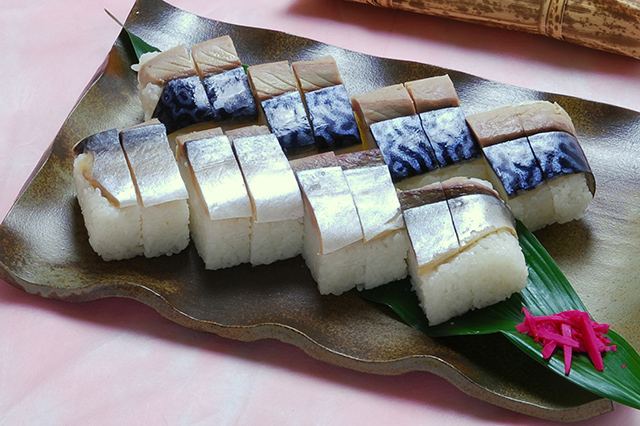
| Prefecture | Hyogo (兵庫県) |
|---|---|
| Region | Kinki |
| Japanese name | 鯖寿司(さばずし) |
| Reading | Sabazushi |
| Home area | All over |
| Main ingredients | I'll be right back. |
History and Origins
A traditional dish is a sushi with a salt bowl that is made with vinegar, but sushi, stick, and sushi are very different in shape. In sushi, as his name suggests, is a sushi, which forms a salt bowl with a shape of head and tail, and then tightens it with vinegar and prepares it with rice. On the other hand, the stick, except for the head and tail, puts a half-sized salt slat in the rice, and wraps it in the bamboo skin. During the time that the refrigeration technology was not developing, many boulders were carried along the streets called "Sun's Road" and salted in all, which carried fish caught in the young bay up to Kyoto. For example, in the west street, there are streets following Mount Tsukaji. The salted boulders have become just fine salt by the time they arrive at Mount Tsuzuzu. In autumn festivals to celebrate the harvest, the sticks in the bamboo leather are carried on rice rice prepared with freshly prepared rice, and with vinegar - salted rice.
When It Is Eaten
The stick is made for Hale's day, such as the fall festival. But the "sing" and other events that are celebrated after the rice plant is finished include sushi, which is used to cut the dough into pieces.
How It Is Eaten
When making sushi, you open a form of salt walnut with a head and tail, tighten it with vinegar, and shape it between rice and rice. On the other hand, if you have a stick, you'll have five sheets of salt on top of your head and tail, and then you'll have five salt bowls wrapped in vinegar, and then you'll have to wrap them in bamboo leather. After finishing it, we cut it out and eat. The sushi will cut the rice with vinegar in half and place it on the rice table.
Recipe — Serves 3
Ingredients
- 2 sALT (秋祭り用)
- Vinegar: 2 cups(400 ml) rice vinegar
- Vinegar: 3 tbsp sugar
- Vinegar: 1 tsp salt
- Cooked rice: 2 × 180 ml rice
- Cooked rice: 2.2 × 180 ml water
- Vinegar: 2 tbsp 1/2 rice vinegar
- Vinegar: 1 tbsp sugar
- Vinegar: 1 tsp salt
Method
- We put salt dishes in the water overnight and we salt them out.
- Take a thin skin off the surface.
- I'll take bones, elbows, and small bones. Small bones should be used with hair loss.
- Half a day, half a day, and half a day, they're soaked in vinegar.
- I'll make sushi. I'll put vinegar in the hard, warm rice, then I'll cover the length of the fish. I'll hold fast so I don't get scared.
- I'll put a bowl on the table and I'll hold it tight. In the case of ferries, it can be wrapped in bamboo leather.
More About Sabazushi
A sushi is a kind of stick-susomi made from the Saba or a sushi from the sushi plant.
Overview
It's said that there's a lot going on in the mountain from behind the mountains.
As a type of sushi, there are sushis, or sushis, which are used for sushi batteries and for stuff, or sushi that is baked or fried rice that is put on sushi.
Kyoto.
Soo is one of the famous Japanese dishes, and from ancient times, in families of Kyoto, it has been made on a festival day, such as a festival. In the civil life of Kyoto, it's a feast eaten by festivals and four-day festivals. In the town of Kyoto, far from the sea, a truck drove across the mountain to the area of Fukui Prefecture, which was under water on the Japanese coast. This road that was brought to us is called the Hijime Road. Even in modern times, where fresh fish are abundant, this eating culture has been inherited. Unlike the battery of Osaka, Sushi Sushi was built in a private home, but there were also several shops that were built on top of it. The salt stalagmite is stored at room temperature with a freshness of salt, a thin bone of the stamen, a sweetened vinegar, and a humidity of the skin of the bamboo. All were carpenters in a time when there was no refrigerator. In recent years, expansion of transportation has also been used, not by traditional recipes where conservation has been central, but by sushi.
I'll be right back.
In the northern part of Okayama Prefecture, there is a mass of sushi in the northern part of the country, and it is still possible to make sushi at home.
Since Okayama Prefecture was not developed, the sea-water supply from the north was so salty that the fish caught in the mountains were preserved and carried in one day over the mountains by the cloud streets. Since they were transported in salt-stuffed conditions, by the time they arrived, the enzymes were thought to have added flavor and salts to their food. Using the broom, some families have been able to make pop-somi. It was also made during festivals and celebrations and was acted upon as a feast. From its looks, it has its name, "The Golden Sushi" and so on.
The recipes for sushi are very different in each household. After it's become possible to transport cold water, some families will use a sieve instead of a salt pepper. Also, there are recipes for the appearance of sushi with heads, a sushi with three cushions on it, a sushi with a captivating wind called sushi, and so on.
The Okayama Prefecture New Year's Fair is being treated as a local dish, and now large department stores such as Tokyo and ZXOsaka are being treated as a masterpiece.
I'm Kosuke of Hiroshima.
On top of that, because of conditions similar to Mount Okayama, it is highly popular in the northern regions of Hiroshima Prefecture and in the interior of the Hiroshima City region. There's a pattern of many "Smushi" and the condensation of the condiments and the entrailing of the rice into the area that's removed.
Also, while some of them are not "smushi" but they are preferred to be wrapped in hijishima plants instead of sea cucumbers, they can be sold in "depa-d" at such department stores as Hiroshima and elsewhere.
I'm a well-known man, Akiko.
In Kochi Prefecture, sushi is eaten all over the place with rice in a moist-knited sabbatical.
Text adapted and translated from the Japanese Wikipedia article 鯖寿司 by its contributors, licensed CC BY-SA 4.0.
Dish data: Ministry of Agriculture, Forestry and Fisheries (MAFF), “Uchi no Kyodo Ryori” (Our Regional Cuisines) database, used under the Public Data License (PDL1.0); translated and adapted from the Japanese original.