Home / Hiroshima / Taimentaisōmen
Taimentaisōmen 鯛めん
| Prefecture | Hiroshima (広島県) |
|---|---|
| Region | Chugoku |
| Japanese name | 鯛めん/鯛そうめん(たいめん/たいそうめん) |
| Reading | Taimentaisōmen |
| Home area | I'm sorry, I'm sorry, I'm sorry. |
| Main ingredients | I'm going to have to take care of it. |
History and Origins
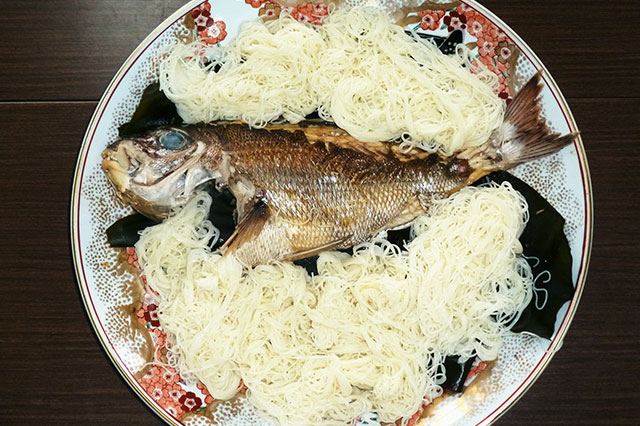
The rice bowl is a dish with a bowl of boiled rice, and a bowl of stew on top of it, and a bowl of rice on top of it, along with sprouts and walnuts, silk eggs, and sweetly boiled rice. Sometimes they wear pine twigs and so on. It's a celebration dish, where you can be dressed in a nice seat, such as a building, a sushi, rice, a wedding, or a boat. Aoi meant "to be a big one," and a hag means "to last long and thin" and was made a happy result. The invited guests praise each other for their size and taste, and they pray for a long time to last as long as they can. When you eat it, you take it to small dishes, add it to the soup, and put it on the dish as you like. The soup is used as a soup with the boiling sauce. Sometimes, when eating at home on a regular basis, I used small fish such as Mebar and Black Chichin, Okoze and Isaki. At the celebration table, you can almost be called a "Sai-sai" when you eat at home. It's difficult to cook the rice so it doesn't break down, but to prevent the boil, we use bamboo leather to make the bottom of the boat and then put it on board and cook it in a large flat pot where it's all over. The Inland Sea, which is a rocky subsoil and tides, has long been a favorite to live in, and has long been covered with fish, so it is eaten with a large amount of food.
When It Is Eaten
I was given a nice seat on the roof of the building, on the sushi, on the rice, on the wedding, on the boat. They were also eaten with such activities as trays and orchestras. A local festival associated with Miyashima's Shinto shrine is to be held on June 17 in the old calendar. In recent years, they're even served at the banquet.
How It Is Eaten
I'm going to put a bowl of boiled rice on top of it, and then put it on top of it with boiling rice, wine, lentils, sugar, and so on. We provide them with sprouts, twigs, silky eggs, and boiled rice. When you eat it, you divide it into small dishes, and then add the soup of the soup. I often don't put the flavor in.
Recipe — Serves 4
Ingredients
- 1(20cm) sea bream
- 4 bunches somen noodles
- a few sansho leaves
- 2 egg
- Seasonings: 1 cups water
- Seasonings: 1/4 cups soy sauce
- Seasonings: 2 tbsp sake
- Seasonings: 2 tbsp mirin
Method
- The sea lion takes away its boils and its entrails and keeps it clean.
- Put the citrus sauce in the boiling pot, and cook gently.
- (You may use a bowl of boiled rice as a wave, and then use a bowl of boiled rice on top of it to loosen the flesh of the rice or the steamed bowl.)
- We'll decorate the silky eggs and the growths of the trees.
More About Taimentaisōmen
A Japanese dish is a local dish that is widely used in the Inland Sea and in the Sudoku coastal areas. It's also called the citrus.
The same food is passed on in Okayama Prefecture, ZX114X, Ehime Prefecture, Oita Prefecture, and so on.)
Overview
The details vary from region to region, but this is a dish made with whole bowls of rice and noodles.
In Japan, it is often associated with the Japanese citrus, and this dish with which they both used it was often eaten as a product of weddings, wardings, and annual celebrations.
In the "George" study, which was done by the Hot Pepper Gurmet Food in 2016, the spiral is in the eighth place.
A secret box for a rare dish.
"The Secret Food Box, published in the fifth year of Akira's reign," was published in the newspaper.
I've made a lot of citrus soup, and I've wrapped it in layers from head to tail and cooked it again with citrus citrus. The stamen will take the walnuts and roast them, and they will be served with a swallow's axle, shungikes, chopped seams and baked rice, and they will be placed on the walnut's belly. We will then wrap them in a bowl of sieve or walnuts, put them in a bowl with a slice of chopped rice or fried eggs, and cook them together with a mixture of dandelion oil and wine.
Shiga Prefecture
Shiga Prefecture They also call me a ladybug.
It's a dish made of boiled citrus, steamed with salt, boiled with citrus, and boiled with boiling sauce, and boiled with boiled rice and boiled with boiled rice.
On May 3th, it is an indispensable meal for the festival, and it is also made by the families. It's also eaten on Hare's day, such as at weddings.
"The bug" comes from "slice" the body of a man.
Hyogo Prefecture
Ako.
Akiko Yuka is Hyogo Prefecture Ako's native dish.
The salted rice is boiled in lye and served on a large plate, and then, on a separate basis, the noodles that have been firmly boiled in the sauce were spread around the bowl with a steamed sauce.
It's a dish that is often eaten during celebrations such as weddings and birthdays.
South China.
I'm sorry. I'm sorry.
A dish made of rice with a piece of flour in it, and a piece of casserole cooked separately, on top of a plate of nats, which had been placed in a bowl of rice. Or the dishes that were boiled and oiled and put on the noodles. It is believed that Shikoku's native food has been passed down.
Okayama Prefecture
Akaguchi City
Okayama PrefectureX is the traditional dish of Akaguchi. It's a large dish with rice on top of boiled noodles.
Akaguchi City is a special product of noodles, and noodles have been born because they are "a thin long one." The dish is a combination of the nativity noodles and nativity bowls, and it is an essential dish for celebration, such as wedding seats and wing-up ceremonies.
At the wedding table, each of us ate at the banquet table, held at the banquet table, and separated from the large plate.
Today, celebrations such as wedding ceremonies are changing in form, and there are fewer opportunities to be eaten.
Okayama City
Okayama PrefectureZXZXZQ039X native dish. It's a dish made of soup and noodles with citrus sauce.
"The dish that I created by Koji Koyaki, second-year-old, and Nishioka, is the dish that I prepared." The wedding seat is also served.
Hiroshima Prefecture
It's a local dish eaten in the Inland Sea area of Japan, such as the city of Hiroshima Prefecture and the city of Sakura. At the feast, they call it "single" and "single" in the family.
A dish with a bowl of boiled noodles, with a bowl of boiling sauce on top of it, and a bowl of tree sprouts, cucumbers, silk eggs, and sweet, boiled rice. When you eat, it is served as a soup of lye, especially on small dishes.
It's a dish served on a table, such as a building, a celebration of Sushi, or rice, or a wedding, or a boat, or something. It's also eaten in such affairs as the bonsai and the Kajiji shrine's Tsushima shrine.
In everyday home cooking, you can use Mebar, Crodichn, and Okose and Isaki instead of ducks.
Kagawa Prefecture
Kagawa Prefecture native food. It's eaten all over the province. I'm also called.
It's a dish made of salted noodles, cooked in a large pot of oil, sugar, and wine, and cooked on a large plate with boiled noodles.
It was a traditional dish to decorate the wedding's end, and it was learned that the bride and groom would present the food with a rocking table, with a bowl of rice on top. In addition to that, I was also able to take part in the celebration of the building-up of the new house and of the watering of fishing boats. It wasn't until the Meiji era that this essential dish became an integral part of the celebration, and in the Edo era, the record of the parade of warriors remains. It is suspected that the cook who worked in the castle was cured and began to show off his cooking throughout the city.
In other places, they use colored noodles or they are arranged with silk eggs and vegetable decorations, and they serve male and female lentils together.
There are also restaurants that offer not one whole but something that is cut and easily eaten.
Ehime Prefecture native food. It's eaten all over the province. In the south, it's called the Matsuyama City area.
It's a dish to be eaten as a soup or as a soup to be cooked.
It is a dish that is often eaten at the Inland Sea Coast. In the South, it is eaten with the flavor of the rich silk eggs and a thousand-sized peppers. In the Matsuyama area, five-colored noodles were often used and were used as offerings to God.
After the Seven-Seven-Seven-Seven-Seven-Seven-Seven-Seven-Seven-Seven-Seven-Seven-Seven-Seven-Seven-Seven-Seven-Seven-Seven-Seven-Seven-Seven-Seven-Seven-Seven-Seven-Seven-Seven-Sin, eating silky noodles-like noodles has spread among the common people since the 'Edo.
A Japanese restaurant is a gift from the Japanese government. At the wedding, noodles have been asked "to keep on with happiness, and long and often long." There is a custom of keeping a large dish of food on the top of the table in the city of Iseshima with a bowl of rice.
Oita Prefecture
I'm sure you'll be pleased. It's a dish with a whole bowl of boiled rice on top of the rice.
I'll cook the lightly cooked rice with citrus juice. The citrus juice is boiled in citrus juice. I'll put the rice on a large plate and then place it on the rice bowl.
It used to be an essential dish for the wedding. Besides wedding, the celebration of the child's first phrase was given at various celebrations, such as when fishermen renewed fishing boats.
There are fewer opportunities to be made at home.
Kumamoto Prefecture
Mountain City
The local dish of Kumamoto Prefecture
It was a inland area, but during the Edo, it was a trading town with climes, liquor, prosperity, and money. The wealthy merchants had their daily harvests carried through Oita Prefecture paddas or carried the seeds from the rice plants.
It was passed on as a dish of hale, eaten by weddings and so on, and each family had a pot or a bowl of sauce that could boil a whole piece of Thailand.
It's believed to be the dish transmitted from Oita Prefecture Princess Island.
Wildflowers
Kumamoto Prefecture native food. They call me Seung Jo.
The dish that makes the head and the middle bones of a man's knife "Ara" and eats the juice on a citrus. It's the dish that was provided during the celebration.
The wildflower has been harvested in abundance and has been influenced by the eating culture of the noodles from the island's native yams.
Other
Add egg white and salt to the skin, put it in an empty tube, and then push it long enough into boiling water.
There was also a recipe for making a rice sauce thinly spread on the board and then poured water on the board and then chopped it down.
It was used in the smoke and in the soup.
Text adapted and translated from the Japanese Wikipedia article 鯛麺 by its contributors, licensed CC BY-SA 4.0.
Dish data: Ministry of Agriculture, Forestry and Fisheries (MAFF), “Uchi no Kyodo Ryori” (Our Regional Cuisines) database, used under the Public Data License (PDL1.0); translated and adapted from the Japanese original.