Taimeshi 鯛めし
| Prefecture | Tokushima (徳島県) |
|---|---|
| Region | Shikoku |
| Japanese name | 鯛めし(たいめし) |
| Reading | Taimeshi |
| Home area | All within the province. |
| Main ingredients | I'm sorry. |
History and Origins
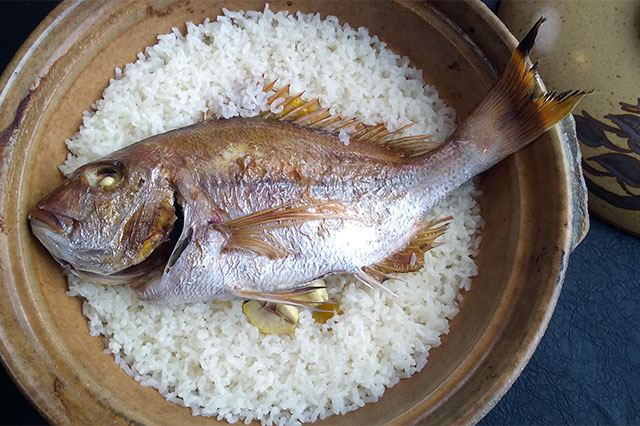
The "Singo-Song" at Tokushima Prefecture Sound Gate is one of the finest fish in the country. Growing up in the changing tide of the Sound Channel has been made into a soft, soft, and food-yaked bowl. It's delicious to eat freshly, but especially with Tokushima Prefecture is known. It's a piece of rice that keeps the bellows round or cut into pieces. The combination of tight-knit pipe and delicious rice is remarkable, and the local people are also popular with tourists who come from outside the province.
When It Is Eaten
It's not made much in a typical home, but is basically served in a restaurant for the year.
How It Is Eaten
It's the way Tokushima prepares the rice. In other prefectures, besides this cooking method, there are times when you can place a cut of the rice on the rice as well as a cut of the cucumber together.
Recipe — Serves 4
Ingredients
- 1(500 g) sea bream (生でも食べられる新鮮なものを使用)
- 450 g(3 × 180 ml) rice
- 20 g sperm
- 2 tbsp sake
- 2 tbsp white soy sauce (light soy sauce)
- 650 ml(10cm ) dashi stock (kelp (konbu))
Method
- The sea lion takes the scales and takes out the internal organs. Wash your head, your face, and your mouth carefully, and cut off your water with kitchen paper.
- Turn on the light salt (more than enough salt) and cook until it burns.
- I'll take the start off with a cloth. Put the rice in the rice cooker, and mix it lightly with wine, white oil or thin-snap cloth.
- I'll put two on top and cook.
- When you're done, we'll have five minutes of steam and then we'll get out. Get rid of the bones and relax. If you use a clay pot, if it boils, it will burn for 12 minutes. Stop the fire and evaporate for 15 minutes.
- Put the rice back on and mix it with rice.
- When you eat, you put on a rose leaf.
More About Taimeshi
The Japanese dish with rice and rice is one of the Japanese dishes.
Overview
Sung and rice are representative of foods that are more familiar to the Japanese than they used to be, and the dishes that use them are found in many parts of Japan. The condiment commonly described in modern Japan refers to what was made of a whole bowl of rice that was packed into a meal. The citrus is prepared to remove the scent and produce the flavor; the rice is prepared with oil, salt, wine, and so on. The rice bowl is often used in cooking. Once you're cooked, remove the bones, relax and tear them apart. For spices, there are sprouts of trees, needle-mediculents and so on. It's delicious, even if it's served with hot tea.
In addition to the above, there are other examples that refer to food with flavored tassels or a meal with a stamen's knife.
Station valve
The history of the railway station is seen from the Meiji period.
The lunches are now being sold at the branch station, Kobe Station, Oceanic Station, Hakashi Station, Hakashi Station, Koda, Atashima Station, Numazu Station, Numazu Station, Shizuoka Station, and Sakaoka Station.
The North Cyrene.
In the northern section of the region, it was eaten from old times.
It's a dish with a whole bowl of rice and rice, and it's characterized by the use of vegetables and fried goods only.
When the queen of Japan was on her way to the third Korea war, she sailed to North Shore Island and prayed for victory to the god Hakichi, the local fisherman brought up the fish catch in the Near Sea, and the queen rejoiced in this. When the queen cooks her dinner with the bowl, it is said that she has won a great deal of joy and good taste.
Since the condiment equivalent to the condiment of rice is believed to have appeared in the eighth century of Nara, there has been a development of the pre-Koran condensation that has been boiled in seawater, as well as what has been added with white oil.
It's the only way to get back to your bed.
The Japanese Japanese are known as one of Ehime Prefecture's native dishes, but in some areas they can be divided into two great categories. In the East and Central regions of Japan, we call it the citrus sieve. In the south of Japan, the center of the city of Kisshima, we call it the sieve, the sashimi, the sashimi, the sashimi, the sashimi, the condiment of the ingredients, the eggs, the gama, the lentils, and so forth.
There was a dish in the area that tasted like chicken, which was eaten on rice, and the name was "snap" for its type. Although it was originally part of the Japanese city, in the '50s, a restaurant that served rice under the name "Six Treasure" appeared in Japan' in the 'Six Treasure' in the '50s and became known to other locals. Then the "Creation of Life" spread in the province other than Japan, like Matsuyama City, and so on, until it became the great thing of the South Bank. In the '60s, there were many examples of saying "supreme" but eventually they were united in the name "supreme."
A cooperative from a local restaurant and other places registers local trading coordinates. There is also a tradition that the pirates based on the island of Tsukishima in the Yuichi Sea began eating without using fire on the boat.
In Matsuyama City, using the name "live and fresh" in the year of the year 21 and introduced a large measure of "surprising" as a native dish of Matsuyama City, and thereafter made Ninushima the home of its founder.
They're all beautiful.
It is said that Matsuyoshi Matsumoto, who is also known as "unspoken Lord," loved Western food that was served by his side, or that he used "saki" as a flavor for his favorite food. Based on that theory, it's a dish invented by Osama Osama Nishimura, the first on the board of the beautiful pine palm lake.
I'm going to put some of my own ingredients on the bowl, and I'm going to pour them into a bowl of rice, and then I'm going to eat them.
A footnote, a source.
The 19 East Japanese Railroad Cultural Foundation, 2015. Shizuoka Station's cooking process uses red fish for raw materials, and the package contains its message. It's a 100-year-old hood in every country. It's a 100-year hood. It's published on July 31, 2023. I'm going to make sure that you're all right. I'm going to have to go back to the rocks. I'm going to enjoy the garden and the garden in the old Ch'injiang. It's April 17, 2023.
Text adapted and translated from the Japanese Wikipedia article 鯛めし by its contributors, licensed CC BY-SA 4.0.
Dish data: Ministry of Agriculture, Forestry and Fisheries (MAFF), “Uchi no Kyodo Ryori” (Our Regional Cuisines) database, used under the Public Data License (PDL1.0); translated and adapted from the Japanese original.