Beta Mochi べたもち
| Prefecture | Fukuoka (福岡県) |
|---|---|
| Region | Kyushu & Okinawa |
| Japanese name | べたもち |
| Home area | Premarital Area |
| Main ingredients | It's not just wheat, flour, beans. |
History and Origins
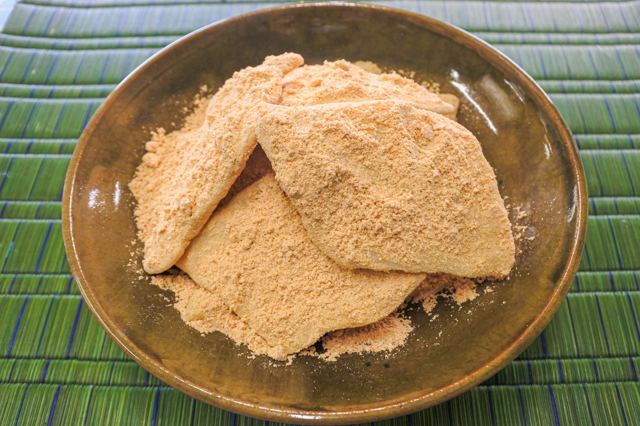
In Fukuoka Prefecture, which produces a high amount of wheat, many farmers have long been growing wheat besides rice. The wheat is ground in each home, the coral is grown in the middle of a farming business, eaten as guests' hospitality, and always made in a home. "Singu" is said to be when Tada's god saw the rice plant and went to heaven, so he said, "I'm going to climb up to the mountain." We thank the God of Tata for the successful end of the Great Aquarium, the people who participated in the rice plantings, the people who host the feasts and the autumn harvests, and the farmer's important events are now being reported to us. The beef is derived from fish from the prefecture sea and Beta. In Sugigime, the tongue-to-mouth thing is called "beta," and it is a fish that is often eaten locally. It resembles a flat shape like a citadel, and is made flatly so that in this area it is associated with the "beta" in the open eye and is said to be called "beet."
When It Is Eaten
You can eat it every year as a family food. In some areas, you can see the ovens in different areas, and you can see the hooks and the stuff in the fabric.
How It Is Eaten
The old-fashioned way of eating is for you to cover up the rich, sugary powder or to pick a little sweet bean. Recently, some stores have been stuck to toppings and treated as tasties.
Recipe — Serves 2
Ingredients
- 200 g wheat flour
- 100 ml water
- 2 g salt
- 100 g kinako (roasted soybean flour)
- 50 g sugar
- 1 g salt
- as needed ( to taste ) white sesame seeds
Method
- Put flour, water and salt in the bowl and put the powder in the earclip.
- With a stick, cut to 1 cm thick and 3 cm by 4 cm shape.
- I'll have to put it in a lot of hot water and boil it with a bowl of rice.
- While I have a little moisture, I put it in a powder with sugar salt in it.
Dish data: Ministry of Agriculture, Forestry and Fisheries (MAFF), “Uchi no Kyodo Ryori” (Our Regional Cuisines) database, used under the Public Data License (PDL1.0); translated and adapted from the Japanese original.