Bouri ぼうり
| Prefecture | Wakayama (和歌山県) |
|---|---|
| Region | Kinki |
| Japanese name | ぼうり |
| Home area | Tadashi City |
| Main ingredients | (Russom) |
History and Origins
The guardian king, sometimes called the Emperor's son, and the Emperor's son, the Emperor, was early to participate in the overthrow of the Shizuo Order. When Emperor Hirohito was cast into hiding by the "extreme transformation" in 1331, he, in order to escape the pursuit of the Confederation, accompanied by a few family members, entered the Bear Realm. This is called "The Bear Fowl of the Great Wall." When I passed through the stream districts of the now - famous Tadashi Osaka, Japan, village, village houses were covered with New Year's Day cinders. The hungry party wanted to ask the villagers for food, but the strict decree was issued not to give any charity or convenience to the mountain range, and none of the villagers gave them any food. But after a group of mountain rangers left, they knew it was the Protector King. The villagers apologized for their insubordination, and then they stopped having soup in New Year's Eve for 600 years, and they began to boil and eat the potato, the father of the lily potato. In 1935, at the 600-year-old patron of the Kyoto temple, even the villagers of the Great Towers joined in to offer up 600 offerings to them in apology for their old insubordination. After that, I started to prepare rice on New Year's Eve, but there are still some cultures in New Year's Eve that still eat "shoe" on New Year.
When It Is Eaten
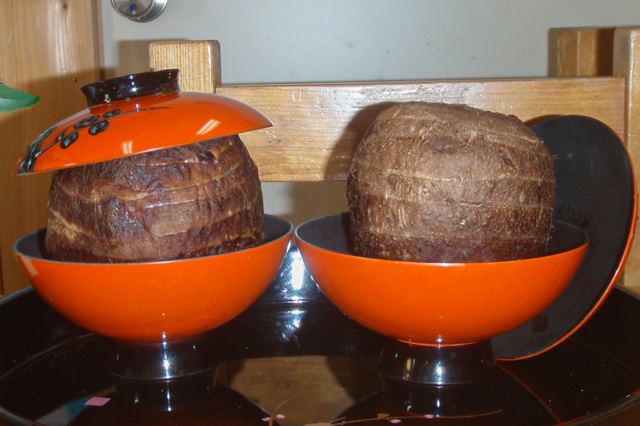
In New Year's Eve, they will boil their mother potatoes for two days without skinning them. Put it on a plate and celebrate it and eat it instead of the stew with the bowl.
How It Is Eaten
Cook four to six hours a day and stir the taste on the second day. The sauce is flavored with soy sauce with soy sauce, sugar and so forth, and you can feel the old-fashioned simple taste.
Recipe — Serves 1
Ingredients
- 1 taro (親芋)
- ジャコ, to taste
- Mix: mirin, to taste
- Mix: bonito flakes, to taste
- Mix: sugar, to taste
- Mix: soy sauce, to taste
Method
- Day: Jaco and cassobar, and make soup.
- Sunlight: A full bowl of freshly prepared soup and flavor A add to the flavor and add it to a thick flavor.
- Sunlight: First they boil in a strong fire, then they boil in a weak fire.
- Sunlight: Four hours in a low fire, and six hours in a fire, and then a fire can be stopped, and it can be a night's match.
- Day: Cook the cooking pot for two hours, looking at the taste content, making a fire again, and making sure it doesn't break.
- Daylight: It's getting cold.
- One point: But the juice is good for many, when the juice is gone, and when the juice is in the soup.
- The potato's mother, seven days ago, was dug from the fields, root and soil. Washing it two days ago, and sitting in the sun for a day and a day. )
More About Bouri
The local dish of Wakayama Prefecture. It was made of whole rice and spread over a bowl, and in Oyama village it was also eaten as condiments instead of rice.
Origins
In 1331, when the guardian father-in-law had fallen into the bearwood, he had taken advantage of the village's desire to visit the village, but the village had also been declared "not to be accommodating those in the mountain range." The villagers who later learned the identity of the mountain-sowned people said they had eaten the "shoe" that had been boiled in the New Year instead of the "sun" in order to apologize for their impurity.
When the six hundred-year anniversary of the guardian king's funeral at Kyoto City in 1935, the villagers of the Great Tower village also joined in to apologize for their past indecision and offer sacrifices with 600 sacrifices. From then on, I've been starting to plant eggs on New Year's Eve, but the culture of eating "sniff" on New Year's Eve has continued to be part of it.
Text adapted and translated from the Japanese Wikipedia article ぼうり by its contributors, licensed CC BY-SA 4.0.
Dish data: Ministry of Agriculture, Forestry and Fisheries (MAFF), “Uchi no Kyodo Ryori” (Our Regional Cuisines) database, used under the Public Data License (PDL1.0); translated and adapted from the Japanese original.