Home / Wakayama / Hata Gonbo Zushi
Hata Gonbo Zushi はたごんぼずし
| Prefecture | Wakayama (和歌山県) |
|---|---|
| Region | Kinki |
| Japanese name | はたごんぼずし |
| Home area | Hashimoto City |
| Main ingredients | Noodle. |
History and Origins
"Skie-ki" is grown in the West Coast area of Hashimoto, situated on the middle of a mountain at an altitude of 552 meters. That name comes from the "snake" and the like in the West Coast area. Not a special breed, but if you grow your bladder in the hard red soil on the steep slope, you'll grow up to be a whole fat, fat "kids." Especially large ones are 5 to 10 centimeters in diameter and about a meter in length. In the past, it has been said that when harvesting, he dug more than a meter of sticky soil in a long walnut, and he had harvested a single piece of soil for 20 or 30 minutes. It took so long to say in the neighborhood, "Don't do it for your son-in-law." However, because of its size, it is generally relatively large, rich in fiber and polyphenol, soft and smells good. Also, the village at the foot of Takano Mountain, "Stretch of Twa," is used in the custom of offering rice and vegetables to Takanoyama. The "Things" was supposed to have continued from the Edo to the early primer, but since then the local union has been back on the scene since 2014.
When It Is Eaten
It was eaten as a farm food. We can sow seed in spring and harvest in November.
How It Is Eaten
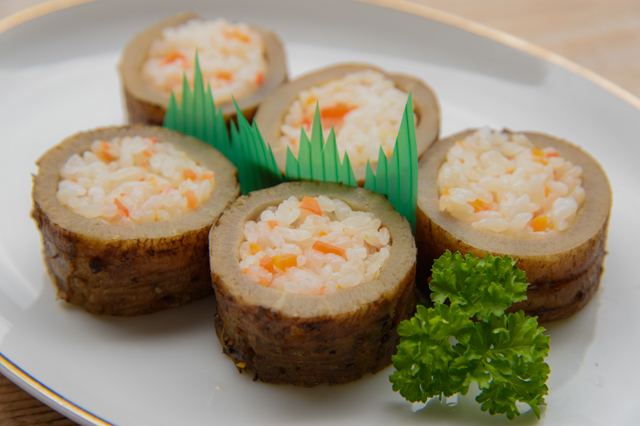
The original menus sold in local unions. The rice was cut through the middle of the rice fields and packed with rice. In addition to this, there are many different recipes and uses, such as tin cans, and candies, and so on.
Recipe — Serves 7
Ingredients
- Sushi rice: 400 g 【】 520 ml 【】 1/4 cups 【】 2 tbsp2/3 【】 1 tsp1/2 to taste 100 ml 25 ml 6 g 40–80 ml 100–150 g to taste rice
Method
- Put the rice in the rice bowl or bowl, and cover the whole bowl with the amount of vinegar. It'll be a little sweeter than a roll.
- We wash well (so that we can choose the thick bladder and remain dry until the soil is gone.)
- Make the cucumbers six centimeters long and cook the soup in the pot until it is soft. I'll cut out the center of the crab while it's warm and stay overnight. In a private home, cutting to two centimeters is easier.
- Carrots are cut into pieces, seasoned with the same amount of boiling juice as rice, cut out some toppings and mix them in rice.
- Pack four of the rice into a tube of centimeters and cut it into two centimeters wide, and put it in the middle of the carrot. If you cut it into two centimeters in three, you'll just have to pack your rice.
More About Hata Gonbo Zushi
The rice paddies are traditional vegetables from the West Coast district of Wakayama Prefecture. The larger ones grow from 5 to 10 centimeters in diameter to about 1 meter in length, but they're not special.
Overview
The name is "Gobau in the West Field." It's an old-growth fish grown in the West Coast area of Hashimoto. The largest one is from 5 to 10 centimeters across a diameter of 3 to 10 centimeters. It's about 3 feet long, but it's not a special species, but it grows big by growing it in hard red soil on a steep slope.
At the time of the harvest, they used their own long bowls to harvest with time and effort, so that they were told nearby, "Don't do it to your son-in-law."
Since the Edo, growing plants have been so popular, as well as the history of the state, that they are sold to Osaka, and farmers are expected to be able to make enough money to prepare for the New Year by selling their food. However, as a special birth, it gradually decreased, and in the early days of the Showa, it was only grown to eat on its own.
Resurrection
In 2008, when farmers grew old and more land was abandoned, the union head of the agricultural exchange union at that time, Okamoto, grew up to be the sole owner of the farm's farm. However, the special product was a problem with increasing crop yields, such as low yield, land security, intensive farming, and soil improvement.
We helped grow and harvested about 500 grams of rice from the ten-ireer grounds. The harvested rice was taken to a supermarket in Osaka Prefecture, and it was indeed "sold only" and the agricultural exchange union increased the yield by 20 to 30 and 16 years by double in 2014 and increased the yield by 270 pounds. Wakayama Prefecture continued to support Hashimoto City, and in 2015, a new ten-foot square square building, with a addition plant near the Gobau field, was built.
In March 2015, Wakayama Prefecture identified and recommended by the elite province's product "Premia Mountain" was awarded a special award to the committee and was added to the tribute to the hometown tax donation (furusato nozei) in Bridgemoto.
The gobow causes a conglomeration disorder, so it can only be produced in the same field for two years. So the task of searching for distant agricultural land and building land is therefore called the task of finding and building land.
Use
A dish with rice and rice in it. This is the dish that was eaten as a farmer's daily food.
Text adapted and translated from the Japanese Wikipedia article はたごんぼ by its contributors, licensed CC BY-SA 4.0.
Dish data: Ministry of Agriculture, Forestry and Fisheries (MAFF), “Uchi no Kyodo Ryori” (Our Regional Cuisines) database, used under the Public Data License (PDL1.0); translated and adapted from the Japanese original.