Ikameshi いかめし
| Prefecture | Hokkaido (北海道) |
|---|---|
| Region | Hokkaido |
| Japanese name | いかめし |
| Home area | Transit area |
| Main ingredients | I've got squid, rice, rice. |
History and Origins
The famous native food of the country. It is said that during World War II, the "Cookfish" was invented as the station's express at the Posto House Line Station, while food shortages in food control have become severe. The food that we used to use "a little rice saving" was, at that time, a squid that was used in large quantities in the south of the country and was easily available. The "coach" that was packed with rice in the squid was easy to eat, but it was also a delicious and delicious dish to eat, and it was still the popular station that many people bought every time the train arrived.
When It Is Eaten
A "coach" can be cooked relatively easily in a private home and can be enjoyed throughout the year. They're very close to each other as well as to other children. They're loved by a large generation, from children to adults.
How It Is Eaten
Take off the leg of a squid called geso, remove its internal organs and cleanly washed body, fill it with rice and rice, fill it with twigs, add oil, sugar, salt, and wine, add it to the pot, and then soak it thoroughly. The rice is cooked with the squid's flavor and the sweet taste of its tassel. When you cook it, if you add too much rice in it, it will burst, so be careful. To prevent a rupture, you had better put a hole in the squid's body with a twig in it. As a tool to pack in with rice, it is delicious to add finely carved peas, peas, and green pieces.
Recipe — Serves 4
Ingredients
- 4–8 cups squid
- 1 cups glutinous rice
- a pinch pickled red ginger
- dashi stock, to taste
- 2 tbsp sake
- 1 tbsp sugar
- 4 tbsp soy sauce
- a pinch salt
- 4–8 hurray twigs
Method
- The squid will remove its internal organs and legs and peel them off and pour boiling water on them. My feet are cut into about five millimeters, and I cook with a thin taste.
- The rice is cooked overnight, then cut the moisture, mix the squid's feet together, fold the squid's body, and hold off its ends with a nail branch.
- Put the liquor in a pot, put it in order, place it in order, and pour it in half an hour until the juice is picked up, add sugar, sesame oil, salt, and let it boil slowly.
- If you have a large squid, you can cut it like two centimeters, and if you have a small squid, you can keep it standing and cut it in a pan and make a slice of red pepper.
More About Ikameshi
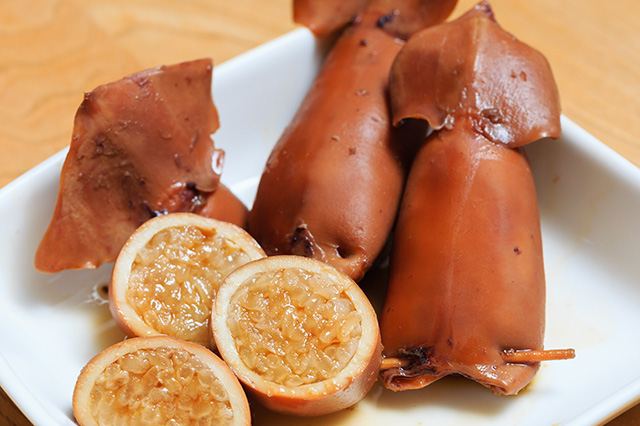
Ikameshi (烏賊飯; literally squid rice) is a Japanese dish of rice-filled squid. It is a regional dish from the Oshima area of Hokkaidō.
Preparation
Ikameshi is prepared by removing tentacles from and gutting the squid, which is then stuffed with washed rice and cooked in dashi. Toothpicks and other such items may be used to keep the rice in place. The rice itself is usually a blend of both glutinous and non-glutinous rice. Other ingredients sometimes used as stuffing include minced squid tentacles, bamboo shoots, carrots and aburaage.
History
In 1941 during World War II when food rations had a shortage of rice, Mori Station ekiben vendor Abeshoten (now Ikameshi Abeshoten) decided to use the plentiful Japanese flying squid that were being caught at the time as a way to ration the supply of rice.
After the war, in 1966, Keio Department Store held their first annual "Famous Novel Ekiben and National Delicacies Competition" (元祖有名駅弁と全国うまいもの大会, Ganso Yūmē Ekiben to Zenkoku Umaimono Taikai), for which Abeshoten entered their ikameshi dish. By the second competition, sales of ikameshi reached the number one ranking and became a regular entry in subsequent years. This gradually made it known nationally as a Mori delicacy and a Hokkaidō delicacy in general.
In recent years, other manufacturers of ikameshi other than Abeshoten have cropped up, and it is now possible to easily obtain it packaged and preserved by such means as special events and mail-order. Even in Honshū, it is sold at many stations where squid are caught nearby.
Text adapted from the English Wikipedia article Ikameshi by its contributors, licensed CC BY-SA 4.0.
Dish data: Ministry of Agriculture, Forestry and Fisheries (MAFF), “Uchi no Kyodo Ryori” (Our Regional Cuisines) database, used under the Public Data License (PDL1.0); translated and adapted from the Japanese original.