Home / Hokkaido / Ishikarinabe
Ishikarinabe 石狩鍋
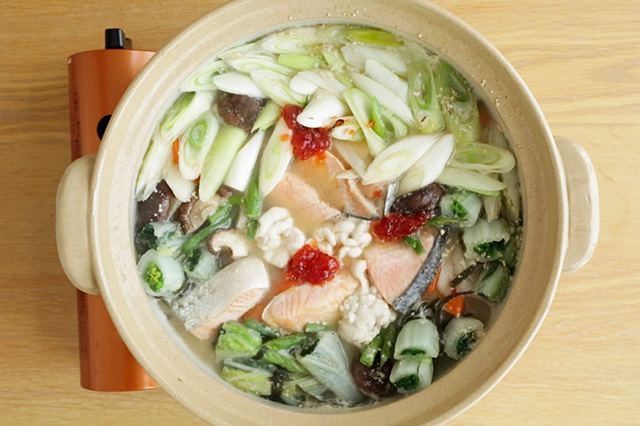
| Prefecture | Hokkaido (北海道) |
|---|---|
| Region | Hokkaido |
| Japanese name | 石狩鍋(いしかりなべ) |
| Reading | Ishikarinabe |
| Home area | Stone - Hunting Land |
| Main ingredients | It's called the salmon. It's called the cabbage. |
History and Origins
The "Sacrifice Cauldron" is a native dish representing Hokkaido. It's supposed to be a fisherman's dish, born of a stone-hunting town on the mouth of a river famous for the Sake. In the stone hunt area, fish fishing was a big business since the days of Edo. During the celebration of the great fishing season, fishermen were said to have put the fresh pumpkin chops into a pot of citrus and eaten them as a reward. In the 20th century, when the fishing fishing nets of Sake City were noted as a symbol of the water industry of Hokkaido, many tourists gathered for their fishing. Since fishing nets have time to go from the sea to the ocean and to pull them up, it is said that the time it takes tourists to act on "Stone Hunt" to the tourist's "Sacrifice Cauldron" is delicious and has become known nationally.
When It Is Eaten
Winter cooks that heat themselves in cold winters. The taste buds are used to warm up, and they are preferred to boil and eat in a large pot. It was originally a fisherman's dish, but now it's also a regular home dish. Tourists are also popular, and in the stone hunt districts there are several stores famous for "Sacrifice Cauldron."
How It Is Eaten
The "Sacrifice Cafe" is a dish made from chopped saxophones and peppers along with vegetables. Put them in the juice, taste them with a sauce, and finally, if you put a bowl on your accent, it will be a delicious dish. Vegetables often include tools such as lily cabbage, long hair, radishes, tofu, tofu, and so on, depending on the family. In some families, the amount of money is spent on the end, or taste in butter. The leather collagen that is destroyed by burning is also well-known in the "Sciento Cauldron" and is known for its beauty.
Recipe — Serves 4
Ingredients
- 400 g salmon
- a pinch 白子
- a pinch 筋子
- 1 blocks tofu
- 1 konnyaku
- 150 g daikon radish
- 100 g carrot
- 4 shiitake mushrooms
- 50 g burdock root
- 3 long green onion
- 100 g spinach
- 4 Chinese cabbage
- 50 g green beans
- 30 g3 dashi kelp
- kelp dashi stock, to taste
- Miso: 100 g miso
- Miso: 2 tbsp mirin
- Miso: a pinch sugar
- a pinch salt
- a pinch ground sansho pepper
Method
- The salmon is cut into pieces, the albino is cut into the right size, and the muscle is removed from the skin and turned into a rose.
- The tofu is cut in pieces, the tofu is cut in half, the radish is cut in half, the radish is cut in half, and the lentils are cut in half.
- The cabbage and spinach are boiled and ground and wrapped in green, and wrapped in white, and tied in four strips with finely cut cloth, and cut into about two centimeters. Shinji takes the muscle and folds it with her hands and turns it blue.
- You can put cloth in an iron or earthen pot, mix it in the middle, mix it with a mixture of garlic, garlic, sugar, salt, and put them around you and place them in a set of vegetables such as salmon, mustard, mustard, tofu, and so forth.
More About Ishikarinabe
A stone-hunting pot is a Japanese dish made mainly of rice and tasted with citrus, a native dish of Hokkaido.
It is often mixed with salt-stained sesame juice, but a stone-hunting pot is a taste-soured pot and uses raw rice that is not salted.
Overview
Stone-hunting pots are supposed to be boiled in juice from the juices that come out of the cloth. It may add a broth to the juice or use butter, milk, and so forth for a hidden taste. The last thing you eat is eating the berries or flour.
Origins
The name is attached to the stone hunts that the fly goes back to when it is laid. The use of Western vegetables, such as onions and cabbages, which were not used in the cooking of fishermen back then, and the use of the mountain bush with moss in a pot to suppress the scent of the cucumbers, is viewed as an idea by the Great Golden Man.
Native food.
Stone-hunting Cauldron Day
It's the anniversary of the "The Barnacle's Party" established at a restaurant in the city of Stonehunt for the PR of stone-hunting pots, and September 15th every year. I applied to the Japanese Memorial Society and was officially recognized in July 2008. Because the date is when the ducks are caught in stone hunts, and the word "eat" and "eat" is used to read "let's go eat" and so on.
Text adapted and translated from the Japanese Wikipedia article 石狩鍋 by its contributors, licensed CC BY-SA 4.0.
Dish data: Ministry of Agriculture, Forestry and Fisheries (MAFF), “Uchi no Kyodo Ryori” (Our Regional Cuisines) database, used under the Public Data License (PDL1.0); translated and adapted from the Japanese original.