Home / Shimane / Kakuzushi/hakozushi
Kakuzushi/hakozushi 角ずし/箱ずし
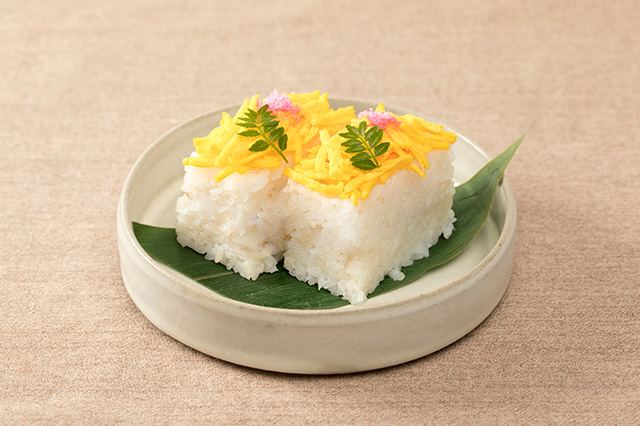
| Prefecture | Shimane (島根県) |
|---|---|
| Region | Chugoku |
| Japanese name | 角ずし/箱ずし(かくずし/はこずし) |
| Reading | Kakuzushi/hakozushi |
| Home area | Iseshima |
| Main ingredients | It's a very simple process. |
History and Origins
"The horn" and "the box" are a type of pusher. The difference is that the wooden frame you use is in the shape and size of the frame you use. The angle is easy to push with a small wooden frame of about five centimeters. In addition to the shape of angulars, there are flowers and pine pines and so on. On the other hand, the wooden frame used for "boxing" is larger than the "horns" and will be cut into pieces. In recent years, many areas have built small, easy-to-do "horns," but in some areas, the "boxing" that can be made in large quantities at once is rooted in local food. The "box" that comes to me in the Hijito area doesn't press me with fish or meat. Add rice, vegetables, and thin boards to the wooden frame of the curve. And then again and again, rice, vegetables, thin boards... Finally, press the top to cut it, and then add the silk eggs, cherry, cherry, blue leaves, and carrots. There's also the theory that during the war years, it was passed on as a military food.
When It Is Eaten
In the past, it was made at home and eaten on a Hale day. They say "the horn" is small and easy to make; there used to be a wooden frame for housemaking and it was natural to make "the horn" on Hale's day. Even today, on Hale Day, there is still a pyre that produces "horns." Also, it is said that in the past, the wooden frame for the sushi had been inherited as one of the marriage tools and as part of the family. It was preserved so that it was not only treated at a feast but also used heavily in giving births and visiting diseases.
How It Is Eaten
The "horns" are wrapped in rice, so the top decoration seems to be empty, but when you eat it, the "box" shows up, so you can see it from the side.) Materials don't use meat or fish, but are the center of vegetables. Fill the wooden frame with vinegar rice and place on top of it the soy sauce and sweetly boiled carrots, rice and so forth. If you put rice on top of it, it will grow by adding lids and pressure. In some cases, the finishing touches include the rich silk eggs, cherry nuts, and mountain peppers, and so on, adding color to the meal. In this decoration, there are no rules, no rules, no rules, and no family personalities.
Recipe
Ingredients
- 4 × 180 ml rice
- Mix: 8 sake
- Mix: 10cm dashi kelp
- Mix: 5 tbsp vinegar
- Mix: 2 tbsp sugar
- Mix: 1 tsp salt
- 60 g burdock root
- 40 g carrot
- 10 g dried shiitake mushrooms
- 1/2 longyang
- Mix: 1 cups shiitake soaking liquid
- Mix: 1 tbsp soy sauce
- Mix: 2 tsp mirin
- 16 Kintoki beans
- as needed shredded egg crepe
- as needed 青葉
- as needed denbu (sweet fish flakes)
Method
- Rice should be cooked in A.
- The dried will be returned with water. (Ringing)
- Ooji, carrots are to be dried and cut thin. I'll cut up the long sky. (Clicks off fine.)
- I cook and season the tools with C.
- When the rice is ready, we mix B with vinegar and cook rice.
- Four tools and a gold-time bean are placed in a rice bowl and rolled and put into a wooden frame.
- On top of the wooden frame and on top of the top of the layer, the silky eggs and the leaves of the green leaf (such as the citrus leaf) and the cherry blossoms are adorned with the cherry tusk.
Dish data: Ministry of Agriculture, Forestry and Fisheries (MAFF), “Uchi no Kyodo Ryori” (Our Regional Cuisines) database, used under the Public Data License (PDL1.0); translated and adapted from the Japanese original.