Nira Senbei にらせんべい
| Prefecture | Nagano (長野県) |
|---|---|
| Region | Chubu |
| Japanese name | にらせんべい |
| Home area | North-Western Area |
| Main ingredients | It's just rice, flour, taste. |
History and Origins
The mountain-stained northeastern region had many steeply sloped fields, small rice fields, and a lot of wheat instead of rice. Also, on the flat ground of the Chikashi River, the wheat was grown around the center as a back-growth of the rice paddies. Rice was so valuable that it couldn't eat every day in its own home that for the sake of saving it, a dish that has long been called flour, has played an important part in daily meals. Among the flours, the ones that were boiled and baked with carved vegetables were called "shoe," or "sook" or "sook" or "berry" or "beep" or "beep" or "beep" or "beep" or "beep" are often made of them. (Singing) is a change in "sunday," which is like a middle meal between meals. A good food was made to eat during the farm work. The season vegetables that we plant in the garden include rich vegetables, cucumbers and so on, but since they are easy to grow and can be harvested any time except winter with snow, every house has been planted in its garden with valuables. Especially when you're a soft spot growing out of spring, you say that the crinkling is a special taste. There are different ways of making soy sauces from different families, and there are different ways of making them. In the old days, we used to put abrasion on fire and oil in cotton to save oil, then rub inside it and pour the melted flour into it and burn it. When I burned it, I cut it into the right size to eat.
When It Is Eaten
They're being eaten through the year. I used to make and eat during farm work and as a baby boy's.
How It Is Eaten
The fabric is baked with a lot of oil and spread out to make the surface look delicious. Add a little taste dandelion and a little oil dandelion and add it to the taste and add it to the cooking pot.
Recipe
Ingredients
- 80 g () 200 g 200 ml to taste 【A】 40 g 【A】 1 tbsp garlic chives
Method
- Wash the lentils well and cut them to 15 mm wide.
- The bowl is filled with ground powder and water, and rice, and flavor A, and blend tightly together. (You can eat it with no flavoring, sugar and so on.)
- Add oil to the frying pan, put it in the middle, and spread two thin.
- When the branding is done, it will turn over, and it will be baked with two faces and finish.
- If you can't add flavor to the dough, eat sugary oil or sugar taste whatever you like when you eat.
More About Nira Senbei
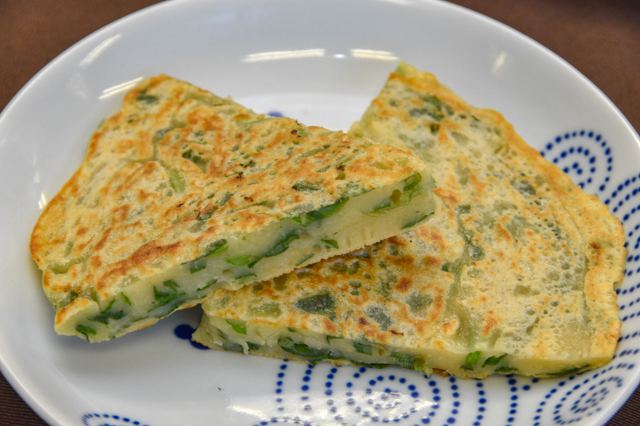
Nilaa is a food similar to a baked chimp that has been cooked with water to melt medium flour, flour, and other flour, plus nilas, milk, eggs, and so on. The shape is circular and is known as the native dish of the Nagano Prefecture region.
Overview
It is a local dish that represents the powdered culture of the state of Hokkaido. Also, the nira from the wild was made well for farm breakers and children.
Nilaa is also a staple food and is now eaten as a food by the common folk, who have always been so close to us. Nilaa, which can be harvested at any time because of the hard growing of crops, has been highly prized in the northern part of the country. Also, they call it "sniffing" by changing the way that they eat food at a break in farming, or a more hungry snack than a snack. It is thought that the name Nilaa was derived from a meal made of flour, like the "Koji" and that it is now eaten as a "Snapfish" that has come to be called "Ni-Ni-Nai."
Text adapted and translated from the Japanese Wikipedia article ニラせんべい by its contributors, licensed CC BY-SA 4.0.
Dish data: Ministry of Agriculture, Forestry and Fisheries (MAFF), “Uchi no Kyodo Ryori” (Our Regional Cuisines) database, used under the Public Data License (PDL1.0); translated and adapted from the Japanese original.