Sasamaki 笹巻き
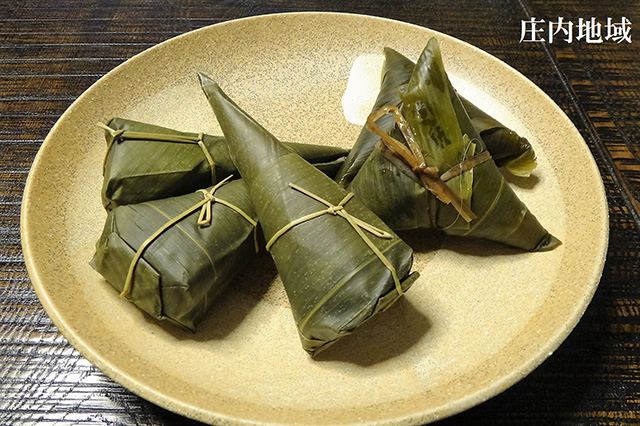
| Prefecture | Yamagata (山形県) |
|---|---|
| Region | Tohoku |
| Japanese name | 笹巻き(ささまき) |
| Reading | Sasamaki |
| Home area | All within the province. |
| Main ingredients | The leaves of rice, the leaves of rice, the sugars, the sugars. |
History and Origins
"The conch is a dish that was boiled after the water was soaked, wrapped and tied with leaves of the rice, and then boiled in boiling water." In other states, "scork" is also called. It was said that the leaves of the carp have a perforation and antibacterial properties, and it was a common ingredient for storing food and wrapping mobile food. Yamagata Prefecture eats well over the year, through the year, through New Year, through festivals and celebrations, and so on. These cultures are not unusual in rice fields, but they are boiled in salt water such as is made in the southern part of the city of Sakura. There is a theory that the "Cyrus" that boils in lye water was passed on as a food preserved through the war of Zheng He. Sakura was especially put in the last paragraph on May 5th, and was eaten in each family, as well as in the hope that the child's health and vigor would grow.
When It Is Eaten
"The Sakura" is a common dish in the last phrase. There is also the custom of using nearly 50 leaves of the tree for New Year's and the 7th festival (symbolics) to celebrate the celebration in every single house in the village. In times past, snowy Yamagata Prefecture often celebrated the phrase above the phrase, or the phrase at the end, a month later. By the end of May and June, the leaves of the carp grew big and were just the right size for the sieve. We don't celebrate much late at the present time, but we can use it all year round by boiling and freezing the leaves. In the meantime, there's been a decline in "reflection" in families, but more families are buying and eating at supermarkets and re-sales and so on.
How It Is Eaten
I'll unwind the leaves and eat them with sugar. In some areas salt is added to it, and in others it is not sugar but black honey that combines. It is common to eat with black honey on a bowl cooked with lye. The citrus not only eats and drinks but also has localities in recipes, such as the manner in which the leaves of the carp are wound, the way they are tied, and the time in which they are cooked. For example, the leaves of the carp are the main source of the circle, but in the top of the country, they can be round and they can be spiraled in the upper part of the country. The ingredients that connect them are: 'Gooji', 'sai', 'gai' and 'sama'. The cooking process of boiling rice in boiling water, which is rolled with leaves from the leaves, is widespread, but in the southern part of Kookaoka, there is a method of cooking it on top of the lye. The way the lye is made is to put 100 grams of ash from the burning of oaks, beech and cherry trees into water, put 900ml in water, put it in fire, boil it, and then take the solution. The fluoronoid pigment in the rice that is boiled in a pure solution of lye water turns yellow in alkali, the rice grain turns into a soft, sticky food, and the rice grain is different from the kind of citrus that boils in boiling water. If, at the bottom of the preparation, the rice is soaked in brine or cooked at different times, the recipes will have a wide range of colors in the community.
Recipe
Ingredients
- 460 g(3 × 180 ml) glutinous rice
- 30 bamboo leaves
- 15 rush grass
- kinako (roasted soybean flour), to taste
- brown sugar, to taste
- 480 g(3 cups) glutinous rice
- [Singing with Linge water] (重曹でも代用可), to taste
- 30 bamboo leaves
- a pinch baking soda
- 15 rush grass
- kinako (roasted soybean flour), to taste
- brown sugar, to taste
Method
- The rice is polished in water overnight, and must be lifted up, and cut off the moisture.
- The leaves of the tree will be selected from the mountains and from the river. Wash, put in a pot, fill with plenty of water, cover, and cook over the fire for about an hour. The ones that were frozen or which were dried and stored in the previous year are soaked in boiling water and then cooled and washed one after another and used to drain the water. (Customer) The string is made to tie. It is cooked and soft together.
- One leaf of the bush will be rolled into a circle, and I'll make one teaspoon of rice or a cup of rice. We will reduce the volume to the size of the leaves in the plant. )
- It folds the lid with another leaf of the plant, and it folds the edge into a foldd triangle, and it pulls the edge around the corner of the triangle to make sure it doesn't break. The shape and the tie of the cord vary from region to region.
- Put them in a large pot, fill them with plenty of water, and cook them in the fire for about an hour. Put a hundred grams of wood made of boiling citrus, bna, and cherry trees in a cloth bag made of citrus water. Put it on fire with 900 meters of water, boil it for about ten minutes, sit down for a day and a night, and take the citrus juice. The rice is soaked overnight in this salt water and cooked with the same mold as the rice. The time of cooking is cooked for two hours. You may use a soda.
- Turn off the fire and take it out of the cold. I'll unwind the leaves and put sugar on the mushrooms and eat them. Or eat black sugar in small amounts of water, or with black honey.
Dish data: Ministry of Agriculture, Forestry and Fisheries (MAFF), “Uchi no Kyodo Ryori” (Our Regional Cuisines) database, used under the Public Data License (PDL1.0); translated and adapted from the Japanese original.