Sunkizuke すんき漬け
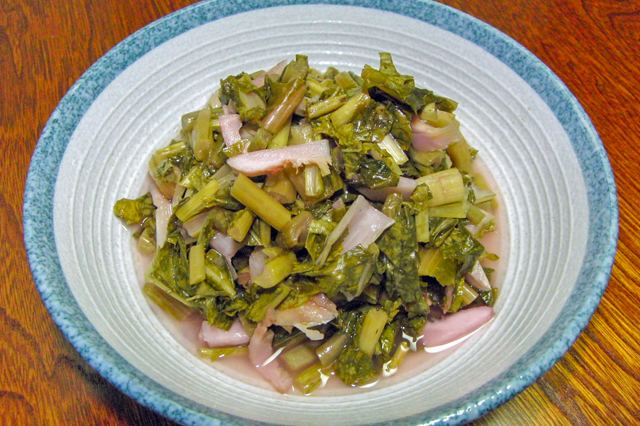
| Prefecture | Nagano (長野県) |
|---|---|
| Region | Chubu |
| Japanese name | すんき漬け(すんきづけ) |
| Reading | Sunkizuke |
| Home area | Kiso |
| Main ingredients | Red suit. |
History and Origins
The mountain Kimura region has long been rooted in its own culture of diet, one of which has a red - robed leaf and has a "snacked" on it. The word "sniff" comes from the word "sniff" meaning "sniff" in an old-fashioned food food that has been passed on to the Habu region by adding "snap seeds" without any salt. In times of not having distribution or traffic, salt was a very valuable commodity in the remote mountain valley of Haji, far from the sea, as it was said, "Susan doesn't lend you salt." To save salt, this glue, which comes from the wisdom of living, has a unique acidity and has a taste different from that of common matter. History is not established, but it is said that at a one-gate meeting, "the spring is falling" and that there has been a dish in ancient documents about 150 years ago, that it was at least 300 years ago. The raw red coat uses the old wooden sieve grown in the Japanan region. There are six different types of clothing that are based on the local location. It is said that the natural lactic acid in molds is particularly found in the roots of the stem and root. And I'm telling you that it's not the subtle difference between the lyses in the coat's lyses, whether it's the wind's soil, or whether it's the other kind of tingling that doesn't do the same. In times past, the seeds of the mountain's own plant, such as the green plant, were beaten down, crushed, and fertilized, used as a "mew seed." Now, they use them as "snack seeds" to dry or freeze the past year. A recent study shows that there are four types of lyses that can be compared to yogurt, and that there are four that can be picked up from more than 300 different types of lysics. A serious study of stacillus acid from the 15th century on has been conducted by Professor Tokyo agricultural University and a prototype of the plant's four different types of lyses.
When It Is Eaten
Snacking is a winter-sleeve-requested staple that can be made from late autumn to winter. Since molds are delicious when they get cold, and the bacteria are said to be more active, they are harvested after waiting for frost to fall. A few decades ago, in the cold, woody regions, they would have eaten the frozen wood from their tubs.
How It Is Eaten
A common dish uses a lot of salt to increase its preservation, but a snack is poisoned by boiling the surface of a leaf with a 60 - degree water. The freshly boiled leaves add juice in a container filled with plastic bags while warm. Since lactic acid causes the bacteria to die when it is hot, it's important to take care of it. Putting one day in a warm place will make it sour. When it's ready, eat it as it is, and put it in a bowl and eat it. Nowadays, we have more ways of eating Japanese and Japanese food.
Recipe
Ingredients
- 3 kg vegetables
- 700 g すんき漬けの種
Method
- After thoroughly washing the dish, leave a bit of a coat on the stem so that the base of the stem remains.
- I'll heat it up in a large pot. I'll pass through the water with the intention of "I'll boil it in hot water."
- I put a plastic bag in a storage container, and I alternated with a two-sniffed seed.
- When you're done with the carpet, fill the water in two with enough water to soak up the leaves, pull out the air, and close the plastic bag.
- Cover it and keep one day in a warm place.
- If you open it the next morning and taste it, and it's sour, then it'll be finished. In a cool place, two or three days more, and then the acidity and flavor become stronger and then keep it in a cool place.
More About Sunkizuke
Snacking is the traditional food of the Nagano Prefecture region, and is a form of gravy made from the red casserole of a local local brand.
It is made by boiling the red cacabs stem, filling it with salt and rinsing it with a soaked seed, and rinsing it with lactate. By the work of lactic acid, which can be obtained mainly as a by - product of the citric acid and other microbes, it is possible to add and store a particular acid and flavor. It is soaked by winter limit and eaten mainly from winter to early spring. In addition, similar nicknames made from Kyoto Prefecture are a product of a different kind of splicing than chewing, such as adding salt and promoting the fermentation by mild heat.
Description
A common substance, such as shallows, uses salt to suppress the growth of bacteria, such as decay and food poisoning. However, Kisaki is a mountainous country far from the sea, and salt was so valuable as to exist when it said, "Susan does not lend you salt." It is therefore difficult to use a lot of salt to store vegetables, and it is thought that it has resulted in an insulable extract. If you don't have cold climates like the old Kotamura and the King's Falls village, you won't be able to absorb the flavor and texture of the treetops. A similar saltless substance has Niigata Prefecture "bunk" or "snack" from Fukui Prefecture, but is now produced little.
Snacking makes it more difficult for bacteria to reproduce by boiling the material, causing germs to be killed, making it more likely to increase in size, and putting them under the cold. It's a viscosity of lye growth by lactic acid and hypothermia. Maintaining low temperature is important in quality, and if average temperature exceeds 0° C, quality drops. It has been reported that when pH is near 4.5 when you finish, it has just the right acidity and the best flavor. If the average temperature is above zero degrees, then in about nine weeks, pH will sink down to 3.0, then green gray will appear, and it will be bad for taste and preservation.
Nutrition and function.
Snacking was a valuable source of protein in winter because the raw protein in the raw materials was preserved without any reduction. This is thought to be due to the decrease in the enzyme's activity if compared with a small amount of salt, because the protein in the raw material is resuscitated by water and uses very little salt.
Snacking contains lgE bacteria that suppress the IgE antibodies that cause various allergies, and of these, experiments with mice have resulted in the control of allergic diarrhea. However, the epidemiological study on the absence of binge intake and allergic disease reported no significant correlation.
How?
The raw red cacabs are used as raw materials. As a species of red cacabs used for wobble, such things as Koda, Akishima, and Kiyoshi, are known. As a ground-up seed, it is used to dry and to fertilize juices, lentils, and vines. It's said that the diploid species has an acid environment in which the bed is first absorbed, not as a micro-stor, but at the beginning of the zygote.
Process
Cut off the leaves of the red cacabs, cut them as they were, or cut into three-inch cubes, put them in a boiling pot, and water them lightly. After a whole night in the room, they store them in a cold shed or a shed, or they store them in cold sheds or in storage from the first day. You can eat it in about a week, but when you mature, you'll stick it in for about two months.
Use
You can eat it as a food with its unique acidity and a good sense of smell. Since it doesn't contain salt, we cut it to the right length, add a cutd stilt and oil, eat it with rice, as well as tea and tea. It's also used as a everyday dish material for boiling, boiling, boiling, cooking, cooking, cooking, rice, and so on. It's used in various ways. Snacked in winter, in early spring, is taken out of the bowl by a shade that is naturally dry and makes a dryer. This can be used as a seed for the hardwoods, and can be used in water-repair cooking, and has been eaten as a stored food since early spring.
Cooking example
- It was cut fine and put into the yuzu sauce. Having a sense of humor, it has an increased appetite effect. It's delicious. In Kudamura we can often eat it when it comes to the autumn farming program called "Puy." - You can eat in Kudamura. Instead of slicing flour, it's a piece of powder that has been spread out to a flat surface and cut to the ground. Put it in the juice, taste it, and eat it along with a snack.
Development of yogurt
We've selected the lactic acid that has been separated from the duplicating and have developed a germ form of yogurt.
Cultural inheritance
From then on, Sunkicon contests are conducted every year in Japan.
In 2014, Kisawa City passed a precedent for the rise of the food harvest. They're subject to such things as taste-smelling with taste-smelling balls.
It was registered with a geographical display protection system on May 26, 2017.
Relationships book
ISSN29-0994, NASSNAC, ALIACI 1339676789.) ISSN 2932-03, NASSEREZE, ALICEO PORTURGE PORTUGE, "Integrity Substitutions: "The Japanese Food and Agriculture Society" 32rd, 1985, 208, Doi: 10.3136 / nsk1932.32.32.208, ISSN 29-03, NAID13375788535311. ISSN 0367-5963, Nasser, Nasser, Nastyki, and INDOW, Nacchan, Jr. ISSN 0286-1178, NAID 1200444430.
Text adapted and translated from the Japanese Wikipedia article すんき漬け by its contributors, licensed CC BY-SA 4.0.
Dish data: Ministry of Agriculture, Forestry and Fisheries (MAFF), “Uchi no Kyodo Ryori” (Our Regional Cuisines) database, used under the Public Data License (PDL1.0); translated and adapted from the Japanese original.