Tamagokanten 卵寒天
| Prefecture | Akita (秋田県) |
|---|---|
| Region | Tohoku |
| Japanese name | 卵寒天(たまごかんてん) |
| Reading | Tamagokanten |
| Home area | All within the province. |
| Main ingredients | Cold weather. |
History and Origins
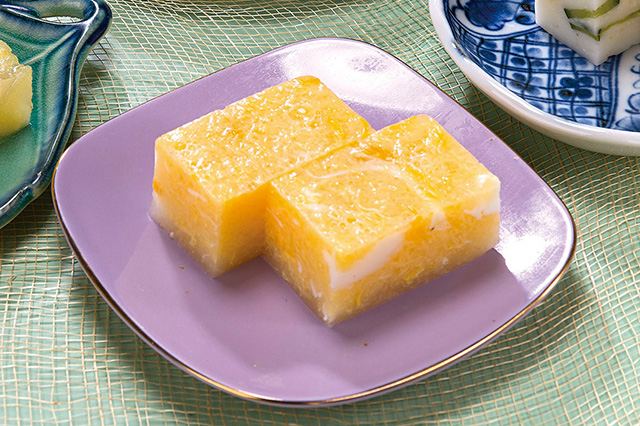
The "Clean Age" is a dish that is mixed with cold liquids and melted eggs and sugar. Cold weather raw materials are seaweed plants. I'm going to melt this and filter it down and then cool it out of the shop. The cold nights, the cold nights, the dry daylight of the day, and the naturally dry ones are the cold weather. The cold weather is characterized by more elastic and more solid than gelatin or ager. Because it's long-term storage as a dry product, in Akita, where winter is long, it's been valued as a food preserve. In Akita it is reported that it is always made up of people from the south of the province, from the south of the country, from the people's gatherings, and from ancient times has been known as tea cakes. Handmade food is used at the wedding feast as a "scrolling" but cold weather can be cut in numbers and can be brought home with ease, making it a "striking" dish. This "Clean Air" is particularly famous among the coldest foods, but there are many ways to cook, to cook melted eggs, to cook melted juices, and to break eggs in a cucumber. Another essential of the cold, with eggs, is the "Big Cloud" by which sugar and cold weather are mixed with milk and eggs. It's a recipe from the south of Akita Prefecture. It used to be said that if you made it well, it would be a good choice.
When It Is Eaten
In the south of the province, traditionally a bonsai New Year's Crescent Cemetery is served in cold weather. Tea requests, of course, are routine food that is eaten in broad places, from the lunch leave of the athletic tournament to the guests' hospitality. There are about 20 kinds of cold weather in the supermarkets at all times, and we are also known for the season as the coldest in first summer and the cold in autumn and the cold in autumn.
How It Is Eaten
Cold weather and water are put in a pot and put on fire. When cold weather melts, sugar and melted eggs are put in and melted into molds and cooled. If you fold tightly, cut it into smaller pieces that are easily eaten. It's also one of the hard workers against lack of winter food to keep up with. Also, there is a wide range of variations from the hot, sweet, cold, hot, and hot, hot and hot weather, which is also made from the hot and cold, which has been called the "Clean and Blue" and the "Clean" and the "Clean and Blue" and the "Clean" and the "Clean" and the "Clean" and the "Clean" and the "Clean" and the cold." Various cold weathers are eaten all over the prefecture.
Recipe — Serves 10
Ingredients
- 2 agar stick
- 5 egg (Mサイズ)
- 250 g sugar
- a pinch salt
- 1,000 ml water
Method
- I put 1,000ccs of water in the pot, put a bar cold weather in it, and melt it.
- I'll put the eggs in a bowl and split them.
- I'll put sugar and salt in before I boil, and then I'll put 2 in when the sugar melts, then I'll stir it and then it'll come out a little cold.
- It'll hold at normal temperature for about an hour.
Dish data: Ministry of Agriculture, Forestry and Fisheries (MAFF), “Uchi no Kyodo Ryori” (Our Regional Cuisines) database, used under the Public Data License (PDL1.0); translated and adapted from the Japanese original.