Okkirikomi おきりこみ
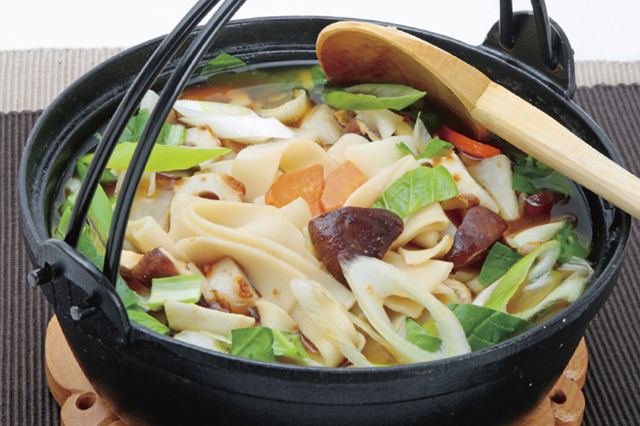
| Prefecture | Gunma (群馬県) |
|---|---|
| Region | Kanto |
| Japanese name | おきりこみ/おっきりこみ |
| Home area | All within the province. |
| Main ingredients | It's not just wheat. It's also wheat. |
History and Origins
The horse is the best place for flour. It's grown well and produces at the top of the country. The Gunma Prefecture agricultural technology center has developed a product that has been developed and produced throughout the country, including the production of "Tung Wave" and "Trounce" and "T" from wheat flour, which are also made in fertilizing a unique food culture. Many native dishes have taken advantage of flour, and they are typical of the bowl. It's a dish that boils a wide variety of rice made from wheat and cooks with vegetables, mushrooms and other things in each home. It is said to be called "supposed" because of the wrap-knit knot that wraps the dough of the noodles around the rice stick and cuts it with a knife. In 2014 I was adopted as a "Creep-Auto-Auto" and was adopted as "SixGunma Prefecture Records" by "unspecified civil culture" in which to take action.
When It Is Eaten
It is believed that from the mid-'Edo, when the stone mill spread to the common people, it began to be known as the everyday diet. It's decided to use broad noodles and vegetables, but there's no specific fat or vegetable type or taste for the noodles, and there's no specific rules for flavoring them, and they vary from home to home. By the way, the daily diet of unsalted and unsalted noodles like a ball is rare in areas where you can eat them only with a pack of horses, and only with a few bowls of rice and a lot of rice.
How It Is Eaten
A wide, unsalted noodles made of flour, placed in a large pot with vegetables in each home, and boiled without boiling. Vegetables vary from home to home, but they often use carrots, long hair, large roots, potatoes, and foster potatoes. In addition, using the season's food and enjoying the season.
Recipe — Serves 4
Ingredients
- Mix: 300 g all-purpose flour
- Mix: 150 ml water
- Mix: 30 g dusting flour
- 60 g burdock root
- Broth: 60 g carrot
- Broth: 100 g daikon radish
- Broth: 150 g taro
- Broth: 4 shiitake mushrooms
- Broth: 1 aburaage (fried tofu pouch)
- Broth: 40 g long green onion
- Mix: 2 L water
- Mix: 40 g niboshi (dried sardines)
- Mix: 10cm) 1 kelp (konbu)
- Mix: 10 g bonito flakes
- Mix: 2 tbsp soy sauce
- Mix: 40 g miso
Method
- I put medium force powder into the bowl, cut the center and add a little water. I'll rub my hands enough until the powder is gone.
- I'll round it up and put it in a big plastic bag and I'll lean on my heels. fold the dough and then lean on it. I repeat it several times until it becomes a little harder than ear bumps. After that, it's always in the bag, and it's 20 minutes away.
- The fabric is placed on top of the plate that was ground with powder and the thickness of the rod is three millimeters thick.
- The fabric of the fabric is ground to the ground according to the need and wrapped around the bar. If you cut through with a knife through the top of the stick, it will be cut to the width of the width of the rice.
- Put in a bowl of water and cloth, a bowl of water with head and wafer, a dish of salt with wax and wax, and dip it in for about five minutes, then put it on the low fire.
- When you boil, bring out the cloth, and the others, with a weak fire, boil for about five minutes, and then rub it with a monkey.
- I'm going to cut a lot of wood into pieces, and I'm going to cut a lot of rice in half, and I'm going to cut a lot of rice in half, and I'm going to cut a lot of slices and long sleeves in half. The bladder will be cut or cut in half depending on the thickness. Oiling cuts short seven millimeters wide. I'll make it as big as I can.
- In the pot, you add soup and other vegetables other than noodles and long sleeves, from hard to hard to cook, and add ten minutes of medium cooking. Add some noodles and add more rice, and put on a long onions, and taste it with a bowl of B's soy sauce and a taste.
More About Okkirikomi
Okkirikomi (okkirikomi, おっきりこみ) is a type of simmered noodle dish that can be found in Gunma Prefecture, some parts of northern Saitama Prefecture, and the Chichibu area. It is usually written in hiragana and sometimes seen as おきりこみ (okirikomi) but may sometimes be found in kanji as well (おっ切り込み).
Overview
There are variations, but in general okkirikomi consists of fat noodles made from wheat flour that are placed raw in a pot with seasonal vegetables. It is then simmered in a thick broth made of miso or soy sauce and seasoned with mirin.
Areas in Japan where multi-cropping wheat is common tend to develop dishes based on wheat; okkirikomi is one example of this. Another is hōtō, a flat wheat noodle dish that originated in Yamanashi Prefecture. Although similar to other related wheat noodle dishes, okkirikomi has characteristics that differentiates it from the others.
Origin
Okkirikomi is an old farmers' recipe that gained popularity due to its simplicity. The noodles are cut by hand into fat lengths and combined with seasonal vegetables such as carrots, leeks, sweet potatoes, taros, or daikon radishes. Then a generous amount of broth is added to the pot and left to simmer. In some areas it is also called nibōtō (煮ぼうとう) or joshu hōtō (上州ほうとう).
Other sources believe that okkirikomi was introduced via China in the 12th century; after eating it at the palace in Kyoto, Yoshishige Nitta brought it back to his home land (present day Gunma) and shared it with his family.
The name okkirikomi developed naturally. Noodles were cut and added to the pot to simmer, and more could be added as needed. In Japanese, this process can be expressed as 切っては入れ (kitte wa ire) and 切り込む (kirikomu), which then became okkirikomi.
Regional differences
Flavor and ingredients
In northern and western Gunma, okkirikomi is typically miso based, but in eastern Gunma it tends to be soy sauce based. In central Gunma, both kinds are popular. Historically, soy sauce was widely available in Eastern Gunma but at that time there were not many opportunities to eat okkirikomi, so as soy sauce became more commonly available in everyday households, people in Eastern Gunma began using it instead of miso for their okkirikomi. It remained popular even when soy sauce became expensive.
The vegetables used in okkirikomi also varies depending on the area. In mountainous regions such as the towns surrounding Mt. Akagi and Mt. Haruna, taro is a common ingredient whereas in areas like Agatsuma and Tano District, potatoes are more often used. However, sweeter vegetables such as sweet potato or pumpkin are generally not added regardless of the area.
Differences between other kinds of noodles
Udon
When making okkirikomi noodles, salt is not added, and the noodles are raw when placed in the pot to simmer. The flour then dissolves into the broth, causing it to thicken. Because of the broth's thickness, eating okkirikomi helps warm up one's body, and thus it is a popular food in winter. Likewise, it is generally not cooked during hot summer months.
In the past, there was a difference in the quality of flour used for udon and okkirkomi; the latter sometimes contained some of the bran. Additionally, okkirikomi was cooked regularly in everyday life, whereas udon was only eaten on special occasions.
Hōtō
There are two main differences between okkirikomi and Yamanashi Prefecture's hōtō.
When compared with hōtō or udon in general, okkirikomi uses 2/3 less water when making the noodles. Using less water gives the noodles a good flavor, but causes them to harden quickly. It is important to knead them slowly yet forcefully to prevent the noodles from hardening. The ingredients are also different; while okkirikomi has both soy sauce and miso based variations, hoto is primarily soy sauce based. Hoto often has sweet vegetables such as pumpkin in it while okkirikomi does not.
Cultural significance
It is known as one of Gunma's soulfoods and is often used for local tourism.
In 2007, the Ministry of Agriculture, Forestry and Fisheries held an event to find the top 100 best local dishes across all of Japan; okkirikomi was one of the dishes selected to represent Gunma. As such, it is known as one of Gunma's soulfoods. In 2009 the ministry published information about each featured dish in English (calling the event Japan's Tasty Secrets) to help spread Japanese food culture abroad.
In 2014, okkirikomi was designated as an Intangible Folk Cultural Property at the prefectural level.
In 2018, Gunma Prefecture ran a stamp rally to promote okkirikomi. 63 restaurants across the prefecture participated. Customers could use the stamps they collected to enter into a random drawing to win Gunma-chan themed prizes.
Text adapted from the English Wikipedia article Okkirikomi by its contributors, licensed CC BY-SA 4.0.
Dish data: Ministry of Agriculture, Forestry and Fisheries (MAFF), “Uchi no Kyodo Ryori” (Our Regional Cuisines) database, used under the Public Data License (PDL1.0); translated and adapted from the Japanese original.