Suiton すいとん
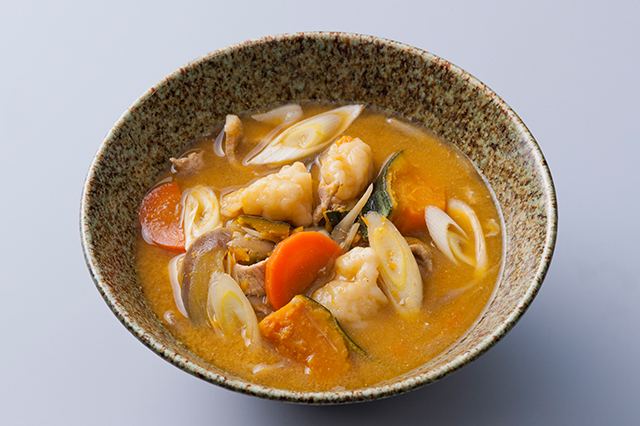
| Prefecture | Gunma (群馬県) |
|---|---|
| Region | Kanto |
| Japanese name | すいとん |
| Home area | All within the province. |
| Main ingredients | It's not just vegetables, it's also vegetables. |
History and Origins
In the swarms where rice and wheat have long been made, flour is especially productive. For that reason, various kinds of flour dishes, such as greasy carpets, are known as native food. One of these is the "shoe-grain" that makes flour melted in water. It's a dish made all over the horse, but it's also a little different from the ingredients and names used by the locals. For example, canning made in Yamada City often uses rice flour. In Fujioka, on the other hand, making with flour is the same as making with flour, but it's called "soy sauce." There is a theory that one of the sources of the melted flour comes from "take and throw" or "Father stirs the pot." Other names are "sitting" and "sniffing coral" and "sniffing" and "sniffing" and so on. They also form their own culture in different areas.
When It Is Eaten
Especially in times of food shortages, they were preferred as a substitute for rice. Of all the local dishes with a large amount of flour, we are known as the daily diet that is relatively easy to eat because we do not have to spin and cut fabric. Also, making flour melted in water made it easy to cook, so it was also a reason that you could produce large amounts and that you had a good appetite.
How It Is Eaten
I took it from boiling and so on, but then I cut it into juice, cut it to the size of vegetables in the home, and cook it. It'll be done by tasting with soy sauce and sauce and boiling with water - melted flour with spoons and soap for several minutes. Vegetables add to each household by preference. By the way, there's also a "sniffer" that makes a dish that looks like a pepper, which reduces water to a dish that uses elastic force and rips it off by hand.
Recipe — Serves 4
Ingredients
- 150 g wheat flour
- 150 ml water
- 60 g daikon radish
- 40 g carrot
- 2 taro
- 2 shiitake mushrooms
- 1/2 long green onion
- 1 aburaage (fried tofu pouch)
- 2 tbsp1/2 soy sauce
- 1 tbsp mirin
- 4 cups dashi stock
Method
- How much can you drop the flour with a spoon of water?)
- Vegetables are cut into easy-to-eat sizes and cooked in soup.
- It's a pot, and I'll put some soup in it, and I'll put some vegetables in it and put it on the fire.
- When the vegetables are seven minutes smooth, drop 1 with a spoon.
- When you boil, you can put in a bowl of garlic and taste it in your soup.
More About Suiton
Suiton (水団 or すいとん) is a Japanese dish that is made by slicing flour dough by hand, rolling it by hand, and scooping it into small pieces, then boiling it in soup.
Overview
Suiton has a long history, and its root "mizu-dango" can be seen in the Muromachi period. It is also called "water dumpling". The cooking method of suiton on the material has changed drastically, and the form of hand-cooked flour like today appears in the late Edo period. From the Edo era to the prewar days, there were stalls and restaurants specializing in suiton, and it was popular food for ordinary people at that time. Although it had decreased considerably in the middle of the Taisho era, immediately after the Great Kanto Earthquake, stalls appeared everywhere in the burned fields as the food situation worsened.
It is a type of dumpling, and as a cooking recipe, "suiton" is made from crushing grains and nuts containing gluten and dropping them into hot water or soup. The way to eat depends on how much effort or arrange the cook has, or a regional custom.
There are many variations, such as simple dumplings made by mixed dough into hot water, and zoni with miso soup or simple soup with broth.
Suiton is also sold as vacuum-packed products by noodle manufacturers such as Shimadaya.
Regional Variation
The name of "suito" is known nationwide, but differs a little depending on the region, "hittsumi (ひっつみ)", "hatto" (はっと), "tsumeri" (つめり), "tottenage" (とってなげ), "odansu" (おだんす) and "hinnobe" (ひんのべ); - called by the name of the dish. These foods similar to suiton are characterized by the ingredients and dashi stock that are put in each region, and the cooking methods differ from region to region. Even in the same region, cooking methods and names vary depending on a district or individual home.
For example, "Hatto" in the northern area of the Miyagi prefecture to Iwate prefecture in the northern part of the Sendai clan is divided into small chunks of flour dough kneaded with cool water and thinned by stretching it like noodle with fingers. In Aomori prefecture, Iwate prefecture, etc., the manner of dividing flour dough is different.
Text adapted from the English Wikipedia article Suiton by its contributors, licensed CC BY-SA 4.0.
Dish data: Ministry of Agriculture, Forestry and Fisheries (MAFF), “Uchi no Kyodo Ryori” (Our Regional Cuisines) database, used under the Public Data License (PDL1.0); translated and adapted from the Japanese original.