Shimotsukare すみつかれ
| Prefecture | Saitama (埼玉県) |
|---|---|
| Region | Kanto |
| Japanese name | すみつかれ |
| Home area | It's not just the city. It's the city. |
| Main ingredients | Dicons, dry beans. |
History and Origins
"The Great Master" is a local dish in the area centered in the northern kingdom of Japan. It has been used to eating first-time snacks and winter snacks. It's not just dried beans, but vegetables and oiled dishes that are cooked and cooked. There are areas and homes where the heads of the new tubes can be carved into small pieces. In northern bases such as Uru and the top of the tail, they are called "stuffs" in the east and in the lower east.
When It Is Eaten
It's typical of cooking at the rice shrine on the first day of the festival in February, leaving the beans in their dues and using them. They are offered as a rice shipment with red rice and a chicken. There's also a side to it.
How It Is Eaten
I'll roast the dried beans in a fried pan and clean the skin. The dichon is dehydrated, the oil is cut, and the carrots are cut. Put tools in the pot and boil it with sesame oil and sugar and fresh water for about an hour. Stop the fire and let the taste in. If you don't have ogre, you can put a cut-off dacon in a plastic bag, beat it with a cane stick, and fold it down.
Recipe
Ingredients
- 1(250 g) 新巻鮭の頭 (fillets)
- 1(1.5 kg) daikon radish
- 2 carrot
- 1 cups soybeans
- 2 aburaage (fried tofu pouch)
- 2 chikuwa (fish cake tube)
- 1 satsuma-age (fried fish cake)
- 150 g 酒かす
- 1 tbsp soy sauce
Method
- Wash the head of a man and cut the bone in pieces. (You can cut it when you're done.)
- I'm going to use the stylus to drop dicons and carrots.
- The roast beans take the skin.
- Oiling is oily and thin. We cut the dust in half a month, and we cut the tofu in half an inch and a half.
- Put all the ingredients in the pot, add some wine and cook.
- When the soybeans become soft, we can taste them with soy oil.
More About Shimotsukare
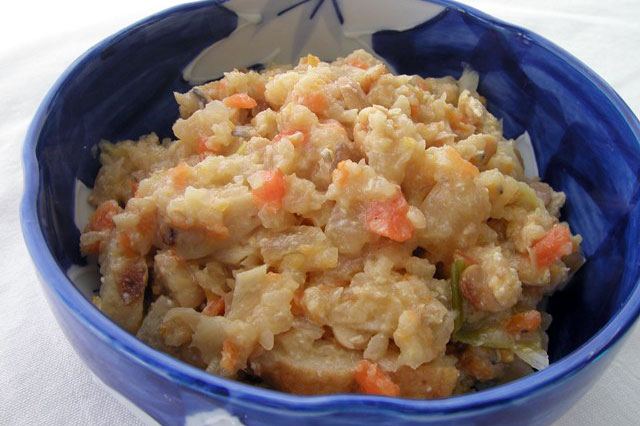
Shimotsukare (しもつかれ) is a local Japanese dish served in the Northern Kantō region of Japan, primarily in Tochigi Prefecture but also in Gunma Prefecture and Ibaraki Prefecture. The dish is generally served on hatsu-u-no hi (初午の日, literally; first day of horse in the month of February) together with sekihan as an offering to appease the legendary deity, inari. Shimotsukare is usually made by simmering salmon head, vegetables, soybeans, abura-age (あぶらあげ or deep fried tofu skins) and sake kasu (酒粕, literally rice pulp from fermented sake). Common additional ingredients include grated raw radish (oroshi daikon) and carrots. The dish is also known as shimitsukari, shimitsukare or sumitsukare in some areas.
Origin and history
The origins of shimotsukare can be traced back to Edo period (1603–1868) and is thought to be a derivation of su-mutsukari (酢むつかり, literally roasted soy beans in vinegar), a speciality dish which was mentioned in mythological narratives of Uji Shūi Monogatari (宇治拾遺物語) and Kojidan (古事談). The origin of the name "shimotsukare" remains in debate. It is also widely believed that as the dish is mainly served in Tochigi Prefecture, formerly known as Shimotsuke Province (下野国), the name of the dish is thought to be a derivation of the phrase shimotsuke no karei (下野の家例, "traditional customs of the Shimotsuke clan")
Presentation
Various presentations of shimotsukare exists in different areas in Japan. The dish is served either hot or cold. Shimotsukare is normally served with rice but could also be taken without it. In some areas, once the dish is simmered, it will not be re-heated again when served.
As a means of preservation, simmered shimotsukare is kept in frozen grounds during winter and served on top of warm rice to allow it to thaw naturally.
Shimotsukare, together with its distinct flavor, scent and semi-liquid appearance is well received by some locals but not all. It is even nicknamed neko no gero (猫のゲロ, literally "cat's barf") by some Japanese.
Nutrition
Some sayings such as "shimotsukare o nana-ken tabearukuto byoki ni naranai" (しもつかれを7軒食べ歩くと病気にならない literally, eating shimotsukare prepared from seven houses will keep you from getting sick) noted that consuming shimotsukare promotes good health. The dish is also sometimes included in jubako (重箱 or Japanese tier bento bako) and shared amongst neighbours to prevent them from catching cold during winter.
Culture
Shimotsukare is a traditional home cooking and the recipe is passed down from mothers to the next generation. Though each preparation carries the same name of 'shimotsukare', ingredients and method of preparation varies from one household to another. Consequently, it is possible for people living in the same district to stumble upon shimotsukare that is totally different from their own preparation.
Shimotsukare can now be obtained conveniently in supermarkets and is sometimes served during kyushoku in some schools in Tochigi Prefecture.
- ^ "Shimotsukare/Sumitukare | Our Regional Cuisines : MAFF". www.maff.go.jp. Retrieved 2025-05-02.
- ^ "Shimotsukare - 【郷土料理ものがたり】". kyoudo-ryouri.com. Retrieved 2025-05-02.
Text adapted from the English Wikipedia article Shimotsukare by its contributors, licensed CC BY-SA 4.0.
Dish data: Ministry of Agriculture, Forestry and Fisheries (MAFF), “Uchi no Kyodo Ryori” (Our Regional Cuisines) database, used under the Public Data License (PDL1.0); translated and adapted from the Japanese original.