Chagayu 茶粥
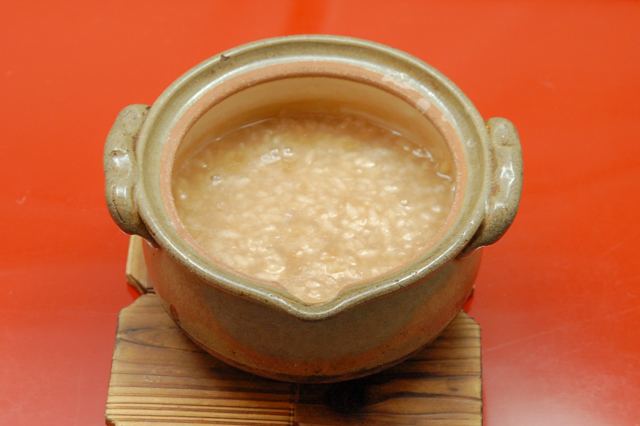
| Prefecture | Nara (奈良県) |
|---|---|
| Region | Kinki |
| Japanese name | 茶粥(ちゃがゆ) |
| Reading | Chagayu |
| Home area | All within the province. |
| Main ingredients | Rice, brown tea. |
History and Origins
It is said that in the early 9th century, the Japanese tea growing began when the Great Britain of Japan brought back tea seeds from Tang and grew in the Buddhajijijijiji in Hikichi. The Water Taker, which is held in the Tokyo Great Temple each year in March, has over 1,200 years of history and has been around, has "Gecha" in its presentation. (Gecha is like the origin of the rice that is boiled and removed by the rice.) And Gobo is said to have a high amount of tea juice, and "Keno" has been eaten for 1,200 or more years.
When It Is Eaten
Nara's tea cup, called "Maji," is characterized by a cold, cooked rice in the cooked tea. "Cooky tea" is a typical daily diet of Nara as it is said, "The morning of Great Britain is early."
How It Is Eaten
Now, few families have a cup of tea every morning, but since there are many families in Japan that cook at night, they eat a lot of cold rice, it seems that tea has become popular in the general family. To make me feel better, I put in a variety of things to eat, such as chicken, chicken, potatoes, and seams.
Recipe — Serves 10
Ingredients
- 1 × 180 ml rice
- 30 g roasted tea
- 5 cups water
- 1 tsp salt
Method
- I cook rice in normal volume.
- I'll boil the broom tea.
- Put the rice salt in and cook it from time to time in the middle. It's done when it comes to taste.
- I like to eat with steamed snacks, baked rice, and so on.
More About Chagayu
A cup of tea is made of rice made from tea.
Overview
Tea is the general name of a cucumber made from tea, and rice as well as vegetables, potatoes and beans can be added. In some areas, home-made teas, mic-dish, powdered teas, and salts are also used differently. In particular, Nara Kaki, which is famous for its age.
the Kinki region, southern tea cup.
In Iga of Nara Prefecture, ZX023X and Mie Prefecture, the nickname "mother" has long been a common dish.
The six eating and drinking terms of the "The Great Kingdom eats four or five degrees of tea a day even for farmers." When the Emperor of the Emperor and the Great Buddha of the South, he helped the people by eating some of the rice. "From then on, I've been eating tea in Nara." Also, while the Nintendo Nintendo, known as the Watertake, has been a permanent event since 752 to this day, the record of the "Cook" and "Yung" sessions, which include the presentation of the monks' meals during the period, is recorded. It has a special name, but "Cooking tea" is boiling and removing the juice, and "Cook" is a lot of tea juice. From these records, it is possible that teacups were eaten in the Republic over 1,200 years ago.
In the general family of Nara Prefecture, they often made it with baked tea in a cotton cup and cooked it with cold rice. In Ono, many houses used morning cold food, which is called "put in" and "cute tea" which is made from rice. In the summer, you'll get cold and eaten except for a bite or a bowl or a bowl of rice, and seasontimes, and potatoes, beans, and so forth.
It has long been said that "the tea of Great Britain, the white of Tokyo, and the raw food of the river" and that there is a solidity of silk and the way to eat it, but the tea of Great Britain is sticky. Nara Prefecture has a high salt content and a high amount of hot tea, so it causes gastritis and cancers, so the high rate of gastric cancer due to the decay of the carbs has been called upon in 1954 (29). There are also changes in taste and diets.
I'm from the other part of town.
After the Ming Day, by the middle of the 17th century, Nara Tea was sold in Edo as a dish called "Naya Tea."
Although food has been common in Western Japan since ancient times as a meal for the common people, tea is spreading throughout the West from China to Yamaguchi Prefecture, and it is spreading from North Japan, either due to the influence of the North Postship or from Osaka to Aomori and Sendai.
However, in the salt islands of Kagawa Prefecture, tea has often been eaten as breakfast.
Cooking.
In Nara, where you boil water in a pot, and make a cup of tea, and boil it, and cool it, there is a custom to cook dinner in the evening, and use the rest of the rice in the morning.) Or you can cook the rice in advance, put a cup of tea in it, and cook it up. If mixed too much, you will become obsessed, so you can turn it back up and down with a spore, and remove the surface bubbles. If the rice grain is flat, we can take it down from the fire and water it for a while. A tea bag may be taken out when it comes out of the right color or smell, but you can keep it until the end. I add salt to prepare it according to my taste. Cooking depends on the local and family preference.
Text adapted and translated from the Japanese Wikipedia article 茶粥 by its contributors, licensed CC BY-SA 4.0.
Dish data: Ministry of Agriculture, Forestry and Fisheries (MAFF), “Uchi no Kyodo Ryori” (Our Regional Cuisines) database, used under the Public Data License (PDL1.0); translated and adapted from the Japanese original.