Kakinohazushi 柿の葉寿司
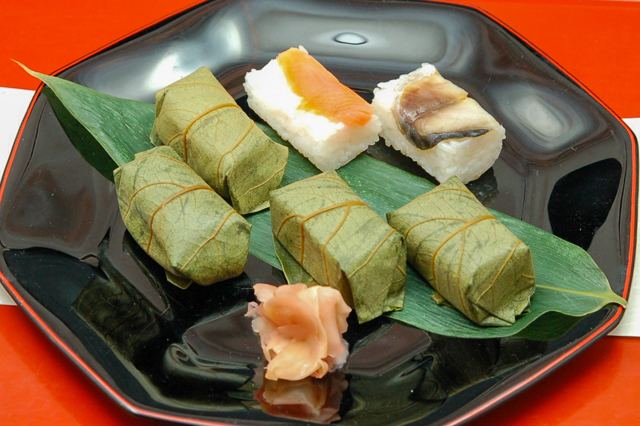
| Prefecture | Nara (奈良県) |
|---|---|
| Region | Kinki |
| Japanese name | 柿の葉寿司(かきのはずし) |
| Reading | Kakinohazushi |
| Home area | Yoshino area. |
| Main ingredients | The leaves of rice, sabbats, and cucumbers. |
History and Origins
"The sushi of the fly" refers to a sushi wrapped in straw leaves with a salted sabbatical. There are theories as to the origin of "The Ip Sushi." There are theories that there were summer festivals in the villages at that time, and that the festival was served, as well as that it had been changed from what we used to be food and soldiers. The "Susomi of the Sakura" uses a lot of tannin and a rich green leaves. The leaves in the rice contain a perfumation effect, and the "thing of the plant" has the effect of embalming, and the "thing of the plant" has the effect of a good night's work. The aroma of the leaves and the yakuza's taste will be transferred to rice and the flavor will be delicious. Instead of the leaves of a bush, the simple leaves that grow in the mountains are used to make the " Simple leaf sushi" from the last phrase to the last phrase in July. The recipe is similar to the sushi in the carp, and the smell of simple leaves is delicious when it goes to rice.
When It Is Eaten
In the Fukuoka and Yoshino region, they make "Iwa's sushi" to celebrate the summer festival. In a rural village, when the rice fields are finished and you can take a breath, the children can also help. Sava is an important fish for Hale Day, and has been eaten for celebration and so on.
How It Is Eaten
If the food gets too cold in a refrigerator or something, and the food gets too hard, you can eat it with a little heat in microwave ovens or something. Wintertime is delicious when it's made of "Izu's sushi." It's time to cook in an oven toaster, wrapped in leaves, and set the surface of the leaves slightly burned. Be careful because over-burning burns rice and goods.
Recipe
Ingredients
- 2 × 180 ml rice
- 150 g fillets
- 20 persimmon leaf
- vinegar (塩サバ用), to taste
- Vinegar: 40 ml vinegar
- Vinegar: 25 g sugar
- Vinegar: 4 g salt
Method
- Wash the back of the leaves cleanly and water them.
- The salt sabbat takes bones if they are on a bone, takes all the fine bones, and tightens them with vinegar for about an hour. I'll remove the skin and cut it into a thin piece on the fourth half of the third and fourth millimeter.
- I make vinegar with vinegar sugar salt.
- We cook rice, mix vinegar and cook rice as soon as we're ready. When you cook rice, add a little sieve and a little wine, and it will be cooked. )
- It's cold. I'll put the rice in a mold.
- Cover the leaves with a bales of rice wrapped around them. (Caramel package)
- It's done after a night or two.
More About Kakinohazushi
Nara Prefecture ZXZQQ023X and Ishikawa Prefecture Koga, Tottori PrefectureK8X native food.
But in Nara PrefectureZXZXZZQQ023X, ZXZQQ08X, ZXZQ4X, ZZQ104X, ZX108X, ZX108X is used as a local feature.
Nara PrefectureWakayama Prefecture
It's a sushi that has been wrapped around the leaves of the bowl and pressed. In some places, after wrapping a cloth, the leaves of the fly will be rolled. The notation is often called "the leaves of the plant." The leaves themselves are for flavor and preservation and do not eat.
It is said that Mizushi Iwa was born in the ZQ 158X age, from the upper stream of the river. According to one theory, a fisherman in Fukuoka, Japan, used salt in the belly of a caught fish, and used the boat of a river and a bear to travel to the Republic, but by the time he arrived in the Republic, he was too salty and developed a way to eat it with a piece of rice to ease the salt. It is estimated that it was first eaten like sushi, and became a recipe for rice, such as we see today, after the Edo, which was introduced by the rice mill. Since then, it has been considered a rare treat for festivals and celebrations. It has become popular especially as the best food for the Japanese and Japanese.
The method of putting food in the leaves of the plant is a traditional storage technique that allows them to have a bacterial effect (which depends on the fact that they are wrapped up in season and so forth) to save food for a few days. Moreover, by sticking to the leaves of the plant, the scent of the leaves of the plant will be transferred to sushi and the flavor will be improved. The leaves of the plant can be salted to make them soft or to increase the effect of the fungus. The leaves of the plant are better for soft leaves (in particular, for early thrombos), because they are soft. Although the story was only old, during the Meiji period, I suggested a sushi with the use of a kanji, and today it is a custom to have a man and a woman as well. There are also more stores that provide sushi for plants that are rich in variety. One of the people who spread sushi from Ishishio, Tanizakiro Tanizaki, can be named. Tanizaki, in his essay "The Gesture of the Sun, " takes up the Sushi of Ishi, and praises it as "The Fabric of Tokyo" "in a sense I am in no way able to imagine. "
It was also on the market for fast car sales. Nara Prefecture uses a lot of the leaves grown in the 5th and Yoshino district. It's chosen "Naya's Goods" and has been passed over to a sushi shop all over the state, whether it's made from raw materials, gifts, or household products. There are a number of private stores and restaurants that provide sushi for mushrooms. In the river village, the main stream of walnut sushi, which is used in traditional salted Saba without vinegar, is called the old style.
Wakayama Prefecture is also designated as a Wakayama Prefecture recommended souvenir item, and you can see several stores in northern China, especially Imbun.
Ishikawa Prefecture Kaga District
You can put sushi in order, scatter cherry and blue algae on the surface, put them on a bowl, and eat them for a few days. I don't usually eat the leaves of a plant. In the home, it is often made mainly during summer and fall festivals.
Tottori Prefecture
In the Tottori Prefecture Wise Head district, there is also a traditional sushi, called a sushi of the fly. We put rice on the leaves of the spread plant, and use a vinegar - hardened cucumber to make the mountain rose have an accent. Although the Wise Head is an old-fashioned source of rice, and the sushi from the Japanese has been a traditionally prepared local dish, the families that we make are less likely to grow. So in 1987, by local farmers, I started the Master's Development Research Institute and started to sell it for the public at stores. It's been chosen later for "A 100 which is really good for the locals to choose."
Text adapted and translated from the Japanese Wikipedia article 柿の葉寿司 by its contributors, licensed CC BY-SA 4.0.
Dish data: Ministry of Agriculture, Forestry and Fisheries (MAFF), “Uchi no Kyodo Ryori” (Our Regional Cuisines) database, used under the Public Data License (PDL1.0); translated and adapted from the Japanese original.