Funayaki ふなやき
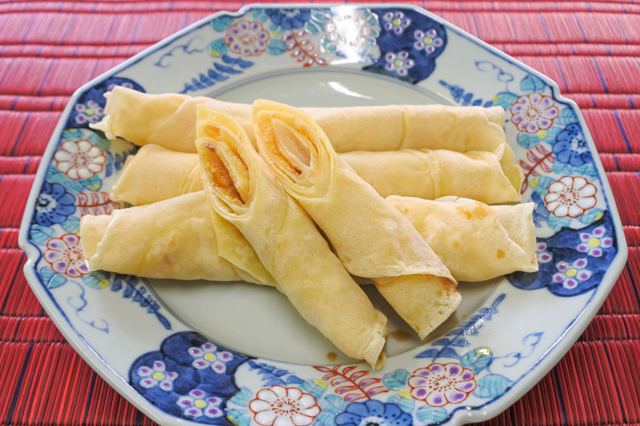
| Prefecture | Fukuoka (福岡県) |
|---|---|
| Region | Kyushu & Okinawa |
| Japanese name | ふなやき |
| Home area | Post-East |
| Main ingredients | And we're going to have to do it with flour and water. |
History and Origins
"Sun's Day" is an old - fashioned flour snack in the rear of the country. Mix flour and water together and cook thinly. The cutting tools vary from region to family, including eating light food with black sugar wrapped around them, or with vegetables on top of them. Thus, in the post-growth region where wheat was growing, the easy-to-be-stained "sun-sun" was often eaten. There are also theories that the "sun" of the Haka is good for the boat, that it burns the dough in a large iron pot with a curved bottom, or breaks it in half and looks like a boat.
When It Is Eaten
They're eaten as snacks and snacks.
How It Is Eaten
When the flour is melted in water and salted, it is baked whole, or wraps in a small piece of black sugar. These include eating black sugar as a dish, vegetables, tastes, snacks, snacks, and so on, and so on, depending on the community and the family.
Recipe — Serves 4
Ingredients
- 120 g wheat flour
- 1/2 egg
- 100–150 g water
- 1 g salt
- as needed oil
- 10 g brown sugar
Method
- The flour runs.
- The eggs are melted, water is mixed, salt is mixed, and salt is mixed.
- Add flour to the flour and mix it with a foamer.
- It's a little oil in the pan, a quarter of the fabric is poured in, and it's thin, round, and baked with a low fire.
- When the surface is dry, it'll be turned upside down and burned until the sides are just a little pale.
- Spreading out on the cutting board and rolling one fourth of black sugar in a shape around a third of your hand while it's warm.
More About Funayaki
Koji, Japan's native food. There are different dishes by the same name throughout Japan.
Shiga Prefecture
The yakuza, the yaki, and the yaki.
In areas like Shiga Prefecture field area, and the Tohoku Bay, where wheat has long been grown, they are known as easy-to-eat snacks during farming time.
I would paint taste buds and sugary oils and add sweet potatoes and corn instead of expensive sugar.
In this case, I often get a black sugar on the ground and get involved.
Wakayama Prefecture
I'll cook well.
In Sasaki district, it was eaten before World War II.
It was boiled in a pot of baked rice with black sugar and carbonate added to the water. Since the bottom of the roast pot was shaped similar to the bottom of the ship, it is thought that the ship's burning process was turned into a low - cooking process.
I'll cook it big and cut it open.
In the '40s, when hotcake mix commercials spread to the average household, it was gradually out of production.
Kyushu
Sakura is an old - fashioned flour bowl in the rear of the country. The melted flour is ground in water, and she burns and wraps her clothing.
When eating as a snack, you can put black sugar in it, and add vegetables and flavored rice in it for a snack or a drink.
The level of the Sudoku River has been growing wheat since ancient times, and the easy - to - eat dishes were often eaten.
It's an old-fashioned meal in the tri-Cho-Cho-Cho-Cho. It's also called the Sakura-Cho-Cho-Cho.
In Kumamoto Prefecture, it's built in each home from old age and is called the Unazu. It's also eaten as a food for hospitality and is used as a dish for resuscitation vegetables.
There are these theories about the origin of the name:
"Sweet" is the intent of "ship," roasting the fabric in a curved iron pot under the bottom, and breaking it in half is like a ship, so it comes from its name. It was transformed by the Japanese Japanese style book The Parent's Journal. It's like a pre-packaged meal on a boat.
Oshima.
Sakura is the traditional sweets of Kagoshima Prefecture Oshima. - I'm sure he'll be okay with it.
It's a cake baked with dough mixed with flour, flour and black sugar.
It's also sold as souvenirs, but it used to be made in each home. The fact that the cut resembles the shape of the boat in the shape of the kayumi is said to be the name given.
Text adapted and translated from the Japanese Wikipedia article ふなやき by its contributors, licensed CC BY-SA 4.0.
Dish data: Ministry of Agriculture, Forestry and Fisheries (MAFF), “Uchi no Kyodo Ryori” (Our Regional Cuisines) database, used under the Public Data License (PDL1.0); translated and adapted from the Japanese original.