Furofukidaikon ふろふき大根
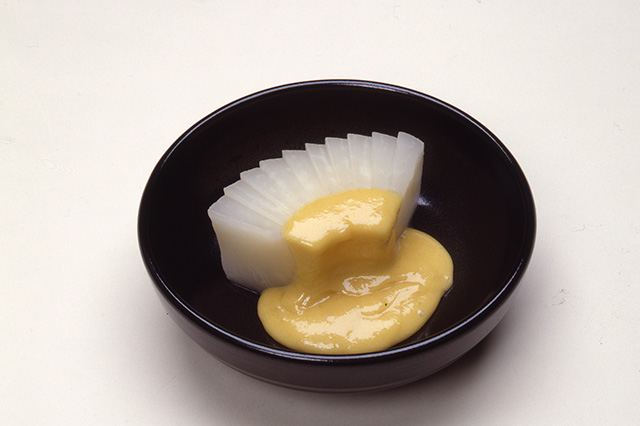
| Prefecture | Kyoto (京都府) |
|---|---|
| Region | Kinki |
| Japanese name | ふろふき大根(ふろふきだいこん) |
| Reading | Furofukidaikon |
| Home area | All Kyoto Prefecture |
| Main ingredients | The Holy House. |
History and Origins
The Kyoto is eating large roots of various species. The "Saidagagaga" in the Tokyo district and the "Saidaga" in the northern district are many and varied. What is commonly known is the Holy House. This root root species is said to be the "members" that were developed from the tail of a writing year. While farmers growing their crops each year in the loving Sacred Court of Toshishigi prefecture, they selected and cultivated round seeds and eventually came to be called the Holy House. One of the old-growing "traditional vegetables in Tokyo" grown at Kyoto has been specified the Holy House with its bluish roots and bitter roots. In the Holy House, it is sweet to be so precise, so soft and so easy and so easy to suffer. It's characteristic again that there's not a lot of boils. Since the water is too high and there are few fibers, you can cook them and enjoy a smooth, smooth touch. The "sun root" is a typical native dish with the Holy House.
When It Is Eaten
The Holy House has been served since late August, and from mid- November to February of next year. The peak of shipments is about two months since November, and is expected to be in mid-December. At this time, the temples in various parts of the country will have a fire. A traditional ceremony that prays for no disease, and those who worship the Holy House will be served the stew of the Holy House. The "Sun-Sook root" is still made up of private homes and is known from a wide range of generations as winter's taste.
How It Is Eaten
Since the sanctum has little bitter taste, it is used mainly for stew. Add the soup to the boiling pot and the soup until it is soft. When you eat it, it's more delicious than when you add white pepper or pepper.
Recipe — Serves 4
Ingredients
- 4 slices(500 g) daikon radish (厚切り)
- 3 cups(120%) water
- 10 g(2%) kelp (konbu)
- 2 tsp(0.5%) light soy sauce
- 4 tbsp(70 g) miso
- yuzu
- water (rice-rinsing water)
Method
- To make your mouth feel better, you can peel your skin thickly and boil it to the root until the bamboo slips through.
- The main root of procedure 1 is boiling in water with a cloth, adding softer citrus oil, and making it tender (it is a softer taste than a very thin absorbant).
- I'm going to multiply it by two. Finally, we make a thousands of cuts of the skin of the pupo.
More About Furofukidaikon
Bathing is Japanese food, with a large cut of vegetables, boiled, boiled, and steamed. Winter season.
They are called "Sweet Stake" and "Sweet Sweat" and "Sweet Snacking" and "Sweet Sniffing" and they all eat hot things.
Origin of Name
There are theories in the origin of the name. The maccupist dryed it in the storage room of the plaster bather, and in winter it was dry and difficult. (That the squabbles that you were taught to spray the juice with a large core, and when you did so, they became solid with warm moisture.) At this point I began to taste the root of the mustard so I could get the juice in the sauce.
There are also theories that people who rub the dirt in a steam bath are like "sweat" or that eating a bath is similar to a bath that blows a bath while you breathe. Or that you blow your breath in boiling a bath.
Text adapted and translated from the Japanese Wikipedia article 風呂吹き by its contributors, licensed CC BY-SA 4.0.
Dish data: Ministry of Agriculture, Forestry and Fisheries (MAFF), “Uchi no Kyodo Ryori” (Our Regional Cuisines) database, used under the Public Data License (PDL1.0); translated and adapted from the Japanese original.