Home / Nagano / Inago no tsukudani
Inago no tsukudani いなごの佃煮
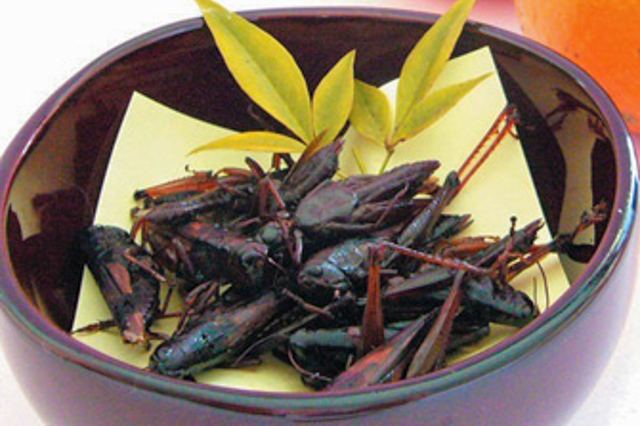
| Prefecture | Nagano (長野県) |
|---|---|
| Region | Chubu |
| Japanese name | いなごの佃煮(いなごのつくだに) |
| Reading | Inagonotsukudani |
| Home area | All within the province. |
| Main ingredients | Locust |
History and Origins
Sejiji, in the Nanjo area, has an ancient culture of insect eating, and he has the custom of eating such things as palm trees, bees children, oysters and brooms. These insects used to be eaten as a food supply to get fewer animal proteins. There are areas where food is eaten in mountainous areas where there are few marine products, such as Gunma Prefecture. In times of war and postwar food shortages, he was feeding on the nutrients needed to feed on the locusts and live on his belly. Black wasps and other larvae, "children of bees, " such as the black wasps, have been eaten in large numbers around the mountains of Japan and are eaten by rice and sweet sauce. He used the traditional method of hunting to prepare the forest with a lured black wasps to bring back their thin red thread. He found a hive in the ground. Although the number of palms has declined since the beginning, and changes in life and food culture have reduced the number of meals prepared at home, yet there is still an insect culture left in Manji.
When It Is Eaten
As you write "Sing children" in Chinese, the locusts are harvested when they are harvested. Between September and October, when the harvest time came, he would put a hand-washed bag on his waist and catch a leaper.
How It Is Eaten
Put the seeds you want in a bag or container and wash them in the hot water every other night. Washing bowls are often made into sweet and steamed soup.
Recipe
Ingredients
- 500 g locust
- 50 ml soy sauce
- 25 ml mirin
- 100 g sugar
- 50 ml sake
- 1 tsp salt
Method
- Locusts pour boiling water, pick up feet and feathers, wash well, and drain well.
- Put a bowl in a hot pan and roast three minutes in a weak fire.
- Put sugar, soy sauce and wine in the pot, boil, boil, boil, roast, and boil with a heavy fire.
- Just before the juice goes out, I put in the garlic.
- When the juice runs out, stop the fire and let the salt go. (IMAGES)
- Their feet make a taste of the sauce with the taste of the bowl, the taste of the sugar, etc.
- Separation of the locusts: Keep your palms in a cloth bag, boil in boiling water, wash with water, cut the water off, and then freeze once. If you cook it, it's easy to eat.
More About Inago no tsukudani
Inago no tsukudani (いなごの佃煮) is a Japanese dish featuring rice grasshoppers that are boiled in soy sauce and sugar. Inago is the Japanese word for locust. The locusts are prepared in the "tsukudani" style of cooking (boiled in soy sauce and sugar). The dish is traditional in Japan's inland and mountain regions, including Nagano and Fukushima, where it once served as an important nutritional supplement.
Background
Locusts have been regarded as natural enemies of agricultural crops since ancient times because of their ability to swarm, which can lead to plagues. There is no way of avoiding this phenomenon other than decreasing the number of locusts before they swarm. People suffered from locust plagues because the locusts left them with nothing to eat after they swarmed; thus, people started to eat them. Because they contain a large amount of protein, they can be a rich source of energy.
Preparation
Before cooking, the locusts are placed into a box or bag without food for one night to remove the feces from their bodies.
The locusts are added to boiling water and drained. They are cooked in a hot frying pan without oil and stirred to remove all traces of water from their bodies. Oil is added, and they are stir-fried to be crispy.
Text adapted from the English Wikipedia article Inago no tsukudani by its contributors, licensed CC BY-SA 4.0.
Dish data: Ministry of Agriculture, Forestry and Fisheries (MAFF), “Uchi no Kyodo Ryori” (Our Regional Cuisines) database, used under the Public Data License (PDL1.0); translated and adapted from the Japanese original.