Yashouma やしょうま
| Prefecture | Nagano (長野県) |
|---|---|
| Region | Chubu |
| Japanese name | やしょうま |
| Home area | North and Central |
| Main ingredients | And I'm going to show you some of the things that I've been doing. |
History and Origins
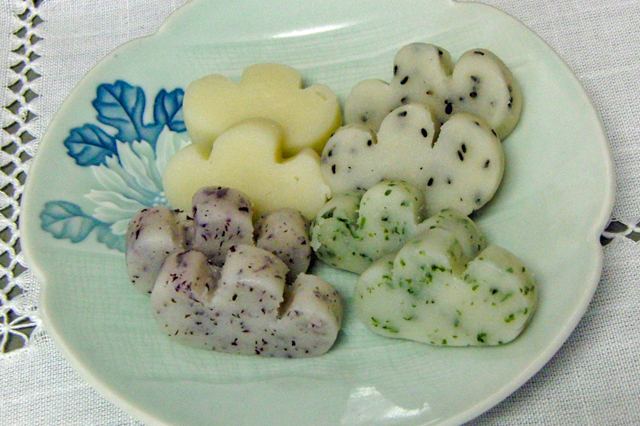
In areas centered in the north, there is a custom of making a "sum" and offering it to the Buddhist altar on February 15 as the day of the deceased Nirvana party. The pepper is a boiled dumplings that are colored with rice flour and used to be made in every home. Generally speaking, "Do" was a house or temple made by children who were given a walk and called it a "take a dump." There are many types of chopsticks that are used to push them over a long stick, and they are shaped like a triangle, with the middle copper around them, with the flowered petals, and in recent years they've been able to draw colorful patterns, and they're popular with children. In Otata City, children are drawn to the original gods by their children, hoping for disease and disease.
When It Is Eaten
On February 15th, on the Nirvana Day, they were built at home and temple to give to the Buddhist altar. At home, they were offered to a Buddhist altar, and at the temple, when it was the law of the Nirvana party, they were passed on to nuns and children.
How It Is Eaten
Mix rice, sugar, salt, add a little hot water, and paste it with a hardness of ear. The piece of torn fabric is steamed with a steamer. I'll put it in the cold water and then I'll put it in the bowl. At that time, we add blue, beans, rice, and so on, and then we take on a long, narrow form. It's common to eat as it is, but if it gets hard after a while, you can cook it or fry it with oil and eat it for a good amount of sugar oil.
Recipe
Ingredients
- 500 g rice flour
- 50 g sugar
- 1/2 tbsp salt
- 370 ml boiling water
- a pinch potato starch
- aonori seaweed, to taste
- black sesame seeds, to taste
- black soybeans, to taste
- red food coloring, to taste
Method
- Mix the bowl with rice powder, sugar and salt.
- Add boiling water, mix with chopsticks, and put them together with hands, and put them together with the hardness of the ears.
- I'll rip the dough in half, and put it in a steamer that was covered with steam and then water it for 20 minutes.
- If it is steamed, you can have a steamed cloth and put it in cool water for about a minute and cool it. (Whistling)
- We're going to blow water and put it in a bowl, and we're going to stick tight. (Laughter)
- Before it's cold, I put blue, beans, rice, and powder in the fabric and cut it long enough to make them into chopsticks and so on.
- The black beans are washed and boiled from the water to the presence of a tooth. While the rice is soft, the cotton thread will cut well. If it gets hard, it'll taste good.
More About Yashouma
The thins are a native dish made from flour from Oita Prefecture. Or a spore of flour or flour for the Nirvana party, thought to be the original type.
Oita Prefecture.
A plain noodles made of flour and boiled with boiled flour and sugar. The shape is classified as noodles, but instead of knife, it is made to tear them off with its fingers from the mass of wheat flour that is often mixed with water. From the soy sauce system, I'm not going to cut it, but I'm going to enter into the system of a silkworm made by hand. It is still a famous native dish of Oita Prefecture, which is the same as thin noodles, along with vegetables and so on.
Sometimes you use black sugar instead of sugar.
A thin one usually eats as a snack, just as it is, or as cold. It's a family dish, but in Sego City and elsewhere, there are many shops that feed them on the counter, and it's rooted in the community to the point where even school meals are often served. In supermarkets and souvenir shops, raw and dried noodles are sold for the use of soy sauce. The commercial noodles are made on a made noodles machine, but many of them are near the shape of the mango.
Origins
There are several theories from Oita Prefecture.
The theory is that during the period of peace, the young nobleman was fond of the snacks made by his nurse. It was originally shaped like a horse made of rice flour, but it was said to be called a "knee" because it was made from flour and became long and thin in plain-snap. The theory is that the wheat as a food for horses was eaten by man by this dish and that "the horse has lost weight."
As for one theory, the following is the tradition given in Toyoji Nakamura.
In a period of peace, a young nobleman named Totohara went from his city to a later country, and lived hidden in a place called Kanno-san's magazine. The women who take care of the surroundings of Otsushi, would have been from Yase, Kyoto. Yase was religious and had joined Sakura in a strange temple. At that time, when I was hungry, I was hungry. When I want this food, I say, "Yo, Oo, Oo, good." Let's say this is the root of the word "sniff."
In the Kashijijijijijijijijijiji, today, on the 23rd day of the Bonsai, there is still a connoisseur that is built as part of the party for the Sungsho. This is supposed to be made into a habit and has reached the present. There is also a sign in the area of this strange temple "The Land of the Fabulous."
Customs
The thin man was acted upon by the Great Master, the day of his death, and was given as a gift in the trays and in the evening.
On March 21st, "The Great Master," he moved the statue of the Great Master who was usually on the road and in the middle of the floor, and he went to the floor and dressed up his hands to his visiting neighbors. It's said that during this event, the cucumbers were salted, spread more widely, and tied together three of them.
The tray was cooked on August 14th and served for the Buddhist altar. At this event, I made it sweet with a mixture of black sugar.
Sources
In Oita Prefecture, raw sweets wrapped in water cans and sugar are made and sold as "sniff."
Oita Prefecture.
In the 20th century, an examination of Japanese dialects has a feature called "Steak Horse," similar name to that of some food items in Japan.
Fukushima Prefecture (Steel XX068X) - Nasako for the Nirvana party on February 15th. (The colored sieve of the Niigata Prefecture) - The color-colored stalagmite of the phrase for the Nirvana party on February 15 and the March tonsils of the March. Niigata Prefecture) - Natako to the Nirvana party on February 15. There's a story about a man named Nagano Prefecture who said, "Oh, I'm so good at it." The sweet - shaped candy that was cut in a tube so that the dough of the pollen, colored with red, green and yellow colors, was colored like a golden-tastaro candy. On February 15th, at the Nirvana party, there are also regions where they devote themselves to Buddhist altars and grave graves and throw them up again. - It's shaped like a cocoon and covered with peas. It's the stuff that you pressed with your finger. - The food that was baked with flour in the leaves of the bowl.
And in Edo, he wrote, "The check-up" in his Edo book, "The White Twelf." It was a thin piece of cloth, and the shape of the horse was steeped in the shape of a horse and the name was thin. "This is a nickname for a tough horse," and you can see that food like this has been eaten since then.
Source of the Language
The shape you hold in your hand resembles that of a horse, so it's called a thin horse.
Text adapted and translated from the Japanese Wikipedia article やせうま by its contributors, licensed CC BY-SA 4.0.
Dish data: Ministry of Agriculture, Forestry and Fisheries (MAFF), “Uchi no Kyodo Ryori” (Our Regional Cuisines) database, used under the Public Data License (PDL1.0); translated and adapted from the Japanese original.