Kaburazushi かぶらずし
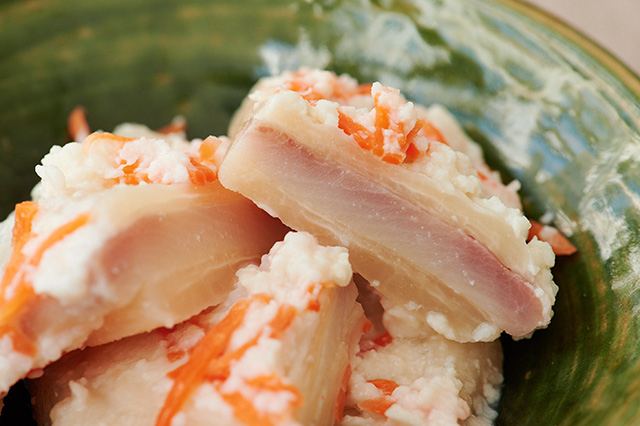
| Prefecture | Ishikawa (石川県) |
|---|---|
| Region | Chubu |
| Japanese name | かぶらずし |
| Home area | All within the province. |
| Main ingredients | (Laughter) |
History and Origins
A traditional cereal that represents Ishikawa Prefecture, with salted or salted burps. It's one of the "unmade"s that comes close to the broom, unlike the old rice bowl. There are theories about origins. The theory is that fishermen in Kanazawa CityIXC are beginning to eat as a New Year's holiday meal in the form of fishing and restitution, and that Ota-dono was acted at the local spa where he visited in Yuzuzuzu. They say it was eaten during the Edo at least. It was spread by fish shops and grocery stores who, at the end of the year, used hand-made "covered" for changing the books to their customers. Bri is one of the foods that represents the Osaka area. Faty cold brimstones can be eaten well by stabbing, boiling, or baking. The Edo era and the newly captured "implicit" were first dedicated to the Lord before they left for the castle. It's said that it was not often said by the common folk who were forced to eat food so expensive as "Bryn, rice and rice." There is also the theory that eating a bite in order to eat a burri was the beginning.
When It Is Eaten
In the first winter, the northern part of the country will be struck by a thunder called "Bryg." When the crescendo goes off, Bry's net fishing will be on the scene. In the Ishikawa Prefecture fishing partnership, the more than seven kilograms of celadon at this time of the year are heading through Burri as a "naturally colding." The Bing by name "kozooka," "Fkrugi" and "gangdo" was a product from ancient times and was presented to the General of Tokugawa. Of the many celadon dishes, it's "no more expensive." Some locals are so settled that they say, "We won't start New Year without wearing it." And when the year is near, it's sold at supermarkets and department stores. Tastes and mouth-to-mouths vary greatly according to the type of tinsels and ripeness and salt. It's said that to make it depends on the temperature and requires experience and skill. Even now, for luxury food, Bligh has been absorbed by a "mass" that is easily available in the average household with herring and large roots.
How It Is Eaten
You can mix brine salt with a little salt, and then fill it with sweet wine that has been mixed in with a mixture of slat. When they mature, they eat them as they do without having anything to eat.
Recipe
Ingredients
- 1–1.5 kg yellowtail (ガンド)
- salt, to taste
- weight (for pressing)
- 10–13 かぶら (特大)
- 1/2 carrot
- yuzu peel, to taste
- 1–2 red chili pepper
- 1 all
- 2 cups rice
- 2 cups boiling water
Method
- Bryu cuts like a cane, puts it in a container, puts it in a container so strong that it won't see the burly, and then puts it on a heavy stone for about 40 days.
- Cut the sky and the sky down, cut them into two strips, cut them without cutting them, shake salt on the bottom of the barrel, and roll and roll the salt over and over again. I'll be salted for about a week with heavy stones.
- Put the hot water in the bowl, mix it together, and make it easy to keep warm (about 50 degrees Celsius) and stay overnight.
- The cane is well watered and keeps the water fresh. Carrots are cut into flowers and salted, red peppers are cut out of seeds, and so on. I'm going to wash the water and cut it into pieces. I'm going to put a burro between the bush and put two tablespoons of rice in a pan, and put them in a tight place, and then I'm going to scatter them. I repeat this by removing the salt on top of the stem or by dropping the leaves on the bottom and by placing the stone on the bottom. (SINGING IN SEVEN COURAGES)
More About Kaburazushi
The sushi wasn't able to fertilize the burri by cutting a cut into the bush. The Koga of Ishikawa Prefecture is widely known, but it can be made extensively in the old Kajiga districts, including Toyama Prefecture West.
Characteristics
One of the dishes that represents the northern winter season is called New Year's. There's a smell of its own conch and lactate, and it's well known for its wine. From mixing vegetables together to sushi, it is also classified as a sushi, but compared to the the Tohoku region sushi.
The raw materials and the tin were made more widely, because the harvest time was limited and precious and because of the cost, the large roots that were easily available and the large roots made from worn - out nitroins were made more widely. In addition, Toyama City, which has been published since 1957, is a sushi but has a common ingredient to use either steam or tin.
Processing
Mainly made from November to January. We salted the cuts or hangings, and cut the cuts and carrots and rags in the saws. In Ishikawa Prefecture, we often cut a bush in half, or cut it in half, or in Toyama Prefecture. And in recent years, at Toyama Prefecture, I've been using ice-viewing printers more often than Saba. Normally, I cut carrots into pieces, but in Kanazawa City I cut them into flowers.
Add rice and add it to the weight, add it to the surface for a few days or two or three weeks, and the sugar and lyses of rice starches form sweet, sour, and distinctive flavors. Moreover, in traditional methods of cooking, no acidity or sugar is added, but on commercials, it can also adjust the acidity and sweet taste by adding vinegar, sugar, and staviar.
During the day, the acid growth of the bacteria is encouraged by the glucose and martos, the decomposing material of the starch, and the glucose and the flector in the coats. In traditional formulas, the lactic acid becomes more than 108cfou/g, and the amount of lactate is equal to 1.5 -2.0w/ w and zygote. By the time the book is finished, the micro-organisms will have nothing but lactic acid and anemics. There is also a large difference between the number of bacteria and the number of bacteria on the market, and there are fewer than 104cfu/g with lysic acid. Since there are such things as Lactobacilus planantalum which is easy to multiply even with pH low, it is possible to produce ursic acid without adding fish. After placing the book in, they eat it with radiation or with a square cut and a bowl attached to it.
History
It was made from gold from the early Edo and has no detailed origin. Tradition has it that "the fisherman who lives in the Kabuki court of Kanzawa would sink in with the bri's cloth on his back and celebrate the New Year's launch" and "The Lord of Mr. Ota ate and spread in the deep spring."
By the time the treasurer was seven years old, he had a record that he had sent a joke to a customer in the yearga, along with this slip. Also, the "Murmur's Diary" of the present Kanazawa CityXXXC city of Tokyo, says that the fishery gave him a "singer" by the fish shop on January 3, 1826. Not only fish stores, but also the headdressers, hairdressers, and other merchants had the custom of giving their customers their first annual sushi or large roots. It is estimated that sushi was eaten mainly by men of war, and by the majority of the public.
The custom of giving a sushi for the first time in the Meiji era continued, but eventually it was abandoned. On the other hand, since the 1920s, the average household has been making sushi. Some of the customers worked on the product at the same time, but the sales didn't increase. After World War II, when the economic situation has recovered, sales of sushi, such as used as for transportation, have begun to rise since about 1953. By 1955, family jams had been reduced, and it was possible to use polyethylene containers to transport them far and wide.
Since 1965, the number of mass - production manufacturers of sushi has increased in serious production, and demand has soared in some ways since 1972. Also, publicity in the press has increased the reputation of its customers, and more and more of its customers have been consumed throughout the country with air and air travel and home distribution. In recent years there has been a strong demand for high-end gifts. There are also areas where people eat sushi in modern times.
Text adapted and translated from the Japanese Wikipedia article かぶら寿司 by its contributors, licensed CC BY-SA 4.0.
Dish data: Ministry of Agriculture, Forestry and Fisheries (MAFF), “Uchi no Kyodo Ryori” (Our Regional Cuisines) database, used under the Public Data License (PDL1.0); translated and adapted from the Japanese original.